The global
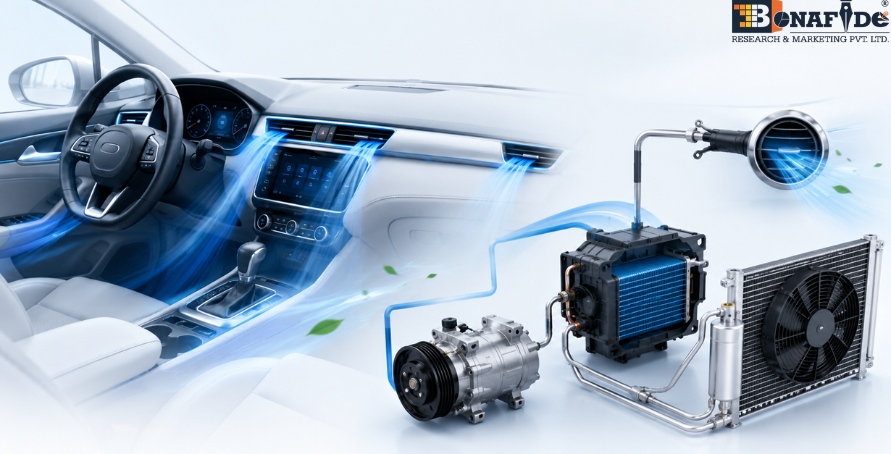
automotive air conditioning market encompasses the design, manufacturing, integration, and servicing of heating, ventilation, and air-conditioning (HVAC) systems used in passenger cars, light
commercial vehicles, heavy trucks, and electric vehicles. These systems regulate cabin temperature, humidity, airflow, and air quality, ensuring passenger comfort and safety across diverse climatic conditions. Automotive air conditioning has evolved from a premium feature into a standard component in most modern vehicles, making it a critical part of vehicle design and user experience. The market is driven by rising global vehicle production, increasing vehicle ownership in emerging economies, growing consumer expectations for comfort and convenience, and the rapid adoption of electric and hybrid vehicles that require advanced thermal-management solutions. Automotive air-conditioning systems also play a vital role in maintaining windshield visibility through defogging and defrosting functions, improving driving safety. The growing emphasis on fuel efficiency and environmental sustainability has encouraged manufacturers to develop energy-efficient compressors,
heat pumps, and low-global-warming-potential refrigerants that comply with evolving environmental regulations. The market is closely associated with the broader automotive, thermal-management, refrigerant, and mobility industries, with leading vehicle manufacturers and component suppliers investing heavily in innovation to enhance HVAC performance and reduce energy consumption. Increasing demand for connected vehicles has further accelerated the integration of smart climate-control technologies, remote cabin pre-conditioning, air-quality sensors, and multi-zone temperature management systems. In electric vehicles, HVAC systems have become even more important because they directly influence
battery efficiency, driving range, and overall vehicle performance. Market activities include research and development of advanced thermal technologies, adoption of environmentally friendly refrigerants, expansion of manufacturing capacities, strategic partnerships between automakers and HVAC suppliers, and continuous product innovation aimed at improving passenger comfort, energy efficiency, and regulatory compliance.
According to the research report "Global Automotive Air Conditioning Market Outlook, 2031," published by Bonafide Research, the Global Automotive Air Conditioning Market was valued at more than USD 58.61 Billion in 2025, and expected to reach a market size of more than USD 84.19 Billion by 2031 with the CAGR of 6.38% from 2026-2031. The global automotive air conditioning market is a vital segment of the automotive industry, encompassing heating, ventilation, and air-conditioning (HVAC) systems that regulate cabin temperature, humidity, airflow, and air quality in passenger and commercial vehicles. The market is supported by a complex supply chain that begins with raw material suppliers providing
aluminum,
copper, plastics,
electronic components, refrigerants, sensors, and semiconductors, followed by component manufacturers producing compressors, condensers, evaporators, expansion
valves, blowers, and control modules. Major industry participants such as Denso Corporation, Hanon Systems, MAHLE GmbH, Valeo, Sanden Corporation, and BorgWarner Inc. supply HVAC technologies to global vehicle manufacturers. Significant opportunities are emerging from the rapid expansion of electric vehicles, where advanced thermal-management systems, electric compressors, and heat pumps are becoming essential for improving battery efficiency and vehicle range. Recent industry developments include the expansion of heat-
pump technology by Hanon Systems and Valeo for
electric vehicle platforms, while Denso Corporation continues to invest in energy-efficient HVAC systems and environmentally friendly refrigerant solutions. The transition from R-134a to lower-global-warming-potential refrigerants such as R-1234yf is reshaping product development and regulatory compliance strategies worldwide. Growing adoption of automatic climate control, air purification systems, smart cabin sensors, and connected vehicle technologies is creating additional growth opportunities for suppliers. Furthermore, increasing vehicle production, rising consumer demand for comfort features, and stricter environmental regulations are encouraging continuous innovation across the automotive air-conditioning value chain, strengthening the market's long-term strategic importance within the global mobility ecosystem.
Passenger vehicles represent the most significant source of automotive air-conditioning demand because they combine high production volumes with increasing consumer expectations for comfort and convenience. Unlike commercial vehicles, which are often purchased based on operational requirements and cost considerations, passenger vehicles are strongly influenced by buyer preferences related to cabin experience. Modern consumers expect effective cooling, heating, humidity management, windshield defogging, and air filtration regardless of vehicle price category. As a result, manufacturers increasingly install air-conditioning systems as standard equipment in compact cars, sedans, SUVs, crossovers, and
luxury vehicles. Urbanization has also played a major role in strengthening demand, as drivers spend longer periods in traffic congestion and require comfortable cabin environments throughout daily commutes. Rising temperatures in many regions, coupled with increasing frequency of heat waves, have further elevated the importance of efficient climate-control systems in passenger transportation. The growth of premium and mid-range vehicle segments has accelerated adoption of advanced HVAC features such as dual-zone climate control, automatic temperature regulation, air purification systems, rear-seat cooling, and connected climate functions. Passenger vehicles are also at the forefront of technological innovation, making them the first recipients of intelligent sensors, smart cabin management systems, and energy-efficient thermal solutions. Electrification further reinforces this trend because electric passenger cars require sophisticated thermal-management systems to regulate both cabin comfort and battery performance. Additionally, government safety standards and consumer awareness regarding cabin air quality have increased demand for filtration technologies capable of reducing dust, pollutants, and allergens.
The growing importance of expansion valves, orifice tubes, and other refrigerant flow-control components stems from the industry's transition toward highly efficient thermal-management systems. These components perform a critical function by regulating refrigerant flow and pressure throughout the HVAC cycle, directly influencing cooling efficiency, compressor workload, energy consumption, and overall system reliability. As automotive manufacturers pursue improved fuel economy and greater energy efficiency, particularly in electric and hybrid vehicles, precise refrigerant control has become increasingly important. Traditional HVAC systems could operate effectively with relatively simple control mechanisms, but modern climate-control architectures require much more sophisticated refrigerant management to support variable operating conditions. Vehicles now encounter a wide range of thermal loads generated by battery packs, electronic components, infotainment systems, and changing passenger comfort requirements. Expansion valves equipped with advanced sensing and control capabilities allow HVAC systems to respond more accurately to these conditions while maintaining stable performance. The transition to environmentally friendly refrigerants has further increased the need for optimized refrigerant flow control because newer refrigerants often require different operating characteristics than legacy alternatives. Electric vehicles create an additional layer of complexity since thermal-management systems must simultaneously support cabin cooling, battery temperature regulation,
power electronics cooling, and heat-pump operation. Under these conditions, expansion devices become essential for maintaining efficiency and protecting critical vehicle systems. Manufacturers are also adopting electronically controlled expansion valves that offer superior precision compared with conventional mechanical devices.
The rapid expansion of battery electric vehicles has fundamentally transformed the role of automotive air-conditioning systems. In conventional internal combustion vehicles, cabin heating and cooling are largely supported by engine-generated thermal energy, but battery electric vehicles operate under entirely different conditions. Every heating or cooling function draws energy directly from the battery pack, creating a strong need for highly efficient HVAC technologies. As a result, climate-control systems have become strategically important components within BEV design. Battery temperature management is especially critical because
lithium-ion batteries perform optimally within specific temperature ranges. Excessive heat can accelerate battery degradation, while extremely low temperatures can reduce charging efficiency and driving performance. Automotive air-conditioning systems therefore play a dual role by supporting both passenger comfort and battery protection. Modern BEVs frequently incorporate heat pumps, electric compressors, smart thermal controllers, liquid cooling circuits, and predictive climate-management software to maximize energy efficiency. These technologies allow manufacturers to improve vehicle range while maintaining cabin comfort under varying environmental conditions. Consumer expectations further strengthen this demand because buyers expect electric vehicles to provide the same or better comfort experience as conventional vehicles. Governments worldwide are also promoting vehicle electrification through emissions regulations and sustainability initiatives, encouraging manufacturers to invest heavily in advanced thermal-management innovation. Furthermore, electric vehicles contain numerous sensitive electronic components, including inverters, power electronics, and high-voltage systems, all of which require temperature regulation.
Automatic air-conditioning technology has become the preferred solution across global vehicle markets because it provides a significantly improved user experience compared with manual climate-control systems. Rather than requiring occupants to continuously adjust fan speed, airflow direction, and temperature settings, automatic systems use sensors and electronic control units to maintain desired cabin conditions automatically. This capability is particularly valuable in regions that experience frequent temperature fluctuations or extreme
weather conditions. Modern consumers increasingly view automatic climate control as an expected feature rather than a luxury option, especially as vehicle interiors become more technologically advanced. The widespread integration of
digital displays, connected services, and intelligent vehicle systems has accelerated the adoption of automatic HVAC controls that can communicate with broader vehicle-management platforms. These systems also contribute to improved energy efficiency by precisely regulating cooling and heating output according to actual demand, avoiding unnecessary compressor operation and reducing energy consumption. In electric vehicles, this efficiency advantage is even more important because HVAC operation directly affects driving range. Automatic systems are also compatible with advanced features such as dual-zone and multi-zone temperature control, humidity sensing, air-quality monitoring, cabin pre-conditioning, and remote climate management through smartphone applications. Growing awareness of
health and wellness has increased demand for systems capable of maintaining optimal air quality and passenger comfort without constant intervention.
Original Equipment Manufacturers occupy the leading position in automotive air-conditioning because modern HVAC systems are no longer standalone components that can be easily added after vehicle production. Instead, they are deeply integrated into vehicle architecture, electronic control systems, safety functions, energy-management platforms, and thermal-management networks. Vehicle manufacturers increasingly install sophisticated HVAC technologies during production to ensure optimal performance, reliability, and regulatory compliance. Factory-installed systems benefit from precise engineering integration involving compressors, evaporators, condensers, sensors, software controls, air ducts, battery thermal-management systems, and vehicle electronics. This level of integration is particularly important for electric and hybrid vehicles, where HVAC performance directly affects energy efficiency and battery operation. OEM-installed systems are also designed to meet specific vehicle performance requirements, cabin layouts, and safety standards that are difficult to replicate through aftermarket modifications. Consumer preferences further strengthen OEM demand because buyers increasingly expect vehicles to be delivered with complete climate-control functionality already installed. Manufacturers are simultaneously expanding the use of advanced technologies such as air purification systems, multi-zone climate control, connected HVAC management, and intelligent thermal sensors, all of which are most effectively integrated during the vehicle assembly process. Regulatory requirements related to refrigerants, emissions, energy efficiency, and occupant comfort also encourage factory-level implementation and testing. In addition, automakers maintain long-term partnerships with HVAC suppliers to develop customized solutions tailored to specific vehicle platforms.



























 We are friendly and approachable, give us a call.