The Global
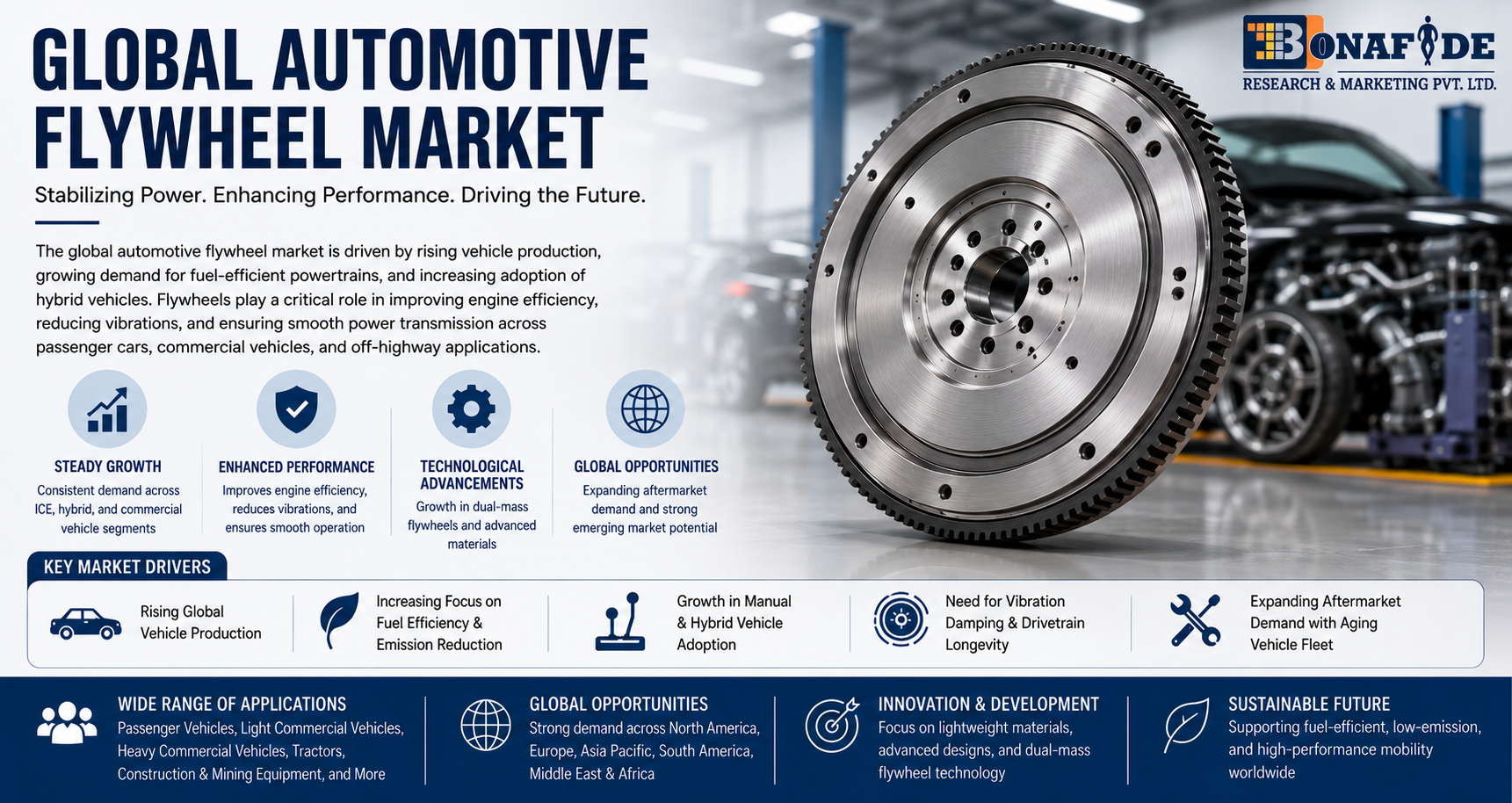
Automotive Flywheel Market is undergoing a structural transformation as the automotive industry balances rapid electrification with the continued dominance of internal combustion engine (ICE) and hybrid
electric vehicle (HEV) powertrains. Automotive flywheels remain indispensable drivetrain components that store rotational energy, smooth engine power pulses, dampen torsional crankshaft vibrations, and efficiently transmit torque to the transmission system. The market encompasses a broad portfolio of technologies including single-mass flywheels (SMFs), dual-mass flywheels (DMFs), lightweight forged-steel flywheels, hybrid-specific flywheel assemblies, precision balancing systems, and certified remanufactured flywheel solutions serving passenger vehicles, light
commercial vehicles, heavy-duty trucks, buses, and off-highway equipment. The regulatory and technological landscape has accelerated significantly in recent years, creating both compliance requirements and long-term market opportunities. Stringent CO? emission regulations across Europe, North America, China, Japan, and South Korea continue to promote engine downsizing, hybridization, and start-stop technologies, substantially increasing demand for advanced dual-mass flywheel systems. Mandatory periodic vehicle inspection programs in countries including Germany, the United Kingdom, Japan, France, South Korea, and several Middle Eastern and Latin American nations legally require replacement of worn drivetrain components, creating a resilient aftermarket that remains relatively insulated from fluctuations in new vehicle sales. Beyond regulatory drivers, the market is evolving through precision manufacturing, lightweight material engineering, automated laser welding, robotic dynamic balancing, certified remanufacturing, and regional production localization, with manufacturers strengthening supply chains, expanding hybrid-specific technologies, and improving drivetrain efficiency to support the global transition toward lower-emission mobility.
According to the research report "Global Automotive Flywheel Aftermarket Outlook, 2031," published by Bonafide Research, the Global Automotive Flywheel Aftermarket was valued at more than USD 13.64 Billion in 2025 and is expected to reach a market size of more than USD 17.14 Billion by 2031, expanding at a CAGR of 3.98% from 2026 to 2031. The market encompasses a comprehensive range of drivetrain solutions including single-mass flywheels (SMFs), dual-mass flywheels (DMFs), lightweight forged-steel flywheels, cast-iron flywheels, and hybrid-specific flywheel assemblies used across passenger vehicles, light commercial vehicles, medium and heavy commercial vehicles, and off-highway equipment. The industry continues to advance through lightweight engineering, precision hot
forging, automated dynamic balancing, laser welding, and hybrid drivetrain integration, enabling manufacturers to improve fuel efficiency, reduce noise, vibration and harshness (NVH), and comply with increasingly stringent emission regulations. Strategic investments continue to reshape the competitive landscape as leading manufacturers expand production capacity, strengthen regional manufacturing footprints, and invest in advanced hybrid-specific drivetrain technologies. Companies including Schaeffler AG, ZF Friedrichshafen AG, Valeo SA, BorgWarner Inc., AISIN Corporation, EXEDY Corporation, Miba AG, and Sona Comstar continue to expand their product portfolios through investments in lightweight forged-steel flywheels, dual-mass flywheel technologies, automated manufacturing facilities, remanufacturing programs, and
digital aftermarket platforms. At the same time, the rapid expansion of hybrid vehicle production, increasing localization of automotive manufacturing across Asia-Pacific, Europe, and North America, and the growing global vehicle parc are reinforcing long-term demand for high-performance flywheel systems. Continuous innovation in materials, manufacturing technologies, and drivetrain integration, together with expanding aftermarket replacement cycles, is expected to sustain market growth throughout the forecast period



























 We are friendly and approachable, give us a call.