The global solar thermal collectors market has progressively advanced in recent years, propelled by extensive governmental backing and technological breakthroughs that enhance system efficiency and integration. Entities such as the International Energy Agency (IEA) emphasize solar thermal technology as a crucial contributor to global renewable heating targets. The European Commission’s Clean Energy Package supports solar thermal adoption through binding renewable heating and cooling goals, while India’s Ministry of New and
Renewable Energy (MNRE) enforces policies fostering solar thermal systems for residential and industrial use. Innovation in collector designs, including vacuum tube and concentrating collectors, has enabled broader application scopes, particularly in industrial process heat and
district heating networks, aligning with climate directives. Regulatory frameworks like the U.S. Department of Energy’s SunShot Initiative incentivize advancements in solar thermal infrastructure, encouraging hybrid system integrations that enhance reliability. Despite competition from photovoltaic panels and
heat pumps, solar thermal technology’s ability to provide cost-effective, high-temperature solutions sustains its market relevance. Regional tax incentives, such as Germany’s Renewable Energy Sources Act (EEG), and
certification programs like Solar Keymark, ensure quality and facilitate market acceptance. International expos such as Intersolar and
Solar Power International have become significant platforms for showcasing innovations and driving collaborations among stakeholders. Challenges like diverse local regulations and the need for skilled installation remain, yet increasing global commitments to reduce carbon emissions and adopt sustainable energy sources position solar thermal collectors as vital components in the future energy mix.
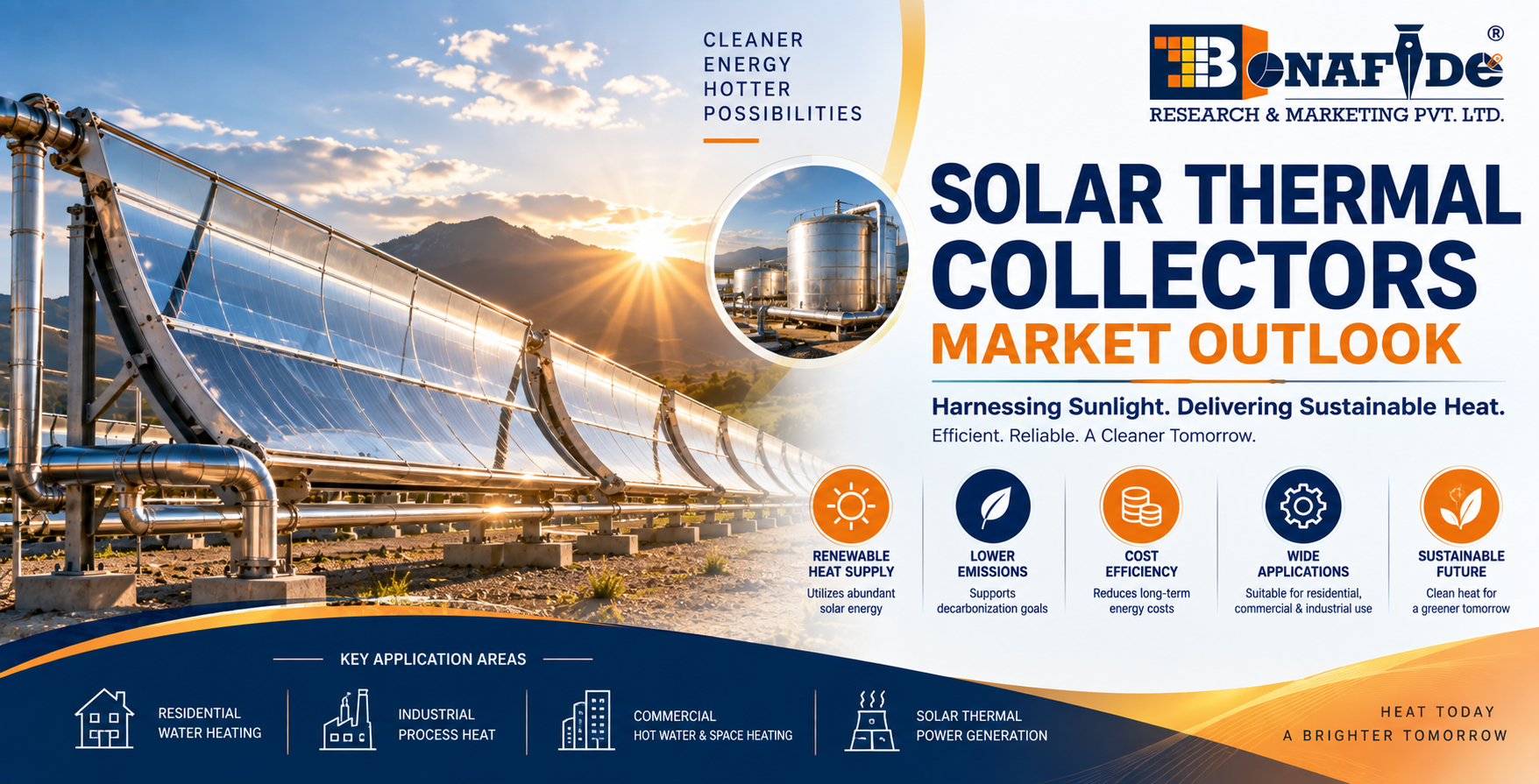
According to the research report "Global Solar Thermal Collectors Market Outlook, 2031," published by Bonafide Research, the Global Solar Thermal Collectors market was valued at more than USD 26.34 Billion in 2025, and expected to reach a market size of more than USD 47.85 Billion by 2031 with the CAGR of 10.73% from 2026-2031. Recent developments in the solar thermal collectors market reveal a dynamic competitive landscape shaped by key players like Viessmann Werke, Bosch Thermotechnology, and Ariston Thermo, who continually refine product portfolios to meet evolving consumer and industrial demands. These companies face barriers such as stringent certification requirements and the need for specialized installation expertise, which influence market entry and pricing strategies. The value chain encompasses raw material suppliers, manufacturers, distributors, and installers, with transaction economics impacted by fluctuating material costs and regional subsidies. Consumer adoption trends highlight a preference for hybrid systems combining solar thermal with photovoltaic or conventional heating, driven by increasing energy cost awareness and sustainability goals. Enterprise uptake is notable in manufacturing and hospitality sectors, motivated by regulatory pressures and operational efficiency. Investment landscapes are bolstered by government-backed green financing initiatives, including the European Investment Bank’s renewable energy funds and the U.S. Inflation Reduction Act’s tax incentives. Infrastructure enhancements and policy support in regions like Japan and South Korea further stimulate market activity. These factors coalesce within a complex ecosystem of regulatory frameworks, technological innovation, and shifting consumer behaviors, driving the solar thermal collectors market forward with robust momentum.
Asia-Pacific’s dominance arises from abundant solar resources, strong government incentives, expanding industrial infrastructure, and significant investments in renewable energy development. High solar irradiance in countries like India and China boosts system efficiency. Government programs offer subsidies and set ambitious renewable energy targets. Manufacturing and industrial growth demand
sustainable energy solutions. Regional trade agreements facilitate technology exchange. Research centers enhance innovation capacities. Urban growth drives residential demand. International collaborations and financial support accelerate infrastructure expansion. Integration with complementary renewable technologies strengthens market presence.
Concentrating solar thermal collectors have gained rapid adoption due to their high efficiency in industrial and large-scale applications, enabled by technological enhancements and supportive government deployments. Their design focuses solar radiation to achieve higher temperatures, suitable for demanding industrial processes, while integration with thermal storage systems ensures continuous operation. Projects in Spain and the U.S. demonstrate reliability and scalability. Improved tracking mechanisms optimize sunlight capture, and government initiatives promote clean energy in manufacturing. Concentrating collectors' adaptability to diverse climates and lower operational expenses compared to flat plate counterparts stimulate widespread acceptance. Their growing use aligns with industrial sectors’ sustainability targets and energy efficiency goals.
Water heating dominates the solar thermal application sector as it provides a practical, cost-efficient solution for residential and commercial heating needs, bolstered by widespread policy support and consumer demand. Proven technology and easy integration with existing plumbing infrastructure make water heating systems attractive. Incentive programs in Australia and the EU lower initial costs, while urbanization increases demand in multi-family housing. Enhanced control via smart technologies improves energy savings. The relative affordability of installation and maintenance compared to industrial systems appeals to homeowners and businesses. Awareness campaigns by agencies like the IEA boost consumer confidence. Water heating's energy bill reduction benefits sustain its market leadership.
Industrial end-users lead the market growth by adopting solar thermal collectors to comply with stringent environmental regulations and reduce energy costs in energy-intensive manufacturing processes. Sectors like textiles, food processing, and pharmaceuticals increasingly incorporate solar thermal technology to meet EU emission standards. Government grants incentivize such clean energy projects. The scalability of systems allows for tailored solutions. Collaboration between manufacturers and industrial operators drives innovation. Rising energy prices and carbon neutrality goals further accelerate uptake. Solar thermal solutions offer reliable, sustainable heating options aligned with corporate responsibility and operational efficiency.
Low-temperature solar thermal systems, operating below 100°C, dominate due to their cost-effectiveness and suitability for residential and commercial heating, supported by efficient collector designs and favorable regulations. These systems meet common heating needs such as space heating and hot water supply. Technologies optimized for this range deliver high efficiency and reliability. Programs like the U.S. Energy Star certification promote adoption. Their simplicity reduces installation complexity and cost. Demand from small businesses and residential sectors remains strong. Advances in coatings and
insulation improve performance. Integration with existing heating infrastructure is seamless, enhancing appeal.
Other installations, including off-grid and hybrid systems, are experiencing the fastest growth due to rising demand for decentralized energy solutions and increased rural electrification investments. Off-grid solar thermal addresses energy access in remote regions, supported by UN development programs. Hybrid systems combining solar thermal with conventional fuels improve reliability. National rural electrification initiatives in India and parts of Africa emphasize such solutions. Modular system designs accommodate varied environments. Decentralized approaches reduce infrastructure costs and losses. Awareness and funding increase adoption. Energy independence and resilience in isolated communities benefit from these installations.











 We are friendly and approachable, give us a call.