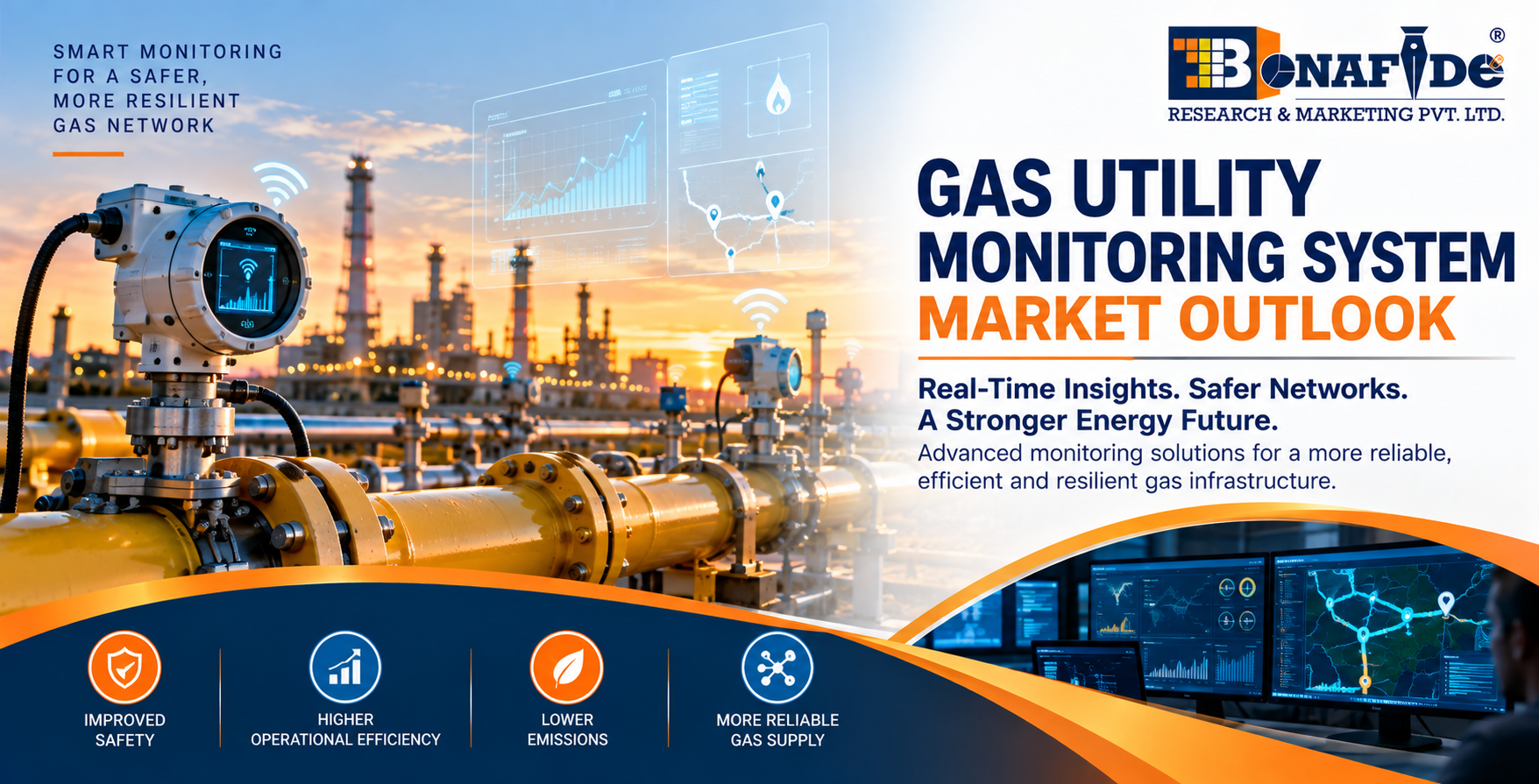
The Global Gas Utility Monitoring System Market is becoming increasingly important as natural gas utilities prioritize pipeline safety, accurate flow measurement, operational visibility and methane emissions control. Recent regulatory developments and public infrastructure records demonstrate the practical need for monitoring technologies across distribution mains, customer connections, pressure regulation stations and metering assets. The U.S. Department of Transportation’s Pipeline and Hazardous Materials Safety Administration (PHMSA) reported approximately 2.37 million miles of gas distribution mains and estimated service lines in the United States in 2024, illustrating the operational complexity of monitoring extensive distribution networks. The International Energy Agency’s Global Methane Tracker 2025 highlights the importance of improved methane measurement, leak detection and repair, supported by satellite observations, ground-based sensors and measurement campaigns. These developments are encouraging utilities to move beyond conventional supervisory control and data acquisition toward connected platforms that consolidate meter readings, pressure data, flow measurements, alarm notifications, asset records and maintenance workflows. In the United States, PHMSA’s Distribution Integrity Management Program requires operators to identify pipeline threats, assess risks, implement mitigation measures and evaluate program performance. These obligations strengthen the relevance of
digital monitoring systems that support traceable records and risk-based maintenance. Adoption nevertheless depends on legacy infrastructure, communications coverage,
cybersecurity readiness, installation costs and integration with existing operational technology. Cloud-enabled analytics, remote instrumentation and automated anomaly detection offer opportunities to improve maintenance prioritization and operational responsiveness, while physical inspections and field verification remain essential. The market’s development will therefore depend on measurable safety benefits, regulatory compliance, reliable data and the economics of modernizing geographically dispersed gas networks.
According to the research report "Global Gas Utility Monitoring System Market Outlook, 2031," published by Bonafide Research, the Global Gas Utility Monitoring System market was valued at more than USD 7.51 Billion in 2025, and expected to reach a market size of more than USD 12.15 Billion by 2031 with the CAGR of 8.57% from 2026-2031. Investment priorities in the Global Gas Utility Monitoring System Market increasingly reflect the need to connect field instrumentation with reliable operational decisions. The International Energy Agency’s Gas 2025 outlook anticipates that global natural gas demand will increase by nearly 1.5% annually between 2024 and 2030 in its base case, adding approximately 380 billion cubic metres over the period. Although this forecast concerns gas consumption rather than monitoring-system sales, it illustrates the scale of network operations that utilities may need to manage. Regulatory frameworks are also shaping technology requirements. The European Union’s Regulation (EU) 2024/1787 establishes methane measurement, monitoring, reporting and verification obligations for covered fossil-fuel activities, while U.S. pipeline operators must maintain distribution integrity management programs under PHMSA regulations. Commercial solutions span smart metering, supervisory control and data acquisition, pressure and flow instrumentation, remote telemetry, leak detection and analytics software. Honeywell, Emerson, ABB and Itron participate in related measurement, automation, control or utility data-management applications. Product selection depends on interoperability, accuracy, installation expenses, cybersecurity controls, maintenance support and integration with existing supervisory systems. Procurement can be slowed by equipment replacement cycles, public utility budget approvals, fragmented asset records and the expense of retrofitting older pipelines. Subscription-based software may reduce upfront infrastructure requirements, although recurring connectivity, integration and support costs must be assessed over the system’s operating life. Competitive differentiation consequently rests on dependable field performance, actionable alerts, compliance-ready records and the ability to convert monitoring data into targeted maintenance. Cloud-based platforms, edge processing and remote sensors remain important technology priorities, provided that utilities preserve safe operating procedures and secure control-system architectures.
Software is expected to expand rapidly because utilities need to convert distributed meter, pressure and flow readings into actionable intelligence, maintenance priorities and auditable operational records. Software supports gas utility monitoring by connecting field devices, communications infrastructure and operational decision-making. Its role extends beyond displaying readings to identifying anomalies, managing alarms, tracking maintenance and producing compliance documentation. Software can consolidate information from geographically dispersed assets into shared operational dashboards, reducing dependence on disconnected spreadsheets and manually assembled reports. Analytical applications can compare historical readings with current operating conditions, helping utility personnel investigate abnormal pressure, unexpected flow changes and recurring equipment problems. Integration with supervisory control and data acquisition systems enables software to contextualize field measurements without requiring operators to replace every installed instrument simultaneously. Remote access allows authorized maintenance teams and control-room personnel to review network conditions across multiple service territories, subject to appropriate access controls and communications reliability. Digital work-order management can connect detected abnormalities with inspection schedules, repair assignments and closure records, improving traceability across maintenance activities. Cloud-based analytics can support centralized data processing and application updates, although deployment must reflect the utility’s security policies, connectivity requirements and operational continuity obligations. The National Institute of Standards and Technology’s energy-sector cybersecurity guidance reinforces the importance of accurate asset inventories, continuous visibility and secure management of connected systems.
Flow measurement is central to gas utility monitoring because reliable throughput readings support distribution balancing, consumption accounting, abnormal-condition detection and operational verification across connected networks. Gas utility monitoring systems rely on flow information to understand the movement of gas through distribution assets and assess whether measured throughput aligns with expected operating conditions. Accurate metering supports customer billing and reconciliation between gas entering a distribution network and quantities recorded at downstream delivery points, subject to meter accuracy and system-boundary definitions. Unexpected flow changes can help identify abnormal consumption patterns, equipment malfunction or potential leakage, although flow data alone cannot establish the precise location or cause of a suspected leak. Industrial and commercial customers often require dependable consumption records to manage operating costs, reconcile invoices and evaluate demand patterns across different production or occupancy schedules. Flow information can be evaluated alongside pressure and temperature readings to provide a more complete understanding of operating conditions and identify inconsistencies that merit investigation. Remote meter-reading systems can reduce the need for routine manual collection and improve the frequency of data availability, provided that suitable communications and calibrated instruments are installed. The U.S. Pipeline and Hazardous Materials Safety Administration maintains gas distribution reporting requirements, while federal pipeline regulations establish operational and integrity obligations that make reliable network information important to regulated operators. Flow-monitoring records can also support maintenance planning by revealing recurring deviations, persistent measurement inconsistencies and changes in network performance over time.
Service lines are a compelling growth area because they connect distribution mains to customer premises, creating extensive monitoring needs across dispersed connections, diverse usage patterns and safety-critical delivery points. Service-line monitoring extends operational visibility from major distribution infrastructure toward the final connection serving a customer. PHMSA recorded approximately 992,371 miles of estimated gas distribution service lines in the United States in 2024, demonstrating the scale of this asset category. Customer connections are distributed across residential, commercial and industrial locations, making centralized asset records valuable for coordinating inspections, repairs and maintenance histories. Service-line records help operators connect location information, meter details, installation characteristics and previous maintenance activity when evaluating network integrity and planning replacement work. Remote monitoring can reduce the need for routine manual meter visits where suitable equipment and communications are available, although physical inspection remains necessary for activities that cannot be verified digitally. Changes in pressure or metered consumption can trigger further investigation at a connection, particularly when interpreted alongside equipment status, customer reports and established operating limits. Digital work management can help field teams prioritize service-line inspections by recording reported issues, previous repairs, risk classifications and the completion of corrective measures. PHMSA’s Distribution Integrity Management Program requires operators to identify threats and evaluate pipeline risks, creating a compliance-related rationale for accurate asset inventories and documented maintenance decisions. Service-line monitoring can also help utilities organize information on new connections and replacement projects, improving coordination between customer service, engineering, metering and field maintenance teams.
Cloud-based deployment is attractive because it centralizes monitoring data, supports access across dispersed utility operations and enables shared analytics without requiring every application to operate on local
servers. Cloud-based systems provide a common environment for storing readings, reviewing alarms, tracking maintenance and generating operational reports. Centralized dashboards can make network information available to authorized personnel across multiple service territories, reducing reliance on separate reporting environments maintained by individual operating teams. Cloud-hosted applications can support software updates and analytics improvements without requiring each user workstation to maintain a separate installation, subject to vendor architecture and utility approval processes. Shared data repositories can improve access to historical meter readings, maintenance records and alarm events, helping teams compare recurring problems across different districts and asset classes. Cloud analytics can process data from multiple connected devices to identify unusual patterns, although the quality of results depends on
sensor accuracy, data completeness and the suitability of analytical models. Hosted platforms may reduce the need to purchase and maintain dedicated local computing infrastructure for every application, but total costs still include subscriptions, communications, integration, security and support. The National Institute of Standards and Technology’s cybersecurity guidance for connected energy systems discusses secure
asset management,
network monitoring and cloud-based analysis and visualization, demonstrating that remote analytics must be implemented with appropriate protective controls. Hybrid architectures remain relevant when utilities need local processing, resilient communications or strict separation between monitoring applications and safety-critical control systems.
Integrated gas utilities can benefit strongly from monitoring systems because they coordinate multiple network functions and can use shared operational data to improve visibility, maintenance planning and service reliability. Integrated gas utilities manage interconnected activities that may include distribution, metering, pressure regulation, customer connections and network maintenance. Unified platforms can provide a consolidated view of assets and operating conditions across departments, helping teams reduce information silos between engineering, operations, metering and maintenance. Integrated utilities can connect network measurements with asset registers and maintenance records, supporting more consistent risk assessments and better-informed prioritization of inspections and replacement projects. Larger operating footprints can make standardized monitoring procedures valuable because teams must coordinate responses across multiple districts, asset classes and customer groups. Shared analytics can help organizations compare abnormal events across locations and identify recurring equipment or operating problems that may not be apparent within isolated local systems. Centralized procurement may allow utilities to establish common technical specifications, cybersecurity requirements and support arrangements across multiple operating units, although purchasing structures differ between organizations and jurisdictions. PHMSA’s integrity management requirements emphasize systematic risk identification, mitigation and performance evaluation, providing a regulatory basis for integrated approaches to asset information and maintenance oversight. Integrated utilities may also have dedicated operational technology teams and established control-room infrastructure, making phased integration with existing supervisory systems more practical than wholesale replacement.











 We are friendly and approachable, give us a call.