The global bifacial solar market has moved decisively from pilot-scale experimentation to mainstream project specification, driven by compelling economic and technical fundamentals validated by multiple international agencies. International
Renewable Energy Agency (IRENA) data confirms global
solar photovoltaic additions reached 510.3 GW in 2025, with bifacial modules comprising a substantial portion of this total. The International Energy Agency's Photovoltaic Power Systems Programme (IEA PVPS) reported that bifacial modules dominated global production, accounting for over 75% of manufacturing output in 2024. This technology captures sunlight from both front and rear surfaces, with the National Renewable Energy Laboratory (NREL) projecting bifaciality factors to increase from 0.65 in 2021 to 0.85 by 2035 under moderate scenarios, supporting higher capacity factors and significant levelized cost of energy reductions. Bifacial installations grew 300% year-over-year in 2025 according to Solar Energy Industries Association (SEIA) data. Utility-scale developers increasingly specify bifacial modules as standard for new ground-mount capacity, with IEA affirming
solar PV remains the fastest-growing power technology globally. Ember's analysis revealed that global solar installations added 380 GW of new capacity in the first half of 2025 alone, a 64% increase over the same period in 2024. The technology's ability to deliver 5-15% higher energy yield than monofacial alternatives, with optimized tracker sites exceeding 20% gains, has fundamentally reshaped project economics and procurement strategies. This transformation is occurring against a backdrop of evolving trade measures, with the U.S. Department of Commerce initiating new anti-dumping and countervailing duty investigations into solar imports from India, Indonesia, and Laos in late 2025, while the European Union's solar PV capacity reached an estimated 406 GW in 2025, according to the European Commission.
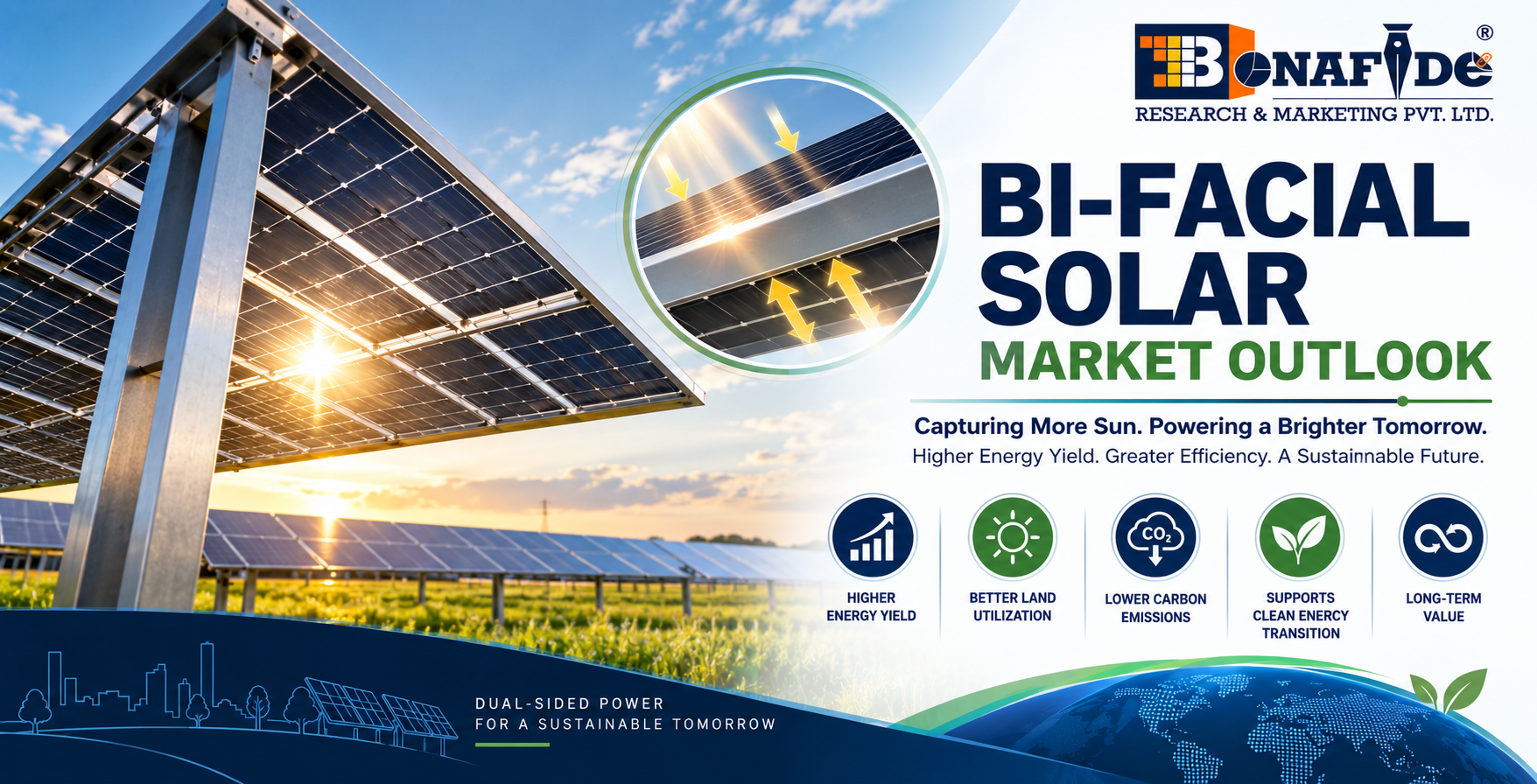
According to the research report "Global Bi-facial Solar Market Outlook, 2031," published by Bonafide Research, the Global Bi-facial Solar market was valued at more than USD 22.84 Billion in 2025, and expected to reach a market size of more than USD 52.65 Billion by 2031 with the CAGR of 15.33% from 2026-2031. The bifacial solar ecosystem has matured into a highly competitive landscape where technological differentiation and manufacturing scale determine market positioning. LONGi
Green Energy Technology, JinkoSolar, Trina Solar, JA Solar Technology, and Canadian Solar maintain dominant positions through vertical integration and continuous investment in research and development for advanced n-type and bifacial cell technologies. Chinese manufacturers represent over 80% of global production across the entire value chain polysilicon, wafers, cells, and modules creating significant cost advantages. In April 2024, Adani Solar introduced its 575 W TOPCon bifacial PV module with efficiencies reaching 22.4%, featuring a transparent back sheet and robust performance warranties. Yashika Energy Systems partnered with Germany's Next2Sun AG in September 2024 to promote vertical bifacial technology combined with agricultural applications, enabling dual land use for farming and energy generation. JinkoSolar's independently developed N-type TOPCon modules achieved a certified maximum conversion efficiency of 25.58% in June 2025, while Tongwei recorded a world-record bifaciality factor of 93.07% verified by T?V Rheinland. The competitive dynamics are further shaped by policy interventions; India's Ministry of New and Renewable Energy mandated that from June 1, 2026, all solar modules used in government projects must source cells from the Approved List of Models and Manufacturers (ALMM) List-II, which includes bifacial Mono C-Si PERC cells. Italy's 2026 budget law limited "Iperammortamento" tax incentives to European-made heterojunction bifacial modules with cell efficiency exceeding 24%. Technology transitions are accelerating, with global industry having completed the shift from p-type PERC to n-type TOPCon, with n-type capacity now exceeding 93% market share. Entry barriers remain substantial, requiring significant capital investment, supply chain integration, and
certification compliance including IEC 61215 and IEC 61730 standards.
Glass-backsheet bifacial modules are gaining momentum due to their lighter weight, lower cost, and superior UV protection compared to dual-glass alternatives, making them increasingly preferred for residential and certain commercial applications. Glass-backsheet construction replaces the rear glass layer with a lightweight polymer backsheet, reducing overall module weight by approximately 15-20% compared to dual-glass equivalents. This weight reduction simplifies rooftop installations and reduces structural loading requirements, particularly important for residential and commercial buildings with load constraints. The transparent backsheet effectively blocks ultraviolet radiation from reaching the rear side of solar cells, preventing UV-induced degradation that can affect dual-glass modules where glass cannot
filter harmful wavelengths. This UV protection extends module lifespan and maintains performance stability over decades of operation. Tempered glass on the front
surface combined with polymer backsheet provides superior impact resistance in hail-prone regions, as demonstrated in JinkoSolar's comparative analysis. This makes glass-backsheet bifacial modules safer and more reliable in regions experiencing severe
weather events. Manufacturing costs for glass-backsheet modules are lower than dual-glass equivalents due to reduced material costs and simpler lamination processes. This cost advantage translates to more competitive pricing, accelerating adoption in price-sensitive market segments. The backsheet construction offers easier cleaning and maintenance compared to dual-glass modules, where both surfaces require cleaning to maintain optimal light transmission. This operational advantage reduces ongoing maintenance expenses for system owners. Field performance data indicates glass-backsheet bifacial modules achieve comparable rear-side energy gains to dual-glass alternatives while offering superior resistance to saline-alkali environments, making them particularly suitable for coastal installations. The lighter weight enables simpler handling during installation, reducing labor costs and installation time, which is especially valuable for residential rooftop deployments where access and maneuverability are constrained.
PERC technology dominates the bifacial solar market because it represents the most mature, cost-effective, and production-scalable platform that balances efficiency gains with manufacturing economics. PERC (Passivated Emitter Rear Contact) technology builds upon conventional cell architectures with a rear-side passivation layer that reduces electron recombination and enhances light absorption. This proven approach delivers reliable efficiency improvements without requiring fundamental changes to existing production lines. The manufacturing infrastructure for PERC cells is extensively developed worldwide, with billions of dollars already invested in production capacity. Manufacturers can produce PERC bifacial cells using approximately 80% of the same equipment as standard cells, minimizing transition costs and enabling rapid scaling. PERC bifacial cells achieve commercially viable efficiencies in the 21-23% range, providing meaningful rear-side energy capture without the premium pricing associated with TOPCon or heterojunction technologies. This balance of performance and cost makes PERC the preferred choice for utility-scale projects requiring bankable technology. Global industry data confirms p-type PERC has been the dominant cell technology, though the industry is now transitioning to n-type. The extensive installed base of PERC production equipment ensures continued availability and cost competitiveness throughout the transition period. PERC bifacial modules demonstrate excellent reliability with lower degradation rates than earlier cell technologies, supported by extensive field performance data from installations worldwide. This track record of proven performance reduces technology risk for project developers and financiers. The technology is compatible with both mono-crystalline and multi-crystalline silicon wafers, providing manufacturing flexibility and supply chain resilience. This adaptability has enabled PERC to maintain market leadership across diverse regional markets. Leading manufacturers including JinkoSolar, LONGi, and Trina Solar continue to optimize PERC cell designs, with ongoing improvements in passivation quality and rear contact structures pushing efficiency boundaries while maintaining cost advantages over emerging technologies.
Residential adoption of bifacial solar is accelerating rapidly as falling module costs, space constraints, and energy independence goals drive homeowners to maximize generation from limited rooftop areas. Rooftop space limitations in urban and suburban environments create strong demand for higher-output solar solutions. Bifacial modules generate additional energy from reflected light without requiring additional installation area, effectively increasing the energy density of residential solar systems. The residential segment is projected to grow at a CAGR of approximately 10% through 2035, driven by consumer demand for energy independence and declining system costs. Bifacial modules enable homeowners to achieve greater self-sufficiency with fewer panels. Innovative installation approaches are unlocking residential bifacial potential. Research demonstrates that bifacial PV systems installed at elevated heights (2 meters) achieve 7.6 times higher net present value compared to panels placed directly on rooftops. Combined south-facing and vertical east-facing configurations yield 21.6% increases in system net present value. Real-world residential installations demonstrate significant economic benefits. A Mumbai apartment rooftop installation commissioned in June 2025 covers 90-100% of residents' power needs, saving approximately ?15 million annually. Declining bifacial module costs have narrowed the price premium over monofacial alternatives, making the technology accessible to residential consumers. The incremental cost for bifacial capability is increasingly offset by higher energy yields and faster payback periods. Residential consumers are increasingly aware of energy yield optimization benefits, driving demand for premium technology that maximizes return on investment. Bifacial modules offer visible performance advantages that resonate with environmentally conscious homeowners. Building-integrated photovoltaics and residential solar-plus-storage systems benefit from bifacial technology's higher energy density, enabling homeowners to achieve greater energy independence with limited available space for solar installations.


















 We are friendly and approachable, give us a call.