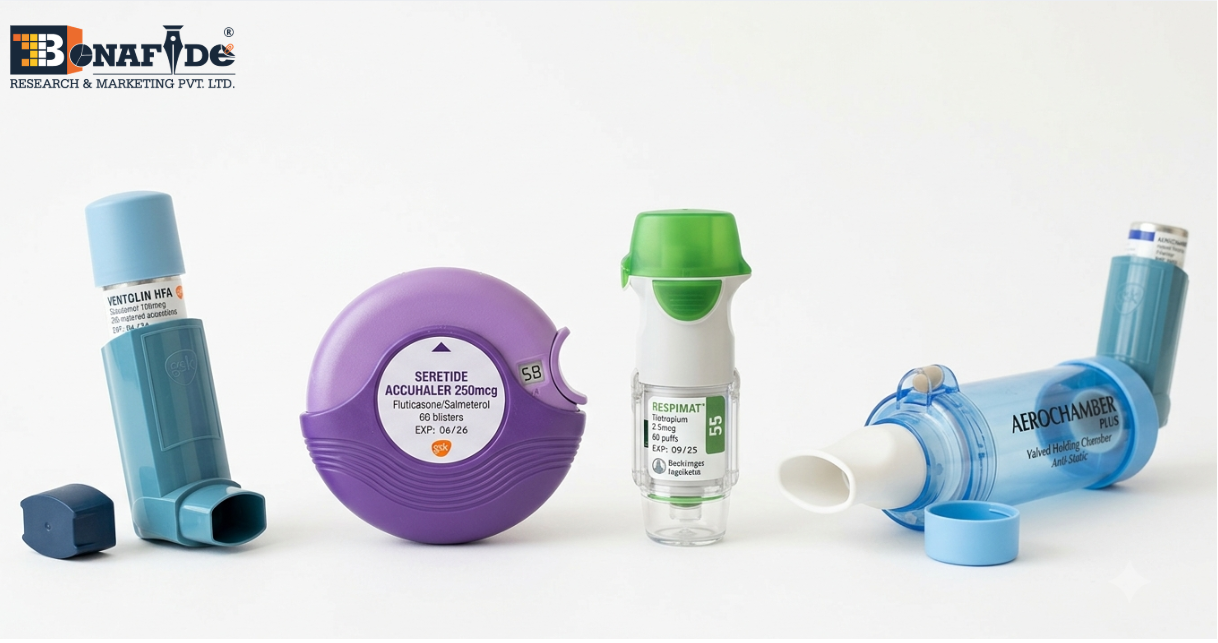
The global inhalation devices market comprises medical devices designed to deliver medications directly into the lungs for the treatment and management of respiratory conditions, including asthma, chronic obstructive pulmonary disease (COPD), and other pulmonary disorders. Major products include metered-dose inhalers, dry powder inhalers, soft-mist inhalers, and nebulizers, which differ in their drug-delivery mechanisms and suitability for individual patients. The market is important because inhaled treatment can provide targeted drug delivery, relieve breathing difficulties, control airway inflammation, and support long-term disease management when prescribed and used correctly. Its growth is supported by the persistent burden of chronic respiratory diseases, exposure to tobacco smoke and air pollution, aging populations, improved diagnosis, and increasing demand for portable and convenient treatment options. Technological developments, including dose counters, connected inhalers, improved aerosol delivery, and patient-friendly device designs, are also influencing product development. Another important driver is the growing emphasis on correct inhaler technique and medication adherence, as improper use can reduce treatment effectiveness and contribute to uncontrolled symptoms and avoidable healthcare visits. Market activities extend across pharmaceutical research, device engineering, drug formulation, manufacturing, quality testing, regulatory approval,
packaging, distribution, and patient education. Manufacturers collaborate with pharmaceutical companies to develop drug-device combinations, while hospitals, respiratory specialists, retail pharmacies, and healthcare professionals contribute to dispensing, treatment selection, and user training. The sector is also associated with international respiratory-health organizations, including the Global Initiative for Asthma (GINA), the Global Initiative for Chronic Obstructive Lung Disease (GOLD), the World Health Organization (WHO), and the Forum of International Respiratory Societies (FIRS), which support evidence-based care and improved access to essential inhaled medicines. Environmental sustainability is another emerging consideration, particularly the reduction of emissions from certain inhaler propellants and improvements in device manufacturing and disposal.
According to the research report, “Global Inhalation Devices Market Overview, 2031” published by Bonafide Research, the Global Inhalation Devices Market is expected to cross 41.79 Billion market size by 2031, with 6.71% CAGR by 2026-31.. Companies such as GSK, AstraZeneca, Boehringer Ingelheim, Teva Pharmaceutical Industries, Cipla, and Novartis develop inhaler-based treatments, while device specialists such as PARI, OMRON Healthcare, and Aptar Pharma contribute inhalation systems, components, and delivery technologies. Growth opportunities include affordable generic inhalers, improved dry powder inhalers, connected devices that support medication adherence, home-based nebulization, and environmentally sustainable alternatives to conventional pressurized inhalers. A notable development occurred in September 2025, when Chiesi announced completion of the Phase III TRECOS clinical development programme for its carbon-minimal pressurized metered-dose inhaler platform, supporting its plans for regulatory submissions. In May 2025, Lupin and Honeywell also announced plans to develop next-generation respiratory inhalers using Honeywell's Solstice Air propellant, which has near-zero global warming potential. These initiatives illustrate how environmental requirements are creating opportunities for reformulation and device redesign. The supply chain begins with pharmaceutical ingredients, excipients, device polymers, metals, canisters, metering
valves, propellants, and packaging materials. Manufacturers then develop formulations and device components, conduct performance and quality testing, obtain regulatory approvals, and coordinate production and packaging. Contract development and manufacturing organizations can support formulation development, specialized powder processing, device engineering, and commercial manufacturing. Finished products move through pharmaceutical wholesalers, distributors, hospital pharmacies, retail pharmacies, and healthcare providers before reaching patients. Supply-chain reliability depends on consistent raw-material quality, specialized manufacturing capabilities, regulatory compliance, and effective inventory management. Opportunities also exist in emerging markets, where greater access to respiratory diagnosis and treatment can support demand for affordable devices.
Metered-dose inhalers (MDIs) are gaining attention as manufacturers work to improve the delivery of respiratory medicines while addressing environmental concerns and patient usability. These devices release a measured quantity of medication from a pressurized container, allowing patients to administer treatment through a compact handheld system. They are widely used for asthma and chronic obstructive pulmonary disease (COPD), with formulations containing bronchodilators, inhaled corticosteroids, or combinations of active ingredients. One important development influencing this segment is the transition toward propellants with lower global warming potential. Traditional MDIs have relied on hydrofluoroalkane propellants, which can contribute to climate change when released into the atmosphere. Pharmaceutical companies are therefore investigating alternative propellants that preserve dose consistency, aerosol performance, and product stability while reducing environmental impact. Chiesi has advanced the development of its carbon-minimal inhaler platform, while other manufacturers have explored next-generation propellant technologies and reformulated products. These changes involve substantial technical work because replacing a propellant can affect aerosol characteristics, formulation compatibility, manufacturing processes, and regulatory requirements. Another factor supporting MDIs is their versatility across different treatment regimens and their portability for patients who need medication during everyday activities. When used with a spacer, a conventional pressurized inhaler can also be easier for some patients to use because the accessory reduces the need to coordinate actuation precisely with inhalation.
The others category in the therapeutic-application classification covers a range of conditions whose treatment needs differ from the established management pathways for asthma and chronic obstructive pulmonary disease. Depending on the market research methodology, this category may include cystic fibrosis, bronchiectasis, pulmonary infections, pulmonary arterial hypertension, and other conditions treated with inhaled medicines. The exact composition varies between reports, so the category should not be assumed to represent one uniform disease group. One factor supporting its development is the need to deliver certain medicines directly to the respiratory tract, particularly when treatment targets airway secretions, local infection, or specific pulmonary processes. In cystic fibrosis, for example, inhaled
antibiotics may be prescribed to manage chronic airway infections, while inhaled hypertonic saline and other therapies can help with mucus clearance in appropriately selected patients. The Cystic Fibrosis
Foundation describes inhaled medicines as an established component of care for people with cystic fibrosis, alongside airway-clearance techniques and other treatments. Inhaled therapies are also used in selected cases of bronchiectasis, although treatment depends on the underlying cause, the patient's clinical history, and the medicine prescribed. Pulmonary arterial hypertension represents a different application: specific inhaled medicines, including iloprost, can be used in selected patients to affect pulmonary blood vessels rather than primarily treating airway obstruction. These examples demonstrate why device requirements can vary significantly across this category. Some treatments require nebulizers capable of delivering specialized formulations, whereas others may use dedicated inhalation systems designed for a particular medicine. Development opportunities arise from new drug formulations, improved aerosol performance, patient-friendly administration, and delivery systems tailored to the characteristics of individual diseases.
Home care settings are becoming increasingly important in respiratory treatment as healthcare systems seek practical ways to support patients who require continuing therapy without repeated hospital visits. People living with asthma, chronic obstructive pulmonary disease, cystic fibrosis, and certain other pulmonary conditions may need inhaled medicines as part of their regular treatment plans. Depending on the patient's condition and prescribed therapy, treatment can involve metered-dose inhalers, dry powder inhalers, or nebulizers that convert liquid medication into an inhalable aerosol. Home nebulization can be particularly relevant for selected patients who have difficulty using handheld inhalers effectively, including some individuals with advanced respiratory disease, physical limitations, or inadequate inspiratory flow. Clinical recommendations emphasize that the choice of home device should be individualized rather than based solely on convenience. One important driver is the shift toward patient-centred care, in which stable patients can manage appropriate aspects of their condition at home while maintaining access to medical supervision and follow-up. Portable equipment, simpler device operation, caregiver education, and access to replacement accessories can help patients incorporate treatment into everyday routines. Home-based management may also reduce the practical burden associated with travelling to healthcare facilities for routine treatment, particularly for older adults and people with mobility challenges. In addition, remote consultations and
digital health services can support communication between patients and clinicians, although these services do not replace emergency assessment when severe breathing difficulties occur. The COVID-19 pandemic further highlighted the value of maintaining suitable care pathways outside hospitals, while also demonstrating that home treatment must be accompanied by appropriate clinical guidance and escalation procedures. Manufacturers have opportunities to improve device portability, noise levels, cleaning procedures, medication compatibility, and ease of handling for patients and caregivers.
Online pharmacies are changing the way some patients access respiratory medicines by connecting digital prescription services with medicine dispensing and delivery. This channel is particularly relevant to people with chronic respiratory conditions who need regular replenishment of maintenance inhalers, reliever medicines, or other prescribed treatments. Once a prescription has been issued, an appropriately licensed
online pharmacy may allow a patient to submit prescription details, check product availability, arrange payment, and have the medicine delivered to a home address. These services can reduce the time and travel involved in obtaining repeat supplies, which may be especially helpful for older adults, people with mobility limitations, caregivers, and patients living far from a well-stocked pharmacy. The United States Food and Drug Administration recognizes convenience, privacy, and potential cost savings as advantages of legitimate online pharmacies, while warning that unsafe websites may sell counterfeit, unapproved, or otherwise substandard medicines. The development of electronic prescriptions,
digital payment systems, prescription-refill reminders, and customer-support services can further simplify the ordering process. Online channels may also help patients compare available products and coordinate repeat orders, although the selection of an inhaler must remain consistent with the prescription and appropriate clinical advice. This is important because inhalers are not universally interchangeable: different devices may contain different active ingredients, doses, and operating mechanisms, and patients may need instruction when switching products. A reliable online pharmacy therefore requires appropriate prescription verification, qualified dispensing oversight, secure handling of personal information, suitable storage and shipping procedures, and a clear process for resolving delivery problems.
Digital and smart inhalation devices are attracting growing attention because conventional inhalers cannot independently tell patients or healthcare professionals whether prescribed doses are being taken consistently or whether inhalation technique is appropriate. Smart systems address part of this challenge by incorporating electronic sensors into an inhaler or attaching a monitoring accessory to an existing device. Depending on the design, these systems can record the date and time of use, detect device activation, provide reminders, and transfer information to a smartphone application or a healthcare professional's monitoring platform. This functionality is particularly relevant to asthma and chronic obstructive pulmonary disease, where treatment effectiveness can be affected by missed doses, incorrect technique, and difficulty maintaining long-term medication routines. A scientific review published in 2021 described how digital inhaler platforms can help patients and clinicians understand medication-taking patterns and use the resulting information to support treatment discussions. More recent evidence also demonstrates both the potential and the limitations of this technology. A 2025 systematic review and meta-analysis covering 12 randomized trials involving 2,483 children and adults found that patient-facing digital inhalers probably improve asthma control, although evidence for some other outcomes remains uncertain. The review also identified practical challenges, including
sensor failures and smartphone synchronization problems. These findings help explain why manufacturers and digital-health developers are exploring connected inhalers, adherence dashboards, automated notifications, and tools that allow clinicians to review medication-use information during consultations.





 We are friendly and approachable, give us a call.