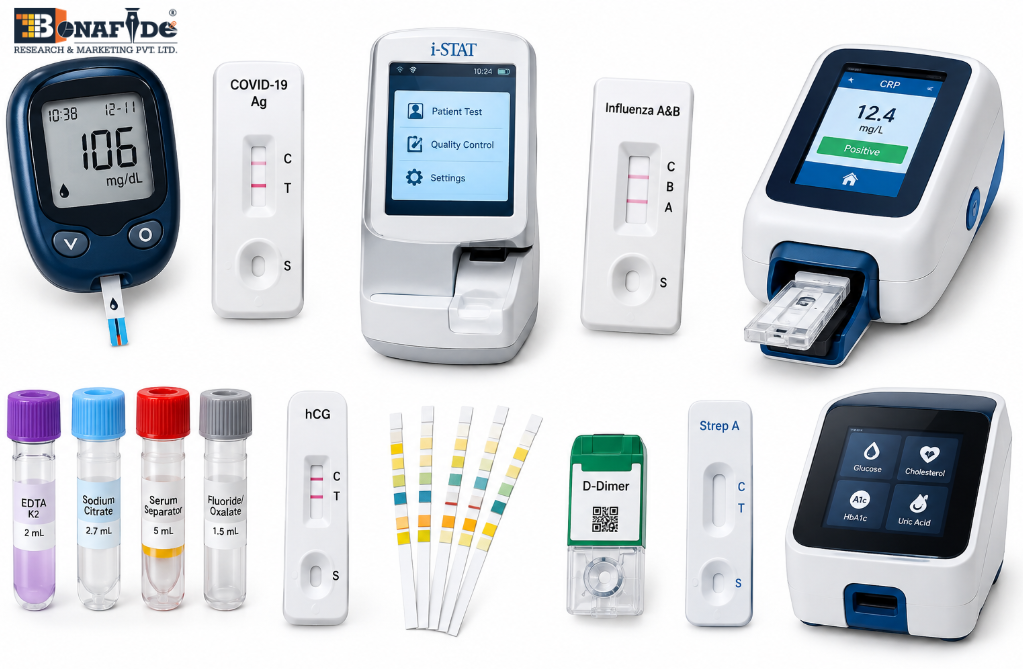
The global Point-of-Care (POC) Diagnostics market comprises diagnostic tests, instruments, and platforms that enable medical testing to be performed close to the patient, including in hospitals, clinics, physician offices, emergency departments, pharmacies, and increasingly at home. These technologies provide rapid results and support timely clinical decisions, reducing dependence on centralized laboratories and helping decentralize healthcare delivery. The market covers applications such as glucose and HbA1c testing, infectious-disease testing, cardiac markers, coagulation, pregnancy and fertility testing, and other diagnostic applications. Major growth drivers include the increasing prevalence of chronic and infectious diseases, ageing populations, demand for rapid diagnosis, expansion of
home healthcare, miniaturization and digitalization of
diagnostic devices,
telehealth integration, and rising healthcare investment in emerging economies.
POC diagnostics are particularly important for improving access to testing in rural, remote, and resource-limited settings, where conventional laboratory infrastructure may be limited. The World Health Organization (WHO) highlights diagnostics as fundamental to healthcare decision-making and established a Diagnostics Taskforce following the 2023 World Health Assembly resolution to strengthen global diagnostic capacity. Key industry associations and stakeholders include professional laboratory and clinical organizations, regulators, healthcare providers, manufacturers, and international bodies such as WHO. Market participants conduct activities including research and development, test and instrument manufacturing, clinical validation, regulatory approval, commercialization, distribution, training, quality management, and integration of diagnostic results with electronic health records and
digital healthcare platforms. The market is also being shaped by the development of multiplex testing, molecular diagnostics,
biosensors, and
artificial intelligence-enabled diagnostic platforms, which can expand the range of conditions detected at the point of care. Increasing emphasis on early disease detection, preventive healthcare, and personalized treatment is further supporting adoption across clinical and community settings. Regulatory agencies and healthcare organizations are also focusing on accuracy, quality assurance, affordability, and interoperability to ensure reliable use of POC technologies.
According to the research report, “Global Point-of-Care (POC) Diagnostics Market Overview, 2031” published by Bonafide Research, the Global Point-of-Care (POC) Diagnostics Market is expected to cross 76.46 Billion market size by 2031, with 8.01% CAGR by 2026-31..Key companies include Abbott, F. Hoffmann-La Roche, Siemens Healthineers, Danaher, BD, bioM?rieux, QIAGEN, QuidelOrtho, Werfen, Nova Biomedical, and OraSure Technologies, reflecting a competitive landscape spanning glucose monitoring, molecular diagnostics, infectious-disease testing, cardiac markers, coagulation, and other applications. Major opportunities arise from the expansion of home healthcare, telehealth-enabled testing, decentralized healthcare, ageing populations, increasing chronic and infectious diseases, and demand for rapid diagnosis in emerging economies. Technological opportunities are particularly significant in molecular POC diagnostics, where PCR, multiplex testing, miniaturized instruments, digital connectivity, and automated interpretation can support rapid clinical decision-making. In a notable development, Roche received FDA clearance and a CLIA waiver in January 2025 for its cobas liat multiplex molecular tests for sexually transmitted infections, with results available in approximately 20 minutes, expanding decentralized testing in urgent-care, retail-clinic, and community settings. Abbott’s i-STAT Alinity, meanwhile, illustrates the industry’s focus on handheld testing, providing blood-test results within minutes near the patient. From a supply-chain perspective, the market involves raw-material and component suppliers, assay and reagent developers, instrument manufacturers, contract manufacturers, regulatory and quality-control processes, distributors, hospitals and clinics, pharmacies, and end users. Efficient supply chains require reliable procurement of reagents, consumables, sensors, plastics, electronics, and
packaging, followed by manufacturing, quality testing, regulatory compliance, cold-chain or controlled storage where necessary, distribution, installation, technical support, and replenishment of recurring test consumables.
The clinical urgency of identifying acute coronary syndromes and metabolic risk factors within the gold hour of symptom onset has fundamentally reshaped emergency and primary diagnostic workflows. Cardiometabolic monitoring kits address this critical threshold by consolidating multiple assay determinations, such as cardiac troponin I and T, high-sensitivity C-reactive protein, brain natriuretic peptide,
lipid fractions, and glycated hemoglobin, into unified handheld testing platforms. Rather than sending individual blood samples to distant central clinical pathology laboratories where centrifugal separation and immunoassay processing cause multi-hour turnaround delays, these point of care systems process unseparated capillary whole blood in minutes. Immediate diagnostic feedback allows emergency department clinicians to rapidly rule in or rule out acute myocardial infarction, initiate thrombolytic or interventional cardiology procedures without delay, and adjust pharmaceutical therapies for severe heart failure or dyslipidemia in a single outpatient encounter. Furthermore, the rising global prevalence of metabolic syndrome, characterized by the co-occurrence of hypertension, hyperlipidemia, abdominal obesity, and insulin resistance, creates continuous operational necessity for co-monitoring vascular and endocrine
biomarkers simultaneously. Advanced microfluidic biosensors integrated into modern cardiometabolic panels allow non-laboratory clinical personnel to evaluate subtle vascular inflammation alongside continuous glucose and lipid fluctuations.
Lateral flow assays utilize a simple yet robust biochemical mechanism where a liquid sample migrates via passive capillary action along a series of porous polymeric membranes, interacting sequentially with conjugated antibodies, target analytes, and immobilized capture lines. This structural architecture eliminates the need for electric micro-pumps, delicate optical sensors, or complex liquid handling
robotics, making the test platform extraordinarily durable and operational in virtually any environment without specialized technical training. The integration of highly stable colloidal gold nanoparticles, fluorescent quantum dots, and
cellulose nanobeads has dramatically enhanced the analytical sensitivity and signal detection of lateral flow strips, bridging the historical performance gap between rapid manual assays and centralized laboratory immunoassay analyzers. Because these disposable strips can be mass-manufactured through scalable roll-to-roll liquid deposition and
membrane lamination processes, production costs remain exceptionally low compared to silicon microfluidic cartridges or molecular PCR chambers. The platform easily accommodates diverse sample matrices, including whole capillary blood, nasal swabs, saliva, and urine, without requiring pre-analytical centrifugation, filtration, or chemical extraction steps. Furthermore, modern lateral flow architectures are increasingly designed with multiplex lines capable of detecting distinct pathogen targets or biomarker profiles simultaneously on a single test cassette.
Home-based diagnostic testing allows individuals to monitor vital biomarkers, acute infections, and metabolic changes within their personal living spaces, eliminating transportation barriers, scheduling delays, and potential exposure to nosocomial pathogens in crowded medical clinics. The operational
foundation of this transition relies on the engineering of user-friendly handheld devices, automated
lancet systems, single-step lateral flow cassettes, and intuitive digital interfaces that guide non-technical users through proper sample collection and assay execution. Modern home diagnostic systems incorporate sophisticated built-in fail-safes, such as sample volume verification indicators, control line checks, and temperature-compensated signal readers, ensuring that analytical accuracy remains consistent even when operated by untrained consumers. This direct consumer access is particularly vital for the long-term management of chronic metabolic conditions like diabetes, where frequent daily glucose checks dictate real-time insulin dosing decisions, as well as for reproductive health monitoring, anticoagulation management, and rapid screening for seasonal respiratory pathogens. Beyond immediate diagnostic feedback, modern home testing kits increasingly feature wireless Bluetooth connectivity, allowing handheld readers and biosensor strips to automatically pair with mobile applications. These companion digital platforms process test measurements, track longitudinal biomarker trends, and securely transmit diagnostic reports directly to attending physicians via
telemedicine channels.
Healthcare regulatory frameworks mandate that sophisticated point of care diagnostic instruments, high-complexity assay cartridges, and devices tied directly to therapeutic decision-making maintain prescription status to protect patient safety. Prescription authorization ensures that a licensed healthcare professional evaluates the patient's overall clinical presentation, selects the appropriate diagnostic assay, and reviews test results within the broader context of complete medical history and physical examinations. This medical gating mechanism is especially critical for diagnostic platforms that yield complex biomarker measurements, such as cardiac troponin, quantitative molecular viral loads, blood gas balances, coagulation profiles, and specialized therapeutic drug concentrations. An incorrect or unguided interpretation of these advanced metrics by an untrained individual could lead to catastrophic clinical errors, including inappropriate pharmaceutical dosing, missed diagnoses of life-threatening events, or delayed emergency interventions. Furthermore, prescription based diagnostic platforms are deeply embedded into formalized clinical practice guidelines, hospital discharge protocols, and chronic disease management plans that dictate specific testing intervals for high-risk patients.
Urine is biologically ideal for rapid point of care diagnostics because the body naturally excretes a wide spectrum of metabolic byproducts, systemic biomarkers, hormones, renal proteins, and foreign chemical substances through the kidneys. Obtaining a urine sample is entirely pain-free and requires no invasive venipuncture, capillary skin pricking, or mucosal scraping, making it exceptionally tolerable for pediatric, geriatric, and needle-anxious patients across all care settings. From a diagnostic chemistry perspective, urine is largely free of cellular debris like red blood cells and clotting factors that frequently interfere with optical or electrochemical detection mechanisms in whole blood assays, thereby eliminating the need for pre-analytical centrifugation or complex filtration membranes inside test cartridges. Point of care test strips and lateral flow cassettes can be exposed directly to fresh urine to yield immediate, highly visible colorimetric or fluorometric results for
urinalysis parameters, including leukocyte esterase, nitrites, protein, glucose, bilirubin, and specific gravity. The fluid matrix is also the primary medium for screening systemic physiological states and exogenous substances, serving as the gold standard sample for early pregnancy determination via human chorionic gonadotropin, kidney function monitoring through microalbuminuria detection, and rapid screening for drugs of abuse.





 We are friendly and approachable, give us a call.