The global
utility poles market is experiencing an unprecedented transformation, propelled by the most significant surge in electricity grid investment in history. According to the International Energy Agency (IEA), global spending on electricity networks is expected to approach USD 550 billion in 2026, representing a nearly 20% year-on-year increase. This marks a pivotal moment for the sector, as grid investment is finally beginning to catch up with the massive spending on
renewable energy generation. The scale of the challenge, however, remains immense. IRENA estimates that around USD 670 billion of investment is required annually between 2025 and 2030 towards strengthening electricity grids. At the COP30 climate conference, a major breakthrough occurred when members of the Utilities for Net Zero Alliance (UNEZA) announced upgraded annual investment plans, committing a total of USD 148 billion per year to the energy transition. This marks a more than 25% increase in investment commitments and signals unprecedented momentum in grid infrastructure spending. Simultaneously, the IEA has issued a stark warning: electricity demand from data centers,
artificial intelligence, and cryptocurrency could more than double between 2022 and 2026. This surge in demand is placing immense strain on existing grids, necessitating urgent expansion and reinforcement. The IEA has reported that roughly 80 million kilometers of grid infrastructure must be added or replaced by 2040 to support secure energy transitions.
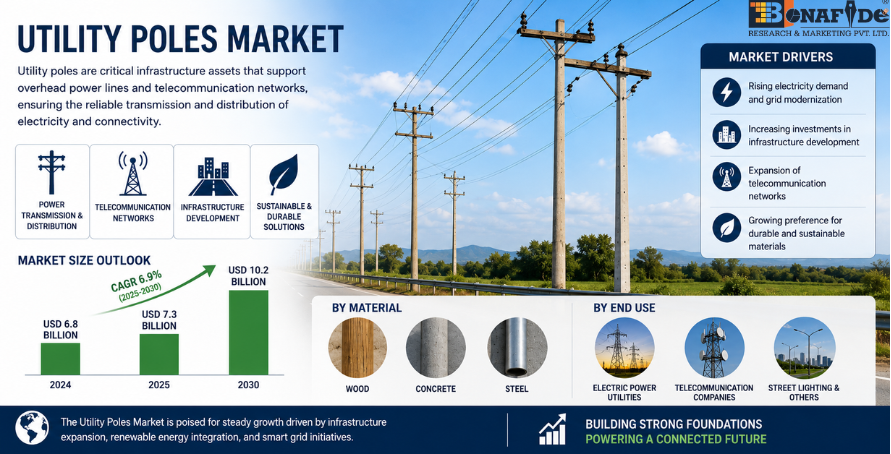
According to the research report "Global Utility Poles Market Outlook, 2031," published by Bonafide Research, the Global Utility Poles market was valued at more than USD 46.17 Billion in 2025, and expected to reach a market size of more than USD 70.42 Billion by 2031 with the CAGR of 7.48% from 2026-2031. The competitive landscape of the global utility poles market is undergoing a fundamental shift, driven by record investment levels, material innovation, and the integration of
digital technologies. The Asia-Pacific region remains the dominant market, driven by rapid urbanization and massive infrastructure spending. China's State Grid Corporation, for example, reported fixed-asset investment of 129 billion yuan in the first quarter of 2026, up 37% year-on-year, driving more than 250 billion yuan of investment across the wider industrial chain. In the Middle East, Saudi Arabia's Saudi Electricity Company (SEC) has launched a comprehensive transmission and distribution network upgrade plan with a core investment of up to USD 58.7 billion (SAR 220 billion) between 2025 and 2030. The European Commission published the European Grids Package on 10 December 2025, setting out measures to modernise and expand Europe's electricity infrastructure, with an estimated €800 billion in investment needed by 2050 for cross-border, hybrid, and offshore grids. This global wave of investment is creating sustained demand for utility poles across all regions.
The distribution segment commands the largest share of the global utility poles market because it represents the vast, essential network that delivers electricity from high-voltage transmission systems to the end consumer, forming the backbone of electrification worldwide. The sheer scale of distribution infrastructure far exceeds that of transmission, requiring millions of poles to support the lower-voltage lines that crisscross urban, suburban, and rural landscapes. Global electrification efforts, particularly in developing economies, are a primary driver, as extending power to remote and underserved areas requires extensive new distribution line construction. The rise in global electricity consumption, with the International Energy Agency reporting a projected growth of approximately 4% in 2024 one of the highest rates in two decades necessitates continuous grid expansion and reinforcement at the distribution level. Rapid urbanization in nations across Asia-Pacific and Africa is fueling unprecedented demand for new distribution infrastructure to support growing cities and industrial zones. Distribution poles are also the primary interface for integrating renewable energy sources, as new solar and wind projects frequently connect to the grid at the distribution level, creating significant demand for new poles to support these connections. The modernization of aging grid infrastructure in developed nations is another critical factor, with utilities upgrading distribution lines using stronger, more resilient materials like steel and composite poles to improve reliability and withstand extreme
weather events. The deployment of
smart grid technologies, which rely on sensors and monitoring equipment mounted on distribution poles, is further entrenching this application's dominance, making it the indispensable
foundation of the global electricity delivery system.
Steel is the largest material segment in the global utility poles market due to its exceptional strength, durability, fire resistance, and long service life, which collectively provide superior lifecycle value compared to traditional alternatives. Steel poles are engineered to support the heaviest loads and withstand extreme environmental stresses, including high winds, ice accumulation, and seismic activity, ensuring the reliability of critical transmission and distribution infrastructure. Unlike wood, steel is impervious to rot, termites, and fungal decay, significantly reducing maintenance requirements and extending service life to 50 years or more, which translates into substantial long-term cost savings for utilities. The non-combustible nature of steel makes it an essential material for grid hardening efforts, particularly in wildfire-prone regions such as the western United States and Australia, where utilities are proactively replacing vulnerable wood poles to enhance public safety and system resilience. The steel industry benefits from a vast, established global supply chain that ensures consistent availability and competitive pricing, allowing utilities to undertake large-scale infrastructure projects without material constraints. Steel's versatility is evident across the entire electricity grid, from high-voltage transmission towers to medium-voltage distribution poles, making it a standardized solution for diverse applications. The ongoing replacement of aging wooden poles with corrosion-resistant steel alternatives, driven by regulatory mandates and the need for modernized infrastructure, is a key factor sustaining steel's market leadership.
The 40 to 70-foot pole size segment is the largest in the global utility poles market because it serves as the versatile and standardized height for power distribution and telecommunication lines, forming the core of the world's electricity delivery infrastructure. This size range, which typically includes Class 3 and 4 poles, provides the optimal balance between structural height, load-
bearing capacity, and cost-effectiveness, making it the preferred choice for primary distribution networks. These poles are ideally suited for carrying medium-voltage distribution lines that transport power from substations to local transformer points, a function that constitutes the vast majority of global pole deployments. Their height ensures adequate ground clearance for public safety while remaining manageable for standard installation equipment and techniques. The 40-70ft pole size is sufficiently robust to support both electrical conductors and communication
cables, making it a multi-functional asset that has become the standard for joint-use infrastructure accommodating telecom attachments. As utilities undertake grid modernization and renewable integration projects, they frequently replace shorter, aging poles with 40-70ft models to meet modern clearance and capacity requirements. Urban and suburban applications favor this size range, as it offers an effective compromise between structural stability and aesthetic impact, making it a standard choice for new developments across residential and commercial areas.
New installation is the fastest-growing installation type in the global utility poles market, driven by the urgent global push to expand and modernize electricity grids to meet rising demand and integrate renewable energy. Rapid urbanization and industrialization in developing nations, particularly across the Asia-Pacific and Africa, necessitate the construction of new power lines and distribution networks, directly driving demand for new poles. The connection of new wind and solar farms to the grid often requires building new transmission lines to reach population centers, necessitating the installation of new, often larger, poles. Large-scale programs to extend electricity access to underserved rural areas, especially in Asia-Pacific and Africa, involve the installation of millions of new poles. The deployment of 5G small cells and fiber optic networks requires the installation of new, strategically placed poles, especially in urban and suburban areas. Global efforts to build more resilient, smarter, and higher-capacity grids are creating substantial long-term demand for new installations across all regions. Market reports consistently identify new installations as a dominant growth segment, reflecting the sustained global investment in new infrastructure to meet the challenges of the 21st-century energy landscape.












 We are friendly and approachable, give us a call.