The global sorbent pads market operates within a complex industrial ecosystem defined by massive hydrocarbon processing capacity and an evolving regulatory landscape. Worldwide refining capacity is substantial, with the United States alone operating 130 operable refineries as of January 2026, representing a total atmospheric distillation capacity of 18.2 million barrels per calendar day. This immense scale of petroleum refining, storage, and transportation inherently generates a persistent demand for spill containment solutions. According to the International Energy Agency (IEA), global refinery crude throughputs are forecast to average 83.5 million barrels per day in 2025, with global oil supply reaching a record 106.9 million barrels per day in August 2025. The International Tanker Owners Pollution Federation (ITOPF) has recorded numerous oil spills from tanker incidents, highlighting the constant need for rapid-response sorbent materials. The market's growth is reinforced by a comprehensive regulatory framework, including the U.S. Environmental Protection Agency's (EPA) Spill Prevention, Control, and Countermeasure (SPCC) rule, which mandates that facilities with aboveground oil storage exceeding 1,320 gallons must have certified spill prevention plans and absorbent materials on hand. The International Maritime Organization (IMO) enforces the MARPOL convention, requiring vessels to maintain oil spill response equipment. The global chemical industry, valued at approximately $5.7 trillion in 2025 according to the International Council of Chemical Associations (ICCA), represents a massive and diverse base of end-users. This layered regulatory environment, combined with the sheer scale of global industrial activity, creates a non-negotiable and consistent demand for certified sorbent products across all sectors handling petroleum and hydrocarbons.
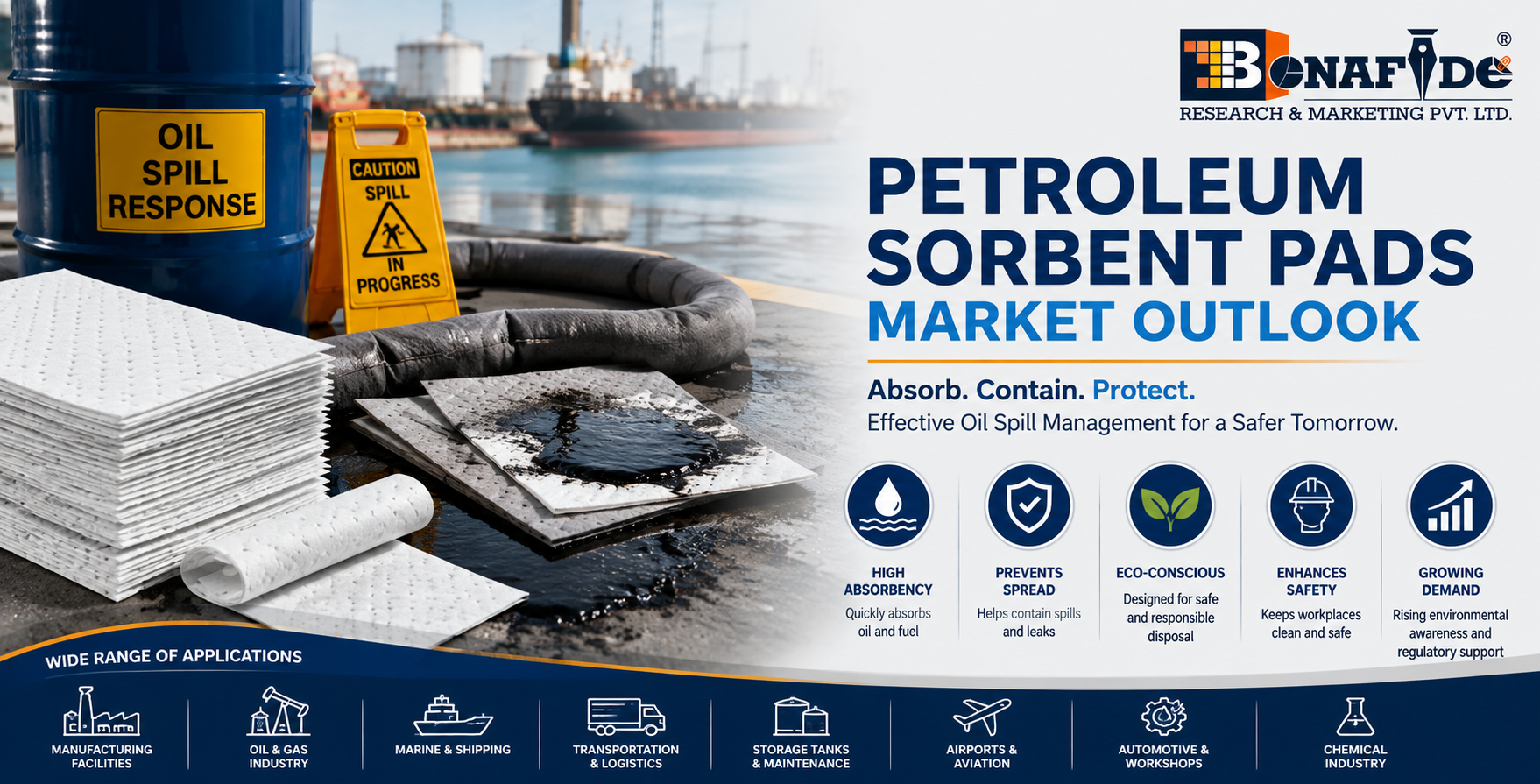
According to the research report "Global Petroleum Sorbent Pads Market Outlook, 2031," published by Bonafide Research, the Global Petroleum Sorbent Pads market was valued at more than USD 25.88 Billion in 2025, and expected to reach a market size of more than USD 43.22 Billion by 2031 with the CAGR of 9.16% from 2026-2031. The competitive landscape for global sorbent pads is shaped by established multinational corporations and specialized regional suppliers, all operating within strict regulatory frameworks defined by bodies like the U.S. EPA, the European Chemicals Agency (ECHA), and the IMO. Leading global players such as 3M, New Pig, Brady Corporation (SPC), and Oil-Dri Corporation are significant participants, offering extensive product lines designed to comply with rigorous international standards. These companies compete on product performance,
certification, and the ability to meet the demanding specifications of the world's largest industrial sectors. A major trend is the increasing focus on high-performance, sustainable, and technologically advanced sorbent solutions. Driven by the scale of global downstream operations and corporate ESG commitments, there is growing demand for sorbent pads with enhanced absorption capacities, quick response times, and eco-friendly materials. The value chain is supported by a robust network of industrial distributors that cater to the geographically dispersed industrial base, from the refining hubs of the U.S. Gulf Coast and Asia-Pacific to the chemical complexes of Europe. Enterprise adoption is heavily driven by compliance with national and international regulations, including the EPA's SPCC rule, the EU's REACH regulations, and the IMO's MARPOL convention. The major industrial players, including national oil companies and large chemical conglomerates, are key consumers, requiring heavy-duty pads for their extensive operations. Companies that can offer certified, high-performance, and cost-effective products are best positioned to secure long-term contracts in this expansive and strategically important global market.
The surge in Natural/Organic sorbents is propelled by aggressive corporate ESG targets and stringent waste reduction mandates across the globe. The organic sorbents segment is expected to grow at the fastest CAGR of 6.4% due to their natural composition, high absorbency, and environmental friendliness. Materials such as cotton, peat moss, sawdust, and plant fibers are widely used to manufacture biodegradable and low-environmental-impact pads. Increasing environmental awareness and stringent regulations regarding oil spills and leaks are driving the demand for natural and biodegradable oil absorbent pads. Corporate ESG commitments are a major factor, with multinational companies setting waste reduction targets that favor biodegradable sorbents. The high cost of disposing of synthetic, oil-saturated pads, coupled with strict landfill regulations, makes natural alternatives economically attractive. The agricultural and food processing sectors, which are large users of sorbents, have a strong preference for biodegradable natural materials. Continuous innovation is leading to the development of more efficient and cost-effective natural sorbents from renewable resources.
The Others segment is the fastest-growing due to the rapid expansion of agriculture, mining, construction, and small industrial activities across the globe. The Others segment includes agriculture, construction, mining, and small workshops, which are growing rapidly as economies diversify. The agribusiness sector, a major contributor to GDP in many regions, requires sorbent pads for machinery maintenance and fuel storage. The mining sector in countries like Chile, Peru, and Australia uses sorbent pads for
heavy equipment maintenance and hydraulic fluid management. Construction and infrastructure projects across the globe create a steady demand for sorbent pads for equipment maintenance and small-scale spill management. Small workshops and automotive repair shops, which are numerous globally, generate consistent demand for light and medium-duty sorbent pads. The growth of the commercial and hospitality sectors creates demand for sorbent pads for small-scale spill management and maintenance. Increasing environmental awareness and regulatory pressure are driving the adoption of sorbent pads in Others segments.
Heavy-duty pads are the fastest-growing absorbency type due to the increasing scale of industrial operations, stringent regulations, and the need for efficient management of larger spills. Heavyweight
petroleum sorbent pads represent the fastest-growing segment within the product type, supported by rising demand from oil and gas operations and
offshore drilling platforms. One heavy-duty pad can replace multiple light or medium pads, making it a more cost-effective solution for larger spills and reducing total waste volume. Stricter enforcement of environmental laws and spill prevention regulations globally compels industries to have robust containment capabilities, driving the adoption of high-absorbency pads. The growth of offshore drilling and pipeline transport segments globally often requires heavy-duty sorbent materials for effective spill response. The world's emergence as a rapidly growing market, fueled by rapid industrialization and increasing oil consumption, is driving demand across all segments, with heavy-duty pads being particularly critical for large-scale industrial operations. The circular economy push in some countries is encouraging the use of reusable heavy-duty pads, which, despite a higher upfront cost, offer long-term savings and reduced waste. Increasing instances of unplanned discharges globally are boosting investments in spill containment kits that include heavy-duty petroleum sorbent materials.
Reusable and wringable pads are the fastest-growing reusability segment due to the convergence of circular economy mandates, economic pressures, and a strong corporate ESG focus. The market is seeing a shift toward biodegradable and reusable sorbents aligning with ESG targets. Companies are increasingly replacing single-use
polypropylene absorbent pads with reusable alternatives that can be wrung out, cleaned, and redeployed multiple times. The high cost of disposing of oil-saturated single-use pads, which often requires special handling and is subject to increasing taxes, is making reusable alternatives economically attractive. About 52% of industries are willing to adopt reusable sorbents for cost reasons. Advanced durable materials have improved the performance and lifespan of reusable pads, making them a more reliable solution. Some facilities wring out reusable pads to recover the absorbed oil, generating a secondary economic value and further reducing environmental impact. The focus on resource efficiency and waste reduction is creating a favorable regulatory environment for reusable products.






















 We are friendly and approachable, give us a call.