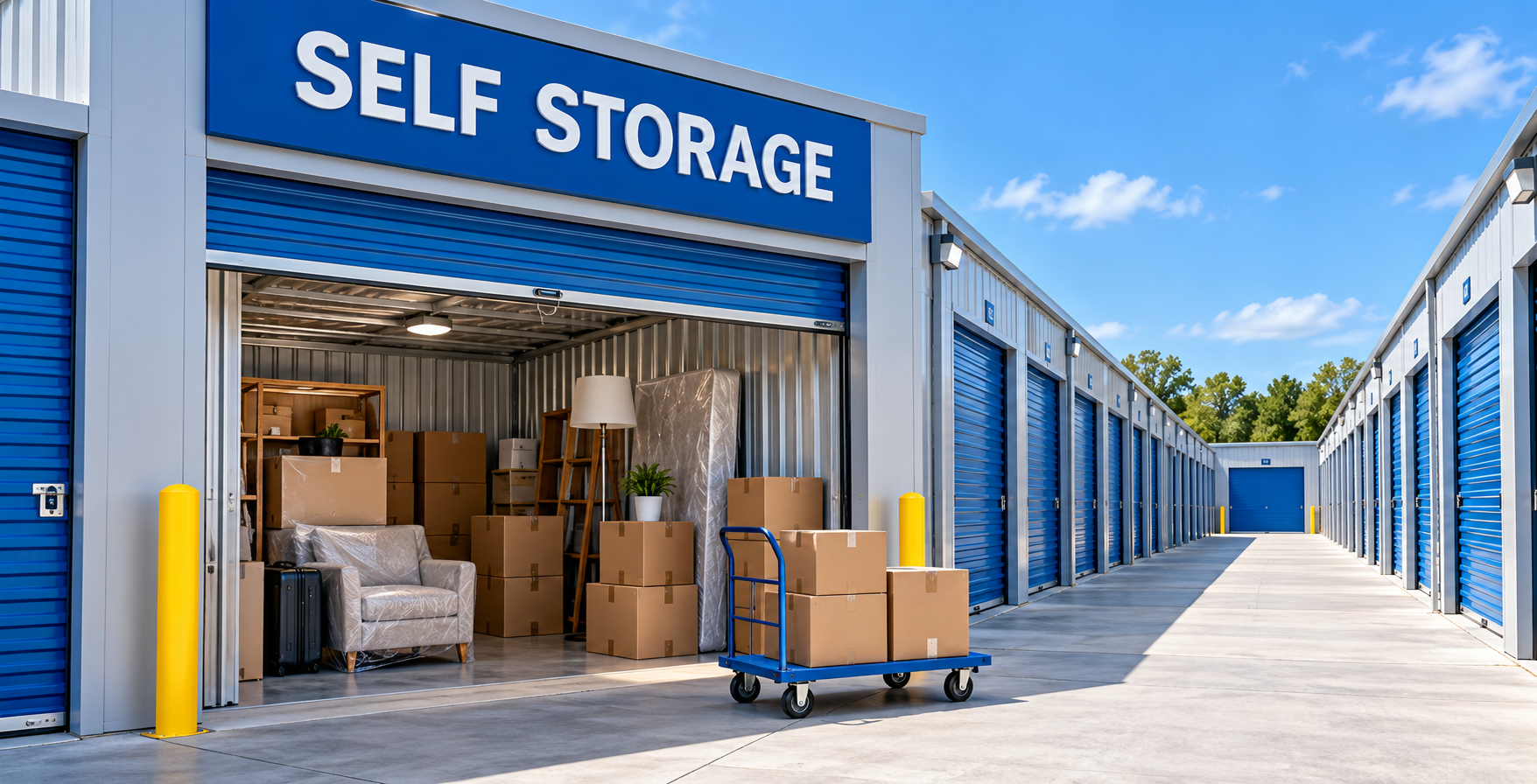
The Global Self-Storage Market is evolving as individuals, households, and businesses increasingly seek flexible, accessible, and secure space for storing personal belongings, business inventory, documents, equipment, vehicles, and other goods. Self-storage facilities provide customers with private rental units that they can access and manage directly, offering an alternative to keeping excess belongings at home or occupying larger commercial premises. The market includes climate-controlled storage, non-climate-controlled storage, portable container storage, and vehicle storage, with facilities offering different unit sizes and rental arrangements to meet varying customer requirements. A major factor supporting the market is the growing need for flexible storage space in urban and densely populated areas. Rising housing costs, smaller residential spaces, household mobility, business expansion, and changing lifestyles are encouraging customers to use self-storage facilities for temporary as well as longer-term requirements. The flexibility of month-to-month and other rental arrangements also allows customers to adjust their storage requirements without making significant long-term commitments. Self-storage has become an important component of the broader flexible-space industry because it provides customers with dedicated storage capacity while allowing them to retain direct access and control over their belongings. Facilities increasingly incorporate features such as electronic access systems, surveillance cameras,
digital rental processes, automated gates, climate control, online payments, and remote management technologies, supporting convenience and operational efficiency across modern facilities.
According to the research report, "Global Self-Storage Market Outlook, 2031," published by Bonafide Research, the Global Self-Storage Market Outlook was valued at more than USD 62.75 Billion in 2025, and expected to reach a market size of more than USD 87.73 Billion by 2031 with the CAGR of 5.89% from 2026-2031.
The increasing demand for flexible storage is one of the major factors shaping the Global Self-Storage Market. Customers increasingly require additional space during residential relocation, home renovation, life-stage transitions, downsizing, travel, temporary accommodation, and other periods when available household space becomes insufficient. Businesses also use self-storage for inventory, documents, equipment, seasonal merchandise, tools, and operational materials without committing to conventional warehouse or commercial premises. This combination of residential and business demand provides self-storage operators with multiple customer segments and supports occupancy across different facility formats. The ability to rent individual units according to space requirements further distinguishes self-storage from larger commercial storage arrangements. Urbanization and changes in residential space are further influencing market development. In major metropolitan areas, high property prices and limited residential floor space can increase the value of additional storage capacity. Customers living in apartments and smaller homes may require dedicated space for seasonal belongings,
furniture,
sports equipment, household items, and other possessions. Self-storage facilities located near residential communities can therefore provide a convenient extension of available household space. At the same time, migration between cities, changing household structures, and increased residential mobility can create temporary storage requirements. These factors are particularly relevant in mature self-storage markets where operators are expanding facilities in densely populated urban and suburban locations.
Urbanization and changes in residential space are further influencing market development. In major metropolitan areas, high property prices and limited residential floor space can increase the value of additional storage capacity. Customers living in apartments and smaller homes may require dedicated space for seasonal belongings, furniture, sports equipment, household items, and other possessions. Self-storage facilities located near residential communities can therefore provide a convenient extension of available household space. At the same time, migration between cities, changing household structures, and increased residential mobility can create temporary storage requirements. These factors are particularly relevant in mature self-storage markets where operators are expanding facilities in densely populated urban and suburban locations.
Technology is also transforming the operation and customer experience of self-storage facilities. Modern facilities increasingly use digital
access control, online reservations, electronic payments, surveillance systems, smart locks, automated gates, remote monitoring, and property-management software. These technologies can reduce the need for on-site staffing while providing customers with faster access to rental information, payments, account management, and facility services. Remote management is becoming particularly relevant for operators managing multiple locations because centralized systems can support monitoring, customer communication, access management, and operational oversight across geographically dispersed facilities. Digital tools are therefore becoming an increasingly important component of facility development and operating strategies.
Security remains a central consideration in the selection of self-storage facilities. Customers expect their belongings to be protected through controlled access, surveillance cameras,
perimeter security,
lighting, individual unit locks, gated entry systems, and other security measures. Operators are increasingly combining physical security infrastructure with digital monitoring technologies to strengthen
facility management. The adoption of electronic access systems and connected surveillance can also provide operators with greater visibility into facility activity. Security features can therefore influence customer confidence, facility positioning, and the ability of operators to differentiate their properties in competitive local markets.
Climate-controlled storage represents another important area of market development. Climate-controlled units can help protect temperature- or humidity-sensitive belongings from environmental conditions, making them suitable for furniture, electronics, documents, artwork, clothing, and other items requiring additional protection. Demand for climate-controlled facilities is particularly relevant in regions experiencing significant temperature or humidity fluctuations. Operators are increasingly incorporating climate-controlled units into new developments and facility expansions, particularly where customers are willing to pay a premium for additional protection and improved storage conditions.
Unit size and storage format also contribute to the diversity of the market. Customers require different amounts of space depending on whether they are storing household goods, business inventory, furniture, equipment, vehicles, or seasonal belongings. Small units can accommodate boxes and personal items, while medium and larger units can support furniture, business inventory, equipment, and other bulky goods. Portable container storage provides additional flexibility by allowing storage containers to be delivered to customer locations or managed through specialized facilities. Vehicle storage also serves customers requiring dedicated space for cars, recreational vehicles, boats, trailers, and other vehicles that cannot be conveniently stored at residential properties.
The application landscape extends across both personal and business users. Personal customers represent a major part of demand because households use self-storage during relocation, renovation, downsizing, life transitions, and periods of limited residential space. Business customers use facilities for inventory, documents, equipment, tools, seasonal stock, and other operational requirements. Small businesses and independent professionals can particularly benefit from flexible storage because they may require additional space without committing to conventional warehouse leases. The combination of personal and business applications creates a diversified customer base and allows operators to serve different occupancy requirements across local markets.
Rental duration is another important characteristic of the self-storage business model. Customers may rent units for short periods during relocation, renovation, travel, or temporary space constraints, while other customers maintain storage for several months or multiple years. Mid-term rentals can provide stable occupancy for customers with ongoing storage requirements, whereas short-term demand can increase during periods of residential mobility and seasonal activity. Longer-duration customers can also contribute to recurring rental revenue and facility stability. Operators therefore manage a mixture of rental durations depending on local demographics, facility characteristics, customer composition, and market conditions.
Booking and distribution are becoming increasingly digital. Online booking allows customers to compare unit sizes, prices, availability, facility features, access arrangements, and rental terms before selecting a storage unit. Digital rental processes can also reduce administrative requirements and allow customers to complete reservations outside conventional facility operating hours. Offline channels remain relevant because some customers prefer visiting facilities, speaking directly with staff, inspecting units, or receiving assistance before renting. The combination of online and offline booking enables operators to serve customers with different purchasing preferences while expanding the reach of individual facilities.
















 We are friendly and approachable, give us a call.