The Global Air
Sports Equipment Market is entering a period of sustained development, supported by increasing participation in recreational air sports, expanding
adventure tourism, rising investment in training infrastructure, and continuous advancements in equipment safety and performance. Air sports equipment encompasses a wide range of products, including container and harness systems, protective
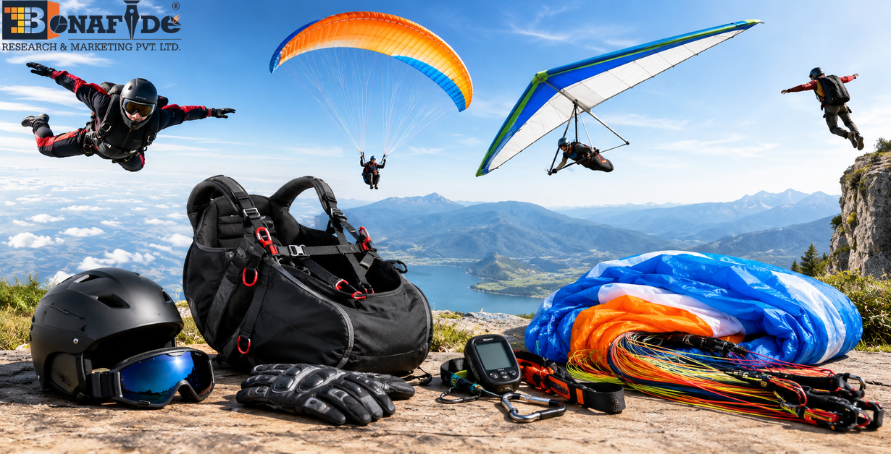
gears, parachutes, paragliders, hang gliding equipment, and specialized accessories used across parachuting, paragliding, hang gliding, and base jumping activities. Growing consumer interest in experience-based recreation and outdoor adventure is encouraging tourism operators, training institutions, and individual enthusiasts to invest in reliable and technologically advanced equipment. The market is also benefiting from improvements in lightweight fabrics, high-strength webbing,
composite materials, aerodynamic designs, reserve systems, and protective technologies that enhance safety, comfort, and flight performance. Europe remains the largest regional market, supported by a well-established air sports culture, extensive mountain and coastal landscapes, organized clubs, professional competitions, training networks, and strong participation in paragliding, parachuting, and hang gliding.
According to the research report, "Global Air Sports Equipment Market Outlook, 2031," published by Bonafide Research, the Global Air Sports Equipment Market Outlook was valued at more than USD 20.31 Billion in 2025, and expected to reach a market size of more than USD 32.28 Billion by 2031 with the CAGR of 8.24% from 2026-2031.
Europe represents the largest regional market, supported by its established air sports ecosystem, favorable geographical conditions for free-flight activities, strong participation in paragliding and hang gliding, specialized manufacturers, training schools, and well-developed adventure tourism infrastructure. North America also maintains a significant position due to established parachuting facilities, recreational participation, professional training centers, and a mature network of equipment suppliers and operators. Europe represents the largest regional market, while Asia Pacific is emerging as one of the fastest-expanding regions due to increasing disposable income, adventure tourism development, expanding recreational aviation infrastructure, and rising participation in countries such as China, India, Japan, Australia, and South Korea. Industry research indicates that Europe maintained the largest regional position, while Asia Pacific is expected to record particularly strong growth during the forecast period. North America benefits from a mature skydiving and recreational aviation ecosystem, established training organizations, specialist manufacturers, and high consumer spending on outdoor recreation. South America is gaining momentum through tourism-oriented paragliding and skydiving destinations, while the Middle East & Africa market is being supported by premium tourism development, commercial aerial experiences, and investment in adventure infrastructure.
Container and harness systems hold the leading position because they provide the structural connection between participants and their primary aerial equipment while supporting critical safety components. In parachuting, the container integrates the main and reserve parachutes with the harness, whereas paragliding and hang gliding harnesses provide body support, positioning, control, and integration with reserve systems. The importance of these products extends across virtually all major participant groups, creating a broad and recurring demand base. Commercial tandem operators require passenger and pilot harnesses capable of repeated operation, while training institutions need equipment suitable for students with different experience levels. Professional athletes and experienced recreational users increasingly seek lightweight, aerodynamic, ergonomic, and technically optimized harness configurations. Manufacturers are responding with compact reserve compartments, improved load distribution, stronger webbing, lightweight fabrics, enhanced back protection, and improved seating systems. The replacement cycle of these products also contributes to recurring demand because high-frequency commercial and training usage results in greater wear and inspection requirements. The broad application base and essential role of harness and container systems therefore support their leading position in the global product structure.
Adventure tour companies are becoming increasingly influential as tourism destinations worldwide expand their range of experience-based activities. Commercial operators provide tandem paragliding, skydiving, introductory flights, and other aerial experiences to tourists who may not otherwise participate in independent air sports. These companies typically purchase equipment in greater quantities than individual consumers and require products capable of handling frequent use. Their procurement requirements include tandem wings, passenger harnesses, parachutes, reserve systems, helmets, protective equipment, and supporting accessories. The growth of adventure tourism across Europe, Asia Pacific, North America, South America, and the Middle East is creating additional opportunities for commercial aerial operators. Tourism destinations with mountains, coastlines, deserts, valleys, and other scenic landscapes are increasingly integrating aerial activities into their recreational offerings. Commercial operators must also maintain replacement inventories and conduct regular inspections because equipment experiences significantly higher utilization than privately owned recreational products. This creates recurring demand for replacement harnesses, parachutes, protective equipment, and related components. The increasing accessibility of tandem experiences is also expanding the consumer base by allowing first-time participants to experience air sports under professional supervision.
Specialty stores remain an important distribution channel because air sports equipment requires considerably more technical evaluation than conventional sporting goods. Wings, parachutes, harnesses, reserve systems, helmets, and protective products must be selected according to participant weight, experience, discipline, operating conditions, and compatibility with other equipment. Specialist retailers can provide fitting services, technical recommendations, product demonstrations, equipment configuration assistance, and maintenance guidance. The importance of specialist distribution is particularly visible in mature air sports markets where retailers operate alongside clubs, training centers, competitions, and established flying locations. Europe benefits from a well-developed network of air sports communities and designated flying regions, supporting specialist equipment distribution. Specialty stores also provide access to replacement components, inspection services, and technical support, which are important for equipment that requires periodic servicing. Online retail is expanding accessibility and enabling international purchasing, but specialist stores retain an advantage for high-value products where consumers require personalized recommendations and professional fitting before purchase.

















 We are friendly and approachable, give us a call.