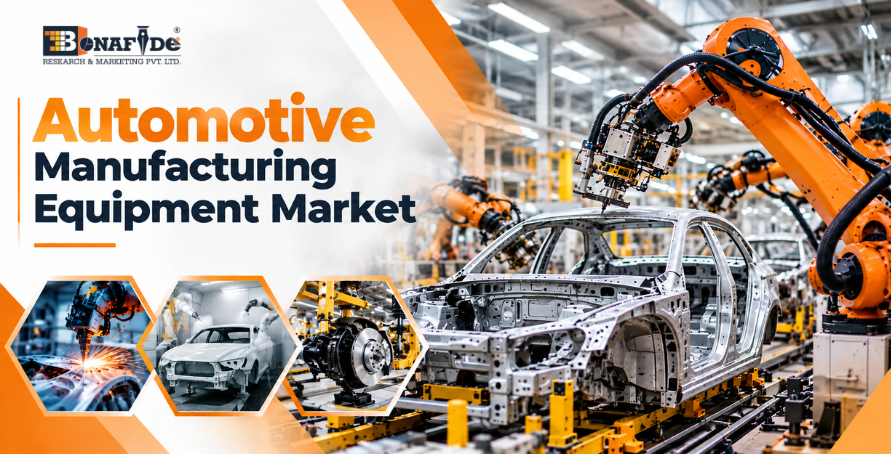
The global automotive manufacturing equipment market has progressed steadily in recent years, propelled by rising vehicle production, rapid electrification, and continuous technological advancements that enhance efficiency, precision, and scalability. Governments and industry bodies worldwide are supporting advanced manufacturing through initiatives aimed at clean energy, electric mobility, and industrial modernization. Regulatory frameworks and incentives encourage automakers to adopt automated, energy-efficient, and flexible production systems. Innovation in
robotics, CNC machining, welding, painting, assembly, and inspection technologies has broadened application scopes across conventional, hybrid, and
electric vehicle platforms. Despite challenges such as high capital costs, skilled labor shortages, and diverse regional regulations, the market remains resilient due to sustained demand for passenger and
commercial vehicles,
lightweight materials, and
smart factory solutions. Increasing commitments to reduce carbon emissions and improve operational efficiency position automotive manufacturing equipment as a vital component of the future mobility ecosystem.
According to the research report, "Global Automotive Manufacturing Equipment Market Outlook, 2031," published by Bonafide Research, the Global Automotive Manufacturing Equipment Market Outlook was valued at more than USD 32.59 Billion in 2025, and expected to reach a market size of more than USD 44.04 Billion by 2031 with the CAGR of 5.28% from 2026-2031. Recent developments reveal a dynamic competitive landscape shaped by key players specializing in machining, assembly, robotics, painting, material handling, and inspection technologies. These companies continually refine product portfolios to meet evolving consumer and industrial demands. The value chain encompasses raw material suppliers, equipment manufacturers, distributors, system integrators, and end users, with transaction economics impacted by material costs, automation levels, and regional incentives. Consumer adoption trends highlight a preference for flexible, automated, and digitally monitored production lines, driven by energy cost awareness, quality requirements, and sustainability goals. Enterprise uptake is notable in passenger vehicle and electric vehicle manufacturing, motivated by regulatory pressures, volume demands, and operational efficiency. Investment landscapes are bolstered by government-backed green financing, EV incentives, and industrial modernization programs.
By Equipment Type, machining and cutting equipment remains the largest category, essential for producing precise, durable, and safety-critical components. Assembly line equipment follows as a major segment, enabling structured and efficient production flows. Robotics and automation equipment is the most dynamic category, expanding as manufacturers pursue higher precision, repeatability, and reduced manual intervention. Painting and coating equipment remains important for corrosion protection and
surface durability. Metal forming and stamping equipment supports the creation of strong, leak-resistant structures, while material handling equipment ensures safe movement of heavy components. Inspection and testing equipment is critical for quality assurance and safety compliance. Welding and joining equipment, though smaller, is indispensable for secure and leak-tight assembly. Overall, the equipment mix is gradually shifting toward automation, robotics, and advanced material handling, while traditional machining and forming remain foundational.
By Mode of Operation, automatic operation is the largest and most influential mode, accounting for the majority of automotive manufacturing equipment demand. It delivers high-speed, consistent, and precise production with minimal manual intervention. Automatic systems integrate seamlessly with robotics, sensors, programmable logic controllers, and
digital monitoring, allowing manufacturers to achieve tighter tolerances and handle complex geometries. Semiautomatic operation remains relevant for specialized, low-volume, or transitional production needs, but it is gradually losing share to fully automatic systems. The shift toward smart factories and Industry 4.0 further accelerates adoption of automatic equipment, as it can be networked, monitored in real time, and optimized through data analytics.
By Vehicle Type, passenger vehicles represent the largest and most influential segment, driven by high production volumes, short model cycles, and intense competition. This category includes sedans, hatchbacks, SUVs, crossovers, and electric cars, all requiring extensive machining, assembly, painting, welding, and inspection. Commercial vehicles form a significant but smaller segment, including trucks, buses, and specialty vehicles used in
logistics, construction, and public transit. Their production emphasizes durability, load capacity, and long service life, requiring heavy-duty equipment and specialized processes. The push toward electrification is affecting both segments, with electric vehicles creating new demands for
battery housing production, lightweight structures, and
thermal management systems.
Regionally, Asia-Pacific represents the leading market for automotive manufacturing equipment, supported by massive vehicle production volumes, rapid industrialization, and continuous investment in advanced manufacturing technologies. China is the primary demand center, with extensive vehicle assembly; component manufacturing, battery production, and EV supply chains. Japan and South Korea contribute through mature automotive ecosystems, advanced robotics, and precision engineering. India is emerging as a major growth market, driven by rising vehicle demand, government manufacturing initiatives, and electric mobility investment. Southeast Asia adds demand through growing assembly operations and export-oriented production. Although regulatory differences and infrastructure maturity create uneven growth across countries, Asia-Pacific is expected to remain the leading region well into the next decade.
Challenges such as high initial investment, skilled labor shortages, and complex installation requirements remain, yet increasing global commitments to reduce carbon emissions and adopt sustainable manufacturing practices position automotive manufacturing equipment as a vital component in the future mobility mix. The market is poised for sustained long-term growth, driven by automation, electrification, and the ongoing modernization of vehicle production worldwide.















 We are friendly and approachable, give us a call.