The Global Cryogenic Tank Market is undergoing significant transformation as industries increasingly require reliable technologies for the storage and containment of liquefied gases at extremely low temperatures.
Cryogenic tanks play a critical role across LNG and energy infrastructure,
industrial gases and chemicals, metals and heavy industries, healthcare and life sciences, electronics and
semiconductor manufacturing, aerospace, marine, research, and other advanced applications. The market includes large stationary cryogenic tanks, medium stationary cryogenic tanks, micro bulk and small cryogenic tanks, cryogenic transport tanks, and cryogenic ISO tank containers. Demand is evolving beyond conventional industrial-gas applications toward large-scale LNG infrastructure, hydrogen systems, advanced healthcare and life-science applications, semiconductor manufacturing, and aerospace and specialized research activities. Manufacturers are increasingly focusing on improved
insulation, pressure management, energy efficiency, automated controls,
digital monitoring, safety systems, and advanced materials to improve tank reliability and reduce cryogen losses. Large stationary cryogenic tanks represent a major market opportunity because LNG terminals, industrial-gas facilities, hospitals, laboratories, semiconductor plants, and energy projects require reliable storage capacity across the cryogenic supply chain. Cryogenic transport tanks and ISO containers are also gaining importance as cryogenic infrastructure becomes increasingly integrated and globalized. LNG remains a principal demand generator, supported by liquefaction, storage, transportation, regasification, power generation, marine fuel, and industrial applications. At the same time, liquid hydrogen is emerging as a strategically important growth opportunity as investment increases in hydrogen production, liquefaction, storage, transportation, mobility, aerospace, and energy applications. Asia-Pacific is emerging as a major growth center, supported by rapid industrialization, expanding LNG infrastructure, industrial-gas consumption, semiconductor manufacturing, healthcare investment, and increasing development of hydrogen and advanced manufacturing capabilities. Electrification and the transition toward lower-carbon energy systems are also creating new applications for cryogenic tank technologies, particularly in hydrogen and energy infrastructure, although conventional LNG and industrial-gas applications are expected to remain important throughout the forecast period.
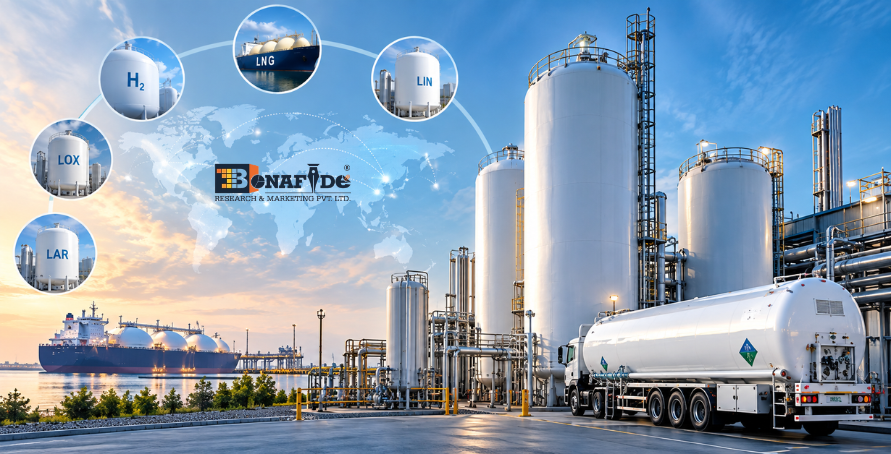
The Global Cryogenic Tanks Market was valued at over USD 11.28 Billion in 2025, driven by LNG, industrial gas and energy demand, projected to grow through 2031. Market estimates can vary depending on the definition of cryogenic tanks, the tank categories included, the treatment of transport and ISO containers, geographic coverage, and whether associated components are included in the market value. For this analysis, the market is defined around commercially manufactured tanks specifically designed for cryogenic storage and containment. The scope includes large stationary cryogenic tanks; medium stationary cryogenic tanks; micro bulk and small cryogenic tanks; cryogenic transport tanks; and cryogenic ISO tank containers. The cryogen scope covers
liquid nitrogen, liquid
oxygen, liquid argon, LNG/liquid methane, liquid hydrogen, liquid
helium, and other cryogenic fluids. This definition provides a focused assessment of the tanks directly associated with cryogenic-fluid storage while avoiding unnecessary double counting between related equipment categories.
The competitive landscape includes global and specialized cryogenic tank manufacturers serving LNG, industrial gases, healthcare, chemicals, metals, electronics, aerospace, hydrogen, and other applications. Competition is increasingly shifting from basic tank supply toward engineered solutions, energy efficiency, automation, safety, customization, lifecycle services, and digital monitoring capabilities. Manufacturers are strengthening portfolios across large stationary tanks, transport tanks, ISO containers, and small cryogenic vessels to address increasingly complex customer requirements. LNG infrastructure continues to represent a major commercial opportunity because large-scale facilities require integrated cryogenic storage across liquefaction, storage, transportation, and regasification. Industrial-gas applications provide a diversified demand base through air-separation plants, bulk-gas distribution, onsite gas systems, and manufacturing operations. Healthcare and life sciences are also generating specialized demand for liquid oxygen, liquid
nitrogen, cryogenic storage, bio banking, pharmaceutical applications, and cell and gene therapy. Semiconductor and electronics manufacturing is creating additional opportunities for high-purity gas handling, precise instrumentation, and highly reliable cryogenic storage infrastructure. Hydrogen is becoming an increasingly important strategic development area for the market. Liquid-hydrogen applications require specialized tanks capable of operating at temperatures near -253°C, creating opportunities for advanced storage tanks, insulation, and safety technologies. Aerospace and defense applications similarly require highly specialized cryogenic tank systems for propulsion, testing,
thermal management, and research. Meanwhile, digitalization is changing tank design as manufacturers integrate sensors, remote monitoring, automated controls,
predictive maintenance, safety alarms, and data-driven performance management into cryogenic storage systems. These technologies can improve operational visibility, reduce product losses, enhance safety, and optimize maintenance requirements. Overall, the global cryogenic tank market is positioned for sustained expansion through 2031, supported by LNG infrastructure development, industrial-gas consumption, healthcare and life-science expansion, semiconductor manufacturing, hydrogen investment, aerospace applications, and increasing demand for efficient and digitally monitored cryogenic storage systems. Asia-Pacific is expected to remain a key regional growth center, while North America and Europe continue to provide significant opportunities through LNG, industrial gases, healthcare, advanced manufacturing, hydrogen, and energy-transition investments. Direct sales are expected to remain the dominant channel for large engineered tank systems because of customization, technical integration, installation, commissioning, and lifecycle-service requirements, while distributors and online channels will remain more relevant for standardized tanks, replacement parts, and MRO products. These combined developments are expected to strengthen the strategic importance of cryogenic tanks across the global energy and industrial infrastructure landscape throughout the forecast period.















 We are friendly and approachable, give us a call.