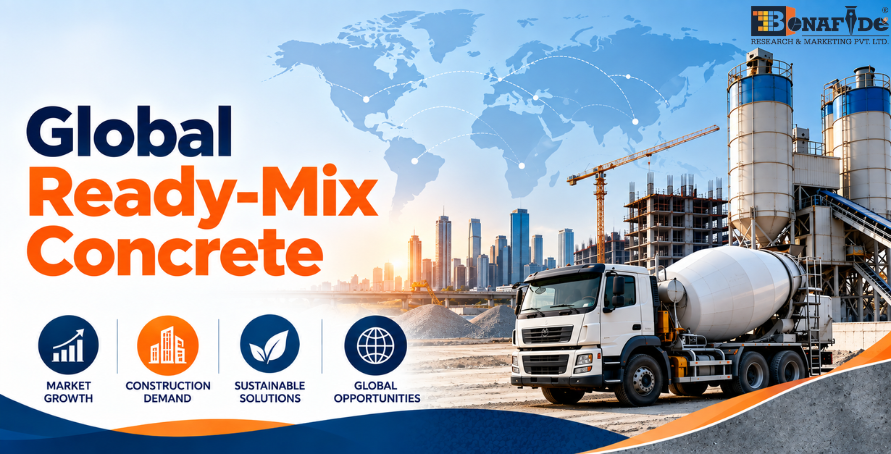
The Global Ready-Mix Concrete Market is expanding alongside construction activity across residential buildings, commercial developments, industrial facilities, transportation networks, utilities, energy projects, and public infrastructure. Ready-mix concrete is produced at centralized batching facilities and delivered to construction sites in a controlled and scheduled manner, helping contractors improve consistency, reduce on-site material handling, and coordinate large concrete placements. The scale of global construction provides a substantial underlying demand base. The Global
Cement and Concrete Association estimates that approximately 14.0 billion m? of concrete was produced globally in 2020, with around 40% associated with residential construction, illustrating the importance of housing within overall concrete consumption. UN DESA reports that cities were home to 45% of the global population of 8.2 billion in 2025, while two-thirds of population growth through 2050 is expected to occur in cities. These trends continue to create requirements for new housing, roads, public transport, drainage, utilities, commercial districts, and community infrastructure. UNEP reported that global building floor area reached 273 billion m? in 2024, increasing 1.7% during the year, with residential buildings representing 77% of total floor area. Asia Pacific provides the largest concentration of construction activity, while North America and Europe contribute through mature infrastructure and renovation markets. The Middle East, Africa, and Latin America are adding demand through urban expansion, housing, infrastructure, industrialization, and major development programmes.
According to the research report, "Global Ready-Mix Concrete Market Outlook, 2031," published by Bonafide Research, the Global Ready-Mix Concrete Market Outlook was valued at more than USD 590.00 Billion in 2025, and expected to reach a market size of more than USD 778.20 Billion by 2031 with the CAGR of 4.84% from 2026-2031. Competition across the industry extends from integrated cement and aggregates producers to dedicated ready-mix suppliers serving local and regional construction markets. Producers are increasingly focusing on operational efficiency, reliable delivery, technical support, sustainability, and application-specific formulations. Decarbonization is becoming a major industry priority as the Global Cement and Concrete Association targets net-zero concrete by 2050 and a 25% reduction in proportionate concrete-related CO? emissions by 2030 from its baseline pathway. This is encouraging greater use of supplementary cementitious materials, optimized concrete designs, alternative binders, recycled materials, carbon-utilization technologies, and environmental product declarations.
Digital dispatch, automated batching, real-time quality monitoring, and data-driven mix optimization are also becoming more relevant as projects increase in scale and complexity. Raw-material availability remains important because cement, aggregates, water, supplementary materials, and admixtures must be sourced and delivered efficiently. Ready-mix production is generally localized because fresh concrete has a limited workable period, making plant location and transportation efficiency critical to project economics. Market participants are therefore strengthening regional production and distribution capabilities while investing in lower-carbon products, higher-performance formulations, and technology-enabled supply systems.
Transit Mixed Concrete Represents the Largest Product Type Segment Globally, Supported by Its Established Truck-Based Delivery Model, Centralized Production, and Broad Suitability Across Residential, Commercial, Industrial, and Infrastructure Projects.
Transit mixed concrete represents the largest product type segment globally because it combines centralized batching with flexible truck-based delivery to construction sites. The approach is widely applicable to residential foundations, commercial buildings, industrial facilities, roads, bridges, pavements, utilities, and other construction activities where concrete needs to arrive within a controlled placement period. Its established production model enables producers to manage material proportions at the batching plant while using mixer trucks to maintain the required consistency during transportation. The scale of the North American industry illustrates the maturity of this delivery model: the National Ready Mixed Concrete Association reports approximately 8,000 ready-mix plants in the United States, and its industry-average EPD indicates that more than 85% of participating plants use truck-mixed or transit-mix production. Similar truck-based delivery systems are used throughout Europe, Asia Pacific, Latin America, and the Middle East, although operating practices vary by local standards and project conditions. Transit mixing is especially useful in urban markets where construction sites have limited space for on-site batching and where deliveries must be synchronized with reinforcement, formwork, pumping, and placement activities. Established fleets also allow suppliers to serve multiple projects from regional plants rather than maintaining separate production facilities at every construction site. Continued housing development, infrastructure construction, industrial investment, and urban expansion therefore sustain broad demand for transit mixed concrete.
High-Performance Concrete Represents the Fastest-Growing Grade Segment Globally, Supported by Rising Requirements for Structural Efficiency, Durability, Service Life, and Lower-Carbon Construction.
High-performance concrete is the fastest-growing grade segment as project owners and engineers increasingly require concrete that delivers higher structural capability together with durability, long service life, and improved resistance to demanding environmental conditions. Applications include high-rise buildings, bridges, tunnels, industrial facilities, transport infrastructure, marine structures, energy projects, and large foundations. Advanced formulations can combine optimized aggregates, supplementary cementitious materials, chemical admixtures, controlled water content, and alternative binders to achieve specified performance. The global shift toward lower-carbon construction is reinforcing this development because project teams increasingly seek to reduce cement and clinker intensity without compromising structural performance. The Global Cement and Concrete Association identifies concrete optimization, clinker reduction, alternative materials, carbon capture, and improved construction practices as important elements of its net-zero pathway. Technical development is also expanding beyond conventional strength requirements. The Asian Concrete Federation’s 2026 programme includes ultra-high-performance concrete, low-carbon binders, recycled materials, durability, seismic performance, AI, machine learning, and life-cycle assessment, reflecting the broader movement toward advanced concrete engineering. Infrastructure projects provide particularly strong opportunities because bridges, railways, highways, tunnels, ports, and energy facilities must often operate under high loads and demanding exposure conditions. As specifications increasingly consider durability, permeability, environmental performance, and service life alongside compressive strength, high-performance formulations are gaining broader application across global construction markets.
Residential Represents the Largest Application Segment Globally, Supported by Housing Requirements, Urbanization, New Community Development, and the Extensive Use of Concrete Across Residential Construction.
Residential construction represents the largest application segment globally because concrete is required throughout housing development, from foundations and slabs to structural walls, columns, parking areas, driveways, drainage, and supporting community infrastructure. The GCCA estimates that residential construction accounted for approximately 40% of global concrete production in 2020, providing a clear indication of the sector’s importance to overall concrete demand. UN-Habitat estimates that 2.8 billion people experience inadequate housing, including approximately 1.1 billion people living in informal settlements and slums, highlighting the continuing need for new and improved housing. Urbanization is further reinforcing this requirement, with UN DESA reporting that cities contained 45% of the global population in 2025 and that two-thirds of future population growth is expected to occur in cities. Asia Pacific contributes substantially through apartment construction, planned communities, and government-backed housing programmes, while Africa and Latin America face significant urban housing requirements. The Middle East is developing residential districts alongside large master-planned and tourism projects, while North America and Europe generate demand through new housing, multifamily development, replacement construction, and selected renovation activity. Residential projects can also create recurring requirements for roads, utilities, drainage, schools, community facilities, and public spaces. The breadth of these applications provides ready-mix producers with a diversified customer base ranging from individual residential projects to large multi-phase housing developments.
New Construction Represents the Fastest-Growing Construction Type Segment Globally, Supported by Urban Expansion, Housing Development, Industrial Capacity Addition, and Large Infrastructure Programmes.
New construction represents the fastest-growing construction type segment as expanding cities and economies continue to add housing, commercial properties, industrial facilities, transport systems, utilities, energy infrastructure, and public assets. UNEP reports that the global building floor area reached 273 billion m? in 2024, growing 1.7% in a single year, while residential buildings accounted for 77% of total floor area. The organization has also highlighted that around half of the buildings expected to exist in 2050 have yet to be built or renovated, indicating continued construction requirements over the longer term. Greenfield projects create concrete demand from foundations through structural frames, floors, pavements, drainage systems, utilities, equipment bases, and external infrastructure. Asia Pacific contributes strongly through high-speed rail, highways, industrial parks, housing,
logistics centres, and urban development, while the Middle East is adding new residential, tourism, commercial, and infrastructure districts. Africa and Latin America continue developing housing, energy, water, transport, and industrial infrastructure, while North America and Europe add new demand through data centres, manufacturing, energy projects, logistics facilities, and selected infrastructure expansion. New construction also allows project teams to incorporate modern concrete requirements during the original design, including lower-carbon materials, durability provisions, environmental documentation, digital quality systems, and advanced structural performance. This creates structured procurement opportunities for ready-mix producers and can support dedicated production, fleet planning, laboratory testing, and scheduled delivery arrangements for major projects.
Asia Pacific Represents the Leading Regional Market for Ready-Mix Concrete Globally, Supported by Its Large Construction Base, Rapid Urbanization, Infrastructure Expansion, Industrial Investment, and Concentration of Major Concrete-Consuming Economies.
Asia Pacific represents the leading regional market for ready-mix concrete because it combines large-scale residential construction, extensive infrastructure development, industrial expansion, and continued urbanization across several major economies. China provides an exceptionally large construction base, with approximately 2.288 billion m? of ready-mixed concrete produced in 2025, while national infrastructure activity included 3,109 km of new railway lines, including 2,862 km of high-speed rail, and 8,699 km of new and rebuilt highways. India provides another major demand base through housing, roads, railways, metro systems, industrial corridors, and urban development. Japan, South Korea, Indonesia, Vietnam, Thailand, Australia, and other regional economies contribute through residential, commercial, manufacturing, logistics, energy, and infrastructure projects. UN DESA reported that 19 of the world’s 33 megacities were located in Asia in 2025, highlighting the region’s exceptional concentration of large urban construction markets. The region also faces substantial long-term infrastructure requirements, with ADB estimating $26 trillion of infrastructure investment needs across developing Asia and the Pacific for 2016–2030 under its climate-adjusted scenario. This combination of population scale, urban expansion, industrialization, housing requirements, and infrastructure investment provides a broad base for ready-mix concrete consumption. Regional construction markets are simultaneously adopting lower-carbon materials, advanced concrete technologies, digital production systems, and performance-focused specifications, further expanding opportunities for established producers and specialist suppliers across the APAC construction ecosystem.













 We are friendly and approachable, give us a call.