The Global
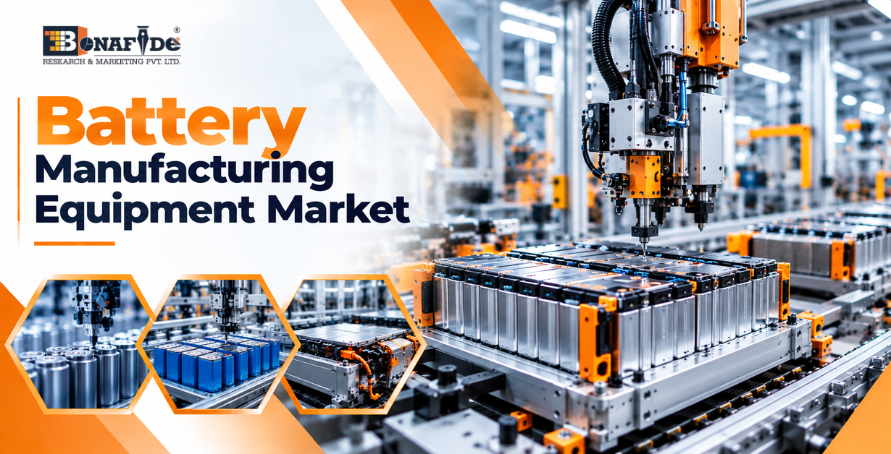
Battery Manufacturing Equipment Market is being shaped by increasing battery deployment, manufacturing capacity expansion, supply-chain localization, and demand for more efficient production technologies. Battery manufacturing equipment covers the machinery and integrated systems used for electrode preparation, cell assembly, electrolyte filling, cell finishing, formation and testing, and module and pack assembly. According to the International Energy Agency (IEA), global electric-vehicle battery deployment reached approximately 1.2 TWh in 2025, an increase of almost 30% compared with the previous year. Global
lithium-ion battery manufacturing capacity also exceeded 4 TWh by the end of 2025, representing growth of approximately 30% year-on-year. These developments support demand for new production lines, capacity expansion and manufacturing upgrades, although installed capacity does not translate directly into equipment revenue. China remains the largest manufacturing hub, while Europe, North America and Southeast Asia are expanding their roles in battery production. Demand is also broadening beyond automotive applications as battery storage becomes increasingly important for electricity systems and
renewable energy integration. Manufacturers are prioritizing equipment that can improve production throughput, reduce defects, maintain consistent cell quality and support different chemistries and cell formats. At the same time, high capital requirements, project delays and differences in factory utilization are influencing investment decisions. The market is therefore being shaped not only by battery demand but also by manufacturers' willingness and ability to convert demand forecasts into operational production capacity.
According to the research report, "Global Battery Manufacturing Equipment Market Outlook, 2031," published by Bonafide Research, the Global Battery Manufacturing Equipment Market Outlook was valued at more than USD 18.33 Billion in 2025, and expected to reach a market size of more than USD 57.01 Billion by 2031 with the CAGR of 21.36% from 2026-2031. Competition in the Global Battery Manufacturing Equipment Market is increasingly focused on process precision, automation, equipment reliability, production-line integration and technical support. Suppliers serve different stages of battery manufacturing, from electrode coating and calendaring to cell assembly, formation and testing, with specialized machinery often configured to meet individual manufacturers' process requirements. Equipment providers compete through production speed, manufacturing yield, energy efficiency, quality-control capabilities, delivery schedules, commissioning expertise and after-sales support. Industry developments also demonstrate growing interest in alternative manufacturing processes. In June 2025, Koenig & Bauer and Volkswagen subsidiary PowerCo completed a proof of concept for a solvent-free dry-electrode coating system, with further pilot-line development planned to assess its suitability for industrial-scale production. In February 2026, QuantumScape inaugurated its automated Eagle Line for solid-state battery pilot production, intended to support customer sampling,
testing and technology integration rather than indicating widespread commercial-scale manufacturing. Government initiatives are also supporting manufacturing investment. The United States Department of Energy's Battery Manufacturing and Recycling Grants programme has a $3 billion funding allocation designed to support domestic battery manufacturing, recycling and the retooling of existing facilities. These developments highlight opportunities in specialized production equipment, process engineering and factory modernization. However, dry coating and solid-state production remain dependent on further technical validation and scalable manufacturing economics. The competitive landscape is also influenced by supply-chain concentration, as China accounts for more than 80% of global lithium-ion battery manufacturing capacity. Equipment suppliers seeking opportunities outside established manufacturing hubs must therefore demonstrate technical competitiveness, reliable local support and the ability to integrate machinery into new production environments.
Electrode Manufacturing Equipment represents a core segment of the Global Battery Manufacturing Equipment Market because electrode preparation is fundamental to cell quality, production consistency and manufacturing yield. The process encompasses material mixing, slurry preparation, coating, drying, calendaring, slitting and inspection, with each stage affecting electrode thickness, density, material distribution and
surface characteristics. These requirements drive demand for precision coating systems, controlled drying equipment, calendaring machinery, automated handling and inline inspection technologies. Large battery factories require equipment capable of maintaining consistent quality at high production volumes while controlling material wastage and operating costs. China benefits from its extensive battery manufacturing ecosystem, while expansion in other regions creates demand for equipment installation, integration and process qualification. Equipment configurations differ according to chemistry, electrode materials, cell format and production capacity, meaning suppliers must balance throughput with flexibility and product quality. Dry-electrode processing is an emerging development because it can eliminate the conventional solvent-based electrode drying stage, potentially reducing energy requirements and simplifying parts of the production process. Nevertheless, industrial scaling, coating performance, production yield and cost competitiveness remain important considerations. Cell assembly, finishing, formation and testing equipment also remain essential to the complete production sequence, and market opportunities are distributed across the full manufacturing line. Electrode manufacturing equipment should therefore be assessed as a major equipment category whose revenue contribution depends on actual procurement, project specifications and machinery pricing rather than technical importance alone.
Solid-State Batteries Represent an Emerging High-Growth Technology Opportunity as Manufacturers Develop Next-Generation Production Processes. Unlike conventional lithium-ion batteries that use liquid electrolytes, solid-state designs incorporate solid electrolyte materials and require manufacturing approaches suited to their specific cell architecture. Potential equipment requirements include specialized material processing, electrolyte-layer fabrication, precision coating, lamination, pressing, controlled layer alignment and advanced cell testing. These requirements create opportunities for equipment developers capable of delivering repeatable processes, consistent interfaces and reliable manufacturing quality. Japan, South Korea, China, Europe and North America are active in solid-state battery research and production development, although technologies differ in maturity and commercial readiness. QuantumScape's Eagle Line, inaugurated in February 2026, illustrates the progression toward automated pilot production and customer testing, but does not establish that solid-state batteries have reached widespread high-volume manufacturing. As development progresses, dedicated equipment demand could grow quickly from a comparatively small initial base. The timing and scale of that growth depend on successful industrial qualification, stable production yields, manufacturing throughput, cell durability and commercially competitive production costs. Solid-state battery equipment therefore represents a prospective growth opportunity rather than a current replacement for the machinery used in established lithium-ion manufacturing. In the near term, conventional lithium-ion production remains the principal basis for equipment demand, while investments in solid-state pilot lines and process development create specialized opportunities for suppliers.
Automotive and Electric Vehicles Remain the Leading Application for Battery Manufacturing Equipment Because Vehicle Electrification Requires Large Volumes of Cells Produced to Stringent Performance, Safety and Quality Standards. The IEA reported that electric vehicles accounted for more than 70% of global battery deployment in 2025, with EV battery deployment reaching approximately 1.2 TWh during the year.
Automotive battery programmes create demand throughout the manufacturing process, including electrode preparation, cell assembly, electrolyte filling, formation, testing and module and pack assembly. Equipment suppliers must accommodate different lithium-ion chemistries, including lithium iron phosphate and nickel-containing technologies, as well as cylindrical, prismatic and pouch cell formats. Automotive manufacturers also require traceability, automated inspection, precise joining, controlled formation processes and reliable end-of-line testing to meet production and qualification requirements. China holds a leading position in automotive battery production, while Europe, North America, Japan and South Korea contribute through vehicle manufacturing, battery development and investments in regional supply chains. Energy storage systems provide an additional source of demand. The IEA reported that global battery storage deployment reached 108 GW of new capacity in 2025, 40% more than in 2024. This growth supports manufacturing investment for storage-oriented batteries and associated assembly and testing systems. Although automotive and EVs remain the primary application to prioritize because of their substantial battery deployment, actual equipment revenue by application depends on production investment, procurement schedules and the equipment required for each battery programme. Energy storage, consumer electronics and industrial batteries provide complementary opportunities across the global market.
Asia-Pacific Leads the Global Battery Manufacturing Equipment Market Through China's Manufacturing Dominance, Established Supplier Networks and Expanding Battery Production Across the Region. China accounted for more than 80% of global lithium-ion battery manufacturing capacity at the end of 2025, according to the IEA, supporting its position as the region's principal center for battery production, equipment procurement and manufacturing expertise. The country benefits from extensive cell production, integrated materials supply chains and a broad ecosystem of machinery and component suppliers. Japan and South Korea contribute through established battery manufacturers, engineering capabilities and investment in next-generation technologies, while India and Southeast Asian economies are developing their roles in battery manufacturing and related supply chains. Growth in regional production creates demand for electrode processing, cell assembly, formation and testing, module and pack assembly, automation and quality-control equipment. Asia-Pacific also benefits from its established electric-vehicle manufacturing base and the increasing need for batteries used in stationary storage. However, opportunities differ substantially across markets: China has a large established manufacturing base, while emerging production centers rely more heavily on new projects, policy support, technology partnerships and successful factory ramp-up. North America and Europe are also expanding manufacturing capacity as companies seek regional supply chains and proximity to automotive customers. According to the IEA, lithium-ion manufacturing capacity in both the United States and European Union grew by approximately 50% in 2025, even as China's manufacturing base remained considerably larger. These investments create opportunities for equipment suppliers across regions, but project execution, factory utilization, local technical support and procurement timing will determine how much announced capacity translates into actual equipment sales. Overall, the market's direction reflects a combination of established manufacturing demand in Asia-Pacific, regional capacity expansion, growing energy storage requirements and the gradual development of advanced production technologies.










 We are friendly and approachable, give us a call.