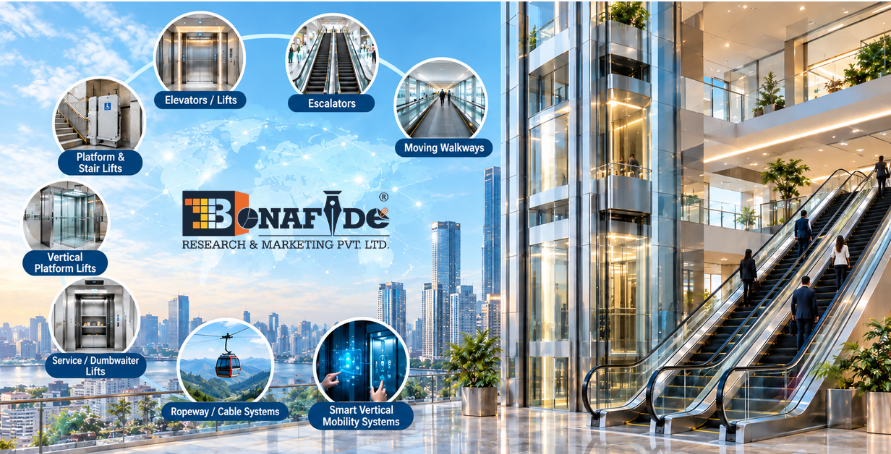
The Global Vertical Mobility Market is undergoing significant transformation as cities become increasingly dense and buildings continue to grow taller, creating greater demand for efficient vertical transportation solutions. Vertical mobility systems play a critical role across residential buildings, commercial complexes, offices, shopping centers, hotels, hospitals, industrial facilities, airports, railway stations, metro systems, and other infrastructure applications. The market includes elevators and lifts, escalators, moving walkways, stair lifts, platform and vertical platform lifts, service and dumbwaiter lifts, specialized vertical transport systems, and ropeway or cable systems. Demand is expanding beyond conventional
elevator installations toward smart buildings, high-rise developments, transportation infrastructure, accessibility solutions, modernization projects, and specialized mobility applications. Manufacturers are increasingly focusing on energy efficiency, compact designs, advanced safety systems, automation,
digital monitoring,
predictive maintenance, and improved passenger experience. Elevators and lifts represent a major market opportunity because they are essential across residential, commercial, institutional, industrial, and high-rise applications. Escalators and moving walkways are also gaining importance as urban transportation networks, airports, shopping centers, and other high-traffic facilities expand. Machine-room-less systems are being increasingly adopted where space optimization is important, while smart and IOT-enabled technologies are creating opportunities for connected equipment and data-driven maintenance. Traction technology remains a principal technology platform, particularly for medium- and high-rise buildings, while hydraulic systems continue to serve selected low- and mid-rise applications. High-capacity vertical mobility systems are important for commercial, industrial, healthcare, transportation, and infrastructure facilities requiring the movement of large numbers of passengers or heavy loads. Maintenance and repair services represent an important recurring opportunity as the global installed base expands and building owners increasingly focus on equipment reliability, safety, modernization, and lifecycle management. Asia-Pacific is a major growth center for the vertical mobility market, supported by rapid urbanization, high-rise construction, commercial development, infrastructure investment, metro expansion, airport development, and modernization activities across China, India, Japan, South Korea, Australia, and Southeast Asia. North America and Europe also provide significant opportunities through building modernization, replacement demand, smart-building development, accessibility requirements, and transportation infrastructure investment.
According to the research report, "Global Vertical Mobility Market Outlook, 2031," published by Bonafide Research, the Global Vertical Mobility Market was valued at more than USD 89.14 Billion in 2025.
Market estimates can vary depending on the definition of vertical mobility, the equipment categories included, geographic coverage, and whether installation, modernization, maintenance, and related services are included in the market value. For this analysis, the market is defined around commercially deployed vertical transportation equipment and associated services. The scope includes elevators and lifts, escalators, moving walkways, stair lifts, platform and vertical platform lifts, service and dumbwaiter lifts, specialized vertical transport systems, and ropeway or cable systems. The competitive landscape includes global and specialized elevator,
escalator, lift, and vertical transportation manufacturers serving residential, commercial, industrial, institutional, transportation, infrastructure, and specialized applications. Competition is increasingly shifting from conventional equipment supply toward engineered mobility solutions, energy efficiency, customization, safety, digital connectivity, modernization, and lifecycle services. Manufacturers are strengthening portfolios across
passenger elevators, high-capacity elevators, escalators, moving walkways, accessibility lifts, and specialized transportation systems to address increasingly diverse customer requirements.
Commercial construction continues to represent a major demand opportunity because offices, shopping centers, hotels, mixed-use developments, and other commercial properties require reliable and efficient vertical transportation. Residential applications provide another important demand base through high-rise apartments, condominiums, and urban housing developments. Transportation and infrastructure projects are creating additional opportunities as airports, metro systems, railway stations, and public facilities require high-capacity elevators, escalators, and moving walkways capable of handling substantial passenger volumes. Healthcare, institutional, and industrial facilities also generate specialized demand for vertical mobility systems. Hospitals require passenger, bed, and service elevators, while manufacturing facilities, warehouses, and industrial plants utilize specialized lifts for personnel and material movement. Accessibility requirements are further supporting demand for stair lifts and platform lifts across residential, commercial, healthcare, and public facilities.
Digitalization is changing vertical mobility system design as manufacturers increasingly integrate sensors, remote monitoring, automated diagnostics, predictive maintenance, connected controls, and real-time performance management. These technologies can improve equipment availability, enhance safety, identify potential faults at an early stage, and optimize maintenance schedules. Energy-efficient motors, regenerative technologies, LED systems, intelligent controls, and
smart building integration are also becoming increasingly important as building owners seek to reduce energy consumption and improve operational efficiency. Modernization represents another significant opportunity for market participants as aging
elevators and escalators require refurbishment, component replacement, control-system upgrades, safety improvements, and complete equipment replacement. Maintenance providers are increasingly combining traditional service capabilities with digital monitoring and predictive maintenance solutions to improve lifecycle performance and reduce unplanned downtime.
Overall, the Global Vertical Mobility Market is positioned for sustained development through 2031, supported by urbanization, high-rise construction, commercial and residential development, transportation infrastructure investment, building modernization, accessibility requirements, and increasing adoption of smart and energy-efficient technologies. Asia-Pacific is expected to remain a key regional growth center, while North America and Europe continue to provide opportunities through modernization, replacement, smart-building development, and infrastructure investment. Direct sales and project-based channels remain important for large engineered systems because of customization, installation, commissioning, and technical integration requirements, while service networks, distributors, and aftermarket channels remain important for maintenance, spare parts, modernization, and replacement activities. These combined developments are expected to strengthen the strategic importance of vertical mobility systems across the global building and transportation infrastructure landscape throughout the forecast period.

















 We are friendly and approachable, give us a call.