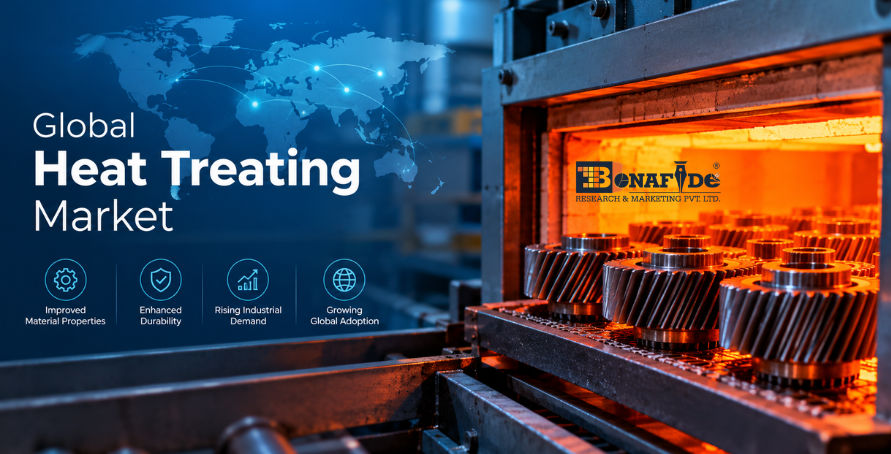
The Global Heat Treating Market is expanding as manufacturers across automotive, machinery, metalworking, energy, aerospace, defense,
construction equipment, mining, and other industrial sectors increasingly rely on controlled thermal processing to improve the mechanical and metallurgical properties of components. Heat treating includes hardening and tempering, carburizing and case hardening, annealing, normalizing, stress relieving, and other specialized thermal processes applied to steel, cast iron,
aluminum, titanium, nickel-based alloys, and other engineering materials. Demand is closely connected to global manufacturing activity because
gears, shafts, bearings,
axles, fasteners, transmission components,
cutting tools, dies, rollers, structural components, and other industrial parts require specific combinations of hardness, toughness, wear resistance, fatigue strength, and dimensional stability. Global
crude steel production remained approximately 1.85 billion tonnes in 2025, providing a substantial material base for downstream heat-treatment applications, while global vehicle production reached approximately 96.4 million units during the same year. Asia Pacific represents the largest regional market, supported by China's extensive automotive and steel industries, India's expanding manufacturing base, Japan's precision-engineering ecosystem, South Korea's automotive and machinery industries, and the growing manufacturing capabilities of Southeast Asia. North America and Europe continue to generate significant demand through automotive, aerospace, defense, machinery, energy, and specialized engineering, while South America is supported by steel, mining, agriculture, automotive, and
heavy equipment. The Middle East and Africa are developing additional opportunities through industrial localization, mining, steel, energy equipment, infrastructure, and defense manufacturing. Across markets, manufacturers are increasingly seeking tighter temperature control, repeatable treatment cycles, lower distortion, improved energy efficiency, automated material handling, and
digital process monitoring. Electrification of industrial heating is also becoming more relevant as manufacturers modernize furnace fleets and seek improved process control and energy management. The growing complexity of engineered components is further increasing the importance of heat treatment as an integrated manufacturing step rather than simply a downstream finishing operation.
According to the research report, "Global Heat Treating Market Outlook, 2031," published by Bonafide Research, the Global Heat Treating Market Outlook was valued at more than USD 109.49 Billion in 2025, and expected to reach a market size of more than USD 138.71 Billion by 2031 with the CAGR of 4.12% from 2026-2031. The Global Heat Treating Market is being shaped by automotive production, industrial machinery manufacturing, steel consumption, component lightweighting, equipment modernization, aerospace and defense manufacturing,
mining equipment demand, and the increasing need for reliable high-performance components. Competition in the Global Heat Treating Market is increasingly focused on process consistency, thermal uniformity, equipment efficiency, automation, metallurgical expertise, quality
certification, and the ability to provide application-specific treatment solutions. The market includes captive heat-treatment operations maintained by automotive and industrial manufacturers as well as specialized commercial heat-treatment service providers serving multiple component manufacturers. Equipment suppliers are also expanding their portfolios across electrically heated furnaces, atmosphere-controlled furnaces, vacuum systems, induction equipment, continuous treatment lines, quenching systems, and digitally integrated thermal-processing equipment. Electrically heated furnaces are gaining particular importance because programmable temperature control, multi-zone heating, automated monitoring, and integration with production-control systems support consistent treatment results. Raw materials and energy remain important cost factors, with electricity and fuel consumption directly influencing the operating economics of heat-treatment facilities. Manufacturers are therefore investing in improved furnace
insulation, heat recovery, optimized cycle times, efficient heating elements, automated controls, and preventive maintenance. Technology development is moving toward digital temperature monitoring, automated recipe management, furnace uniformity control, atmosphere monitoring, real-time data acquisition, robotic loading and unloading, and traceable treatment records. These developments are particularly important for automotive, aerospace, defense, and other industries where component specifications and process documentation are tightly controlled. The market is also benefiting from increasing localization of manufacturing supply chains, as manufacturers seek qualified thermal-processing capabilities closer to
forging, casting, machining, and assembly operations. This is strengthening opportunities for both captive facilities and commercial heat-treatment companies capable of providing specialized processing, metallurgical testing, quality assurance, and application engineering.
Steel represents the largest material segment globally, supported by its extensive use across automotive, machinery, construction equipment, energy, mining, metalworking, transportation, and
general industrial manufacturing. Global crude steel production reached approximately 1.85 billion tonnes in 2025, with China, India, Japan, the United States, South Korea, and other major industrial economies accounting for substantial production volumes. Heat treatment is widely applied to carbon steels, alloy steels, tool steels, stainless steels, and other grades to achieve specific mechanical and metallurgical characteristics. Automotive components such as gears, shafts, bearings, axles, fasteners, transmission parts, steering components, and suspension systems represent major applications, while machinery and industrial equipment require treated rollers, dies, cutting tools, gears, pins, wear components, and power-transmission parts. Mining, agriculture, construction, and material-handling equipment further increase demand for wear-resistant and high-strength steel components. Steel's extensive grade diversity also supports multiple treatment processes, including hardening and tempering, carburizing, annealing, normalizing, stress relieving, and specialized atmosphere-controlled processing. Although aluminum, titanium, nickel alloys, and other advanced materials are gaining importance in aerospace, defense, energy, and lightweight applications, steel continues to provide the broadest overall heat-treatment base because of its enormous production volume and extensive use across industrial components.
Automotive represents the largest end-user segment globally, supported by high vehicle production volumes and the extensive use of heat-treated components throughout vehicle systems. Global vehicle production reached approximately 96.4 million units in 2025, creating recurring demand for gears, shafts, bearings, transmission components, axles, fasteners, steering parts, braking components, suspension systems, and other precision-engineered metallic parts. Heat treatment is particularly important in drivetrain and power-transmission applications where components must withstand repeated mechanical loads, friction, vibration, and temperature changes. Asia Pacific provides the largest automotive production base, with China producing approximately 34.53 million vehicles and India approximately 6.49 million vehicles in 2025. Electric-vehicle development is changing the component mix but does not eliminate heat-treatment requirements, as electric vehicles continue to require reduction gears, shafts, bearings, differentials, braking systems, steering components, fasteners, and other metallic parts. Automotive manufacturers are increasingly demanding tighter dimensional control, consistent hardness profiles, lower distortion, improved fatigue performance, and complete process traceability. These requirements are supporting continued investment in hardening and tempering, carburizing, induction treatment, controlled-atmosphere processing, automated quenching, and digitally monitored furnace systems. The combination of very high production volumes, extensive global component supply chains, continuous model development, and stringent component reliability requirements makes automotive the largest end-user segment within the global heat-treatment market.
Hardening and Tempering represents the largest process segment globally because of its broad applicability across steel components used in transportation, machinery, construction, agriculture, mining, energy, tooling, and general engineering. The process provides a controlled combination of hardness, strength, toughness, and wear resistance, making it suitable for gears, shafts, axles, pins, rollers, fasteners, dies, cutting tools, and numerous power-transmission components. Hardening and tempering can be performed through batch furnaces, continuous systems, atmosphere-controlled equipment, vacuum systems, or induction-based heating depending on component requirements and production volumes. The process remains particularly important in automotive manufacturing because high-volume component production requires repeatable treatment results across large batches. Machinery manufacturers also rely on the process for components exposed to mechanical loading, impact, friction, and repeated operating cycles. Replacement and maintenance components create an additional recurring demand base because treated parts are frequently required to restore or improve the performance of existing industrial equipment. Manufacturers are increasingly integrating hardening and tempering with automated temperature control, controlled quenching, atmosphere monitoring, distortion management, hardness testing, and digital process records. While specialized processes such as carburizing, nitriding, vacuum treatment, and hot isostatic processing are expanding in selected high-performance applications, hardening and tempering retains the broadest component addressable base. Its compatibility with numerous steel grades, established industrial infrastructure, and applicability across both high-volume and lower-volume manufacturing supports its position as the leading process segment.
Electrically Heated Furnaces represent the largest equipment segment globally, supported by their precise temperature control, programmable operation, broad processing flexibility, and compatibility with increasingly automated manufacturing environments. These furnaces can be configured for hardening, tempering, annealing, normalizing, stress relieving, aging, solution treatment, and other thermal processes depending on the furnace design and atmosphere requirements. Electrical heating systems can incorporate multiple heating zones, programmable controllers, thermocouples, sensors, data acquisition systems, and automated material-handling equipment, enabling manufacturers to maintain repeatable treatment conditions across production batches. This is particularly important for automotive and machinery manufacturers where component specifications must remain consistent across high production volumes. Aerospace, defense, tooling, medical, energy, and precision-engineering applications also benefit from the ability to control heating rates, soaking temperatures, cooling profiles, and atmosphere conditions. Modern electrically heated furnaces are increasingly being integrated with
digital manufacturing systems that record process parameters and connect treatment information with individual batches or component identifiers. Manufacturers are also focusing on furnace insulation, heating-element efficiency, cycle-time optimization, heat recovery, and automated controls to improve energy performance. The equipment's ability to support controlled-atmosphere treatment further expands its applicability to components requiring limited oxidation, clean surfaces, or specific metallurgical conditions. Electrically heated furnaces therefore serve both new production facilities and modernization programs in established manufacturing plants, making them a central equipment category within the global heat-treatment industry.
Asia Pacific represents the largest regional market for Heat Treating, supported by its exceptional concentration of steel production, automotive manufacturing, industrial machinery, metalworking,
shipbuilding, energy equipment, and component manufacturing. China provides the largest individual market, supported by an integrated industrial ecosystem spanning steel, automotive, machinery, construction equipment, shipbuilding, energy, defense, and general engineering. India is also strengthening its heat-treatment demand base through expanding automotive production, steel capacity, railway manufacturing, defense production, heavy engineering, and industrial machinery. Japan and South Korea contribute significant demand through automotive,
robotics,
machine tools,
semiconductor equipment, shipbuilding, precision engineering, and advanced materials, while Thailand, Vietnam, Indonesia, Malaysia, and other Southeast Asian economies are developing additional opportunities through automotive, electronics, machinery, and industrial supply-chain localization. The region's automotive production base is particularly significant, with Asia Pacific accounting for more than 60% of global vehicle production in 2025. The large installed base of steel-processing and component-manufacturing facilities creates demand for conventional hardening and tempering alongside carburizing, annealing, induction treatment, nitriding, controlled-atmosphere processing, and other specialized technologies. The region is also becoming increasingly important for advanced heat-treatment equipment as manufacturers move toward automation, tighter process control, digital monitoring, and higher-value component production. The combination of high manufacturing volumes, continuing industrial investment, growing component localization, and increasing technological sophistication provides Asia Pacific with the broadest overall demand base in the global Heat Treating Market.















 We are friendly and approachable, give us a call.