The Global Home Storage & Organization Market is evolving as households increasingly prioritize efficient space utilization, organized living environments, multifunctional interiors, and storage solutions that combine functionality with aesthetic appeal. The market covers closet organizers, shelving units, storage bins and boxes, hooks and hangers, and other products used across bedrooms, kitchens, living rooms, garages, bathrooms, home offices, and utility areas. Growing urbanization, residential renovation, changing household lifestyles, and increasing consumer attention toward decluttering are supporting demand for practical and adaptable organization products. A major factor shaping the market is the increasing preference for modular and flexible storage systems. Consumers are seeking products that can be rearranged, expanded, or customized according to room dimensions and changing household requirements. Modular shelving, adjustable closet systems, stackable containers, multifunctional
furniture, and movable organizers are becoming increasingly relevant as households look to maximize available space without undertaking extensive renovations. IKEA's storage portfolio, for example, emphasizes flexible and modular solutions that can adapt as household needs change. The growing focus on organized and personalized homes is also influencing purchasing decisions. Storage is increasingly being viewed not only as a functional necessity but also as part of
interior design and lifestyle management. Consumers are looking for storage products that coordinate with home d?cor while keeping frequently used belongings accessible and reducing visual clutter. Recent consumer research indicates that households continue to experiment with different organization methods and storage solutions as they balance functionality, personal preferences, and increasingly lived-in residential environments.
According to the research report, "Global Home Storage & Organization Market Outlook, 2031," published by Bonafide Research, the Global Home Storage & Organization Market Outlook was valued at more than USD 47.12 Billion in 2025, and expected to reach a market size of more than USD 62.93 Billion by 2031 with the CAGR of 5.07% from 2026-2031.
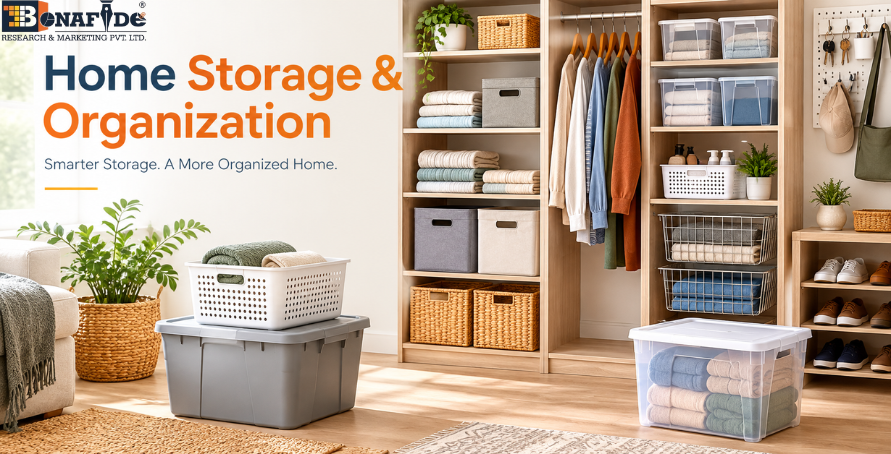
Storage bins and boxes maintain a leading position because they can be used across almost every area of a home without requiring permanent installation.
Plastic containers, lidded totes, stackable boxes, fabric storage boxes, baskets, and specialized organizers are used in bedrooms, kitchens, garages, basements, closets, bathrooms, utility rooms, and living areas. Their broad application makes them suitable for households with different space requirements and budgets. The category benefits from the availability of products in different sizes, shapes, capacities, colors, and designs. Smaller boxes can organize accessories, toys, office materials, and household items, while larger containers can accommodate seasonal clothing,
sports equipment, decorations, tools, and other infrequently used belongings. Stackable containers allow households to utilize vertical space, while transparent products provide visibility of stored contents. Storage bins and boxes are also frequently used during seasonal cleaning, moving, renovation, relocation, and decluttering activities. Another factor supporting the segment is its accessibility across different retail formats. Consumers can find basic storage containers through supermarkets and hypermarkets, while larger and specialized products are available through home improvement retailers, specialty stores, furniture retailers, and online platforms. The relatively straightforward design and broad household applicability allow manufacturers to offer products across mass-market and premium price categories.
Plastic is extensively used across storage bins, boxes, drawer organizers, hooks, hangers, bathroom organizers, kitchen storage products, shelving components, and multipurpose containers. Materials such as
polypropylene and
polyethylene allow manufacturers to develop products with different levels of rigidity, transparency, thickness, and design complexity. Cost efficiency is an important factor supporting plastic's leading position because manufacturers can produce high volumes of standardized storage products for mass-market consumers. Plastic can also be molded into stackable, transparent, collapsible, modular, and space-efficient designs. Its resistance to moisture makes it suitable for kitchens, bathrooms, basements, utility rooms, and other household areas where exposure to humidity may affect alternative materials. Plastic's lightweight characteristics also simplify handling and transportation for both retailers and consumers. Transparent containers allow users to identify stored contents without opening the container, while stackable designs help households make better use of vertical space. Sustainability concerns are encouraging manufacturers to increase recycled content, develop reusable products, improve durability, and reduce unnecessary
packaging.
Supermarkets and hypermarkets remain an important distribution channel because consumers can purchase storage products during routine household shopping trips. Storage bins, boxes, hooks, hangers, drawer organizers, baskets, and smaller shelving products can be merchandised alongside groceries, cleaning products, home textiles, and
general household merchandise. Large-scale procurement enables these retailers to provide products across multiple price ranges and offer promotional discounts, multipacks, seasonal campaigns, and private-label alternatives. Storage products are particularly suitable for mass retail because consumers frequently purchase several units for bedrooms, kitchens, garages, closets, or utility areas. Physical retail also allows consumers to inspect dimensions, construction, capacity, colors, and materials before purchasing. This is valuable for organization products because size and compatibility with existing household spaces can influence purchasing decisions. Seasonal cleaning, relocation, home renovation, back-to-school periods, and holiday preparation can further increase purchases through supermarket and hypermarket channels.
Residential users represent the largest end-user segment because storage requirements exist throughout virtually every household. Consumers purchase closet organizers, shelving units, storage bins, hooks, hangers, cabinets, baskets, and other organization products for bedrooms, kitchens, bathrooms, living rooms, home offices, garages, basements, laundry areas, and utility spaces. Demand varies according to household size, housing type, lifestyle, available space, and income. Families may require storage for toys, school materials, clothing, sports equipment, and household supplies, while individuals living in apartments may prioritize compact and multifunctional solutions. Homeowners also invest in customized closets, pantry systems, garage organization, shelving, and home office storage as part of renovation and improvement projects. The residential segment is additionally supported by increasing interest in decluttering and personalized living spaces. IKEA's recent global home organization research found that consumers continue to develop individual approaches to organizing their homes, while its global product portfolio includes storage systems, wardrobes, shelving, cabinets, and other organization products. These developments demonstrate the broad and recurring nature of residential storage requirements across different household environments.
















 We are friendly and approachable, give us a call.