The Global Smart TV Stick Market is evolving as consumers increasingly shift toward streaming-based entertainment and seek convenient ways to access
digital content through existing
television displays.
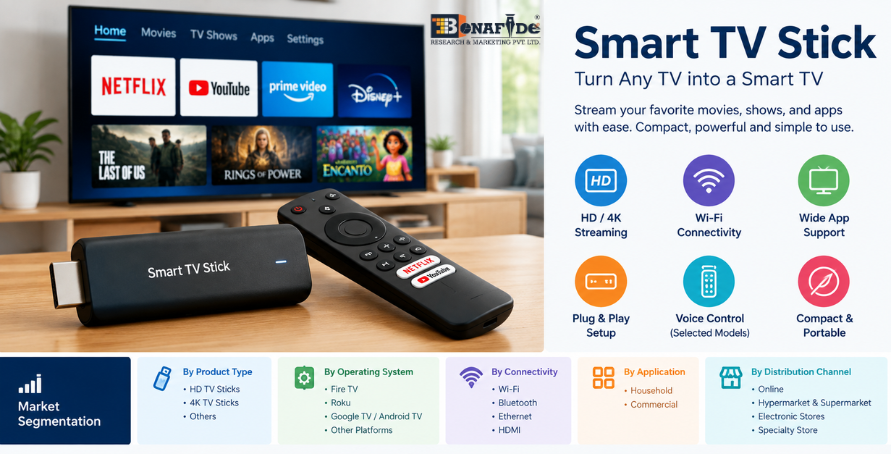
Smart TV sticks provide a compact solution that connects compatible televisions through HDMI and enables access to streaming applications, online video, live entertainment, music, and other digital services. The market includes HD TV sticks,
4K TV sticks, and other compact
streaming devices supported by operating systems such as Android TV OS, Roku OS, Amazon Fire TV OS, Linux-based platforms, and Google TV. A major factor supporting the market is the growing adoption of streaming services across households. Consumers are increasingly combining subscription video-on-demand,
advertising-supported streaming, free content platforms,
live streaming, and digital entertainment applications. This shift is creating demand for external streaming devices that can provide modern entertainment functionality without requiring consumers to replace compatible television sets. The compact form factor of smart TV sticks also makes them suitable for bedrooms, secondary televisions, rental properties, guest rooms, and other residential environments. Smart TV Sticks have become an important category within connected entertainment hardware because they allow compatible televisions to access streaming applications, online video, music, live programming, and other internet-based entertainment services without requiring consumers to replace their existing television sets. Their compact form factor, HDMI connectivity, wireless internet access, operating system integration, and increasingly advanced video capabilities are supporting their adoption across households and selected commercial environments.
According to the research report, "Global Smart TV Stick Market Outlook, 2031," published by Bonafide Research, the Global Smart TV Stick Market was valued at more than USD 10.93 Billion in 2025 and is expected to reach a market size of more than USD 16.04 Billion by 2031, growing at a CAGR of 6.77% from 2026-2031.
The growing penetration of streaming services is one of the major factors shaping demand for Smart TV Sticks. Consumers are increasingly accustomed to accessing entertainment through subscription-based video services, advertising-supported streaming platforms, free streaming channels, live digital content, and application-based television experiences. This transition is changing the role of the television from a traditional broadcast
display into a connected entertainment platform. According to Ofcom's 2025 Technology Tracker, 22% of surveyed UK households reported using a streaming box or stick connected to their television to access streaming services, demonstrating the established role of external streaming hardware alongside smart TVs and other connected devices. As streaming libraries continue to expand and consumers manage multiple content services, Smart TV Sticks provide a convenient hardware interface for accessing these platforms through an existing television.
Technological development is further influencing the evolution of the Smart TV Stick Market. Earlier generations of streaming sticks primarily focused on providing basic access to online video applications, while newer products increasingly incorporate higher-resolution video support, HDR technologies, improved
wireless connectivity, voice-enabled remotes, faster processors, expanded application ecosystems, and enhanced user interfaces. The growing availability of 4K televisions is particularly important because consumers purchasing or already owning higher-resolution displays increasingly expect their external streaming devices to support corresponding video quality. As a result, 4K TV Sticks are becoming an important product category, supported by the availability of 4K content and continued improvements in streaming infrastructure. Leading manufacturers are also integrating features such as Dolby Vision, Dolby Atmos, Wi-Fi 6, voice control, and more personalized content discovery into their streaming hardware and software ecosystems.
Operating systems represent another important competitive dimension within the market. Android TV OS, Google TV, Roku OS, Amazon Fire TV OS, and Linux-based platforms provide different approaches to application access, content discovery, voice interaction, personalization, and integration with broader technology ecosystems. Platform selection can influence the consumer experience because the operating system determines the available applications, user interface, content recommendations, device compatibility, and interaction with other connected devices. Connected TV platforms are also becoming increasingly important gateways between consumers and digital content providers. Ofcom has highlighted the role of connected TV platforms as digital content gateways and has examined issues surrounding the availability and discoverability of content across these platforms. This growing importance of platform ecosystems is expected to encourage manufacturers and technology companies to continue investing in software functionality alongside hardware improvements.
Connectivity is also central to the performance and usability of Smart TV Sticks. Wi-Fi remains the primary technology enabling Smart TV Sticks to access online streaming services, while Bluetooth supports communication with remote controls and compatible accessories. HDMI provides the physical connection between the stick and television, allowing users to add connected entertainment functionality to compatible displays. Improvements in wireless networking are expected to support smoother high-resolution streaming, faster application loading, and improved responsiveness, particularly as households increasingly connect multiple devices to broadband networks. The combination of compact hardware and wireless connectivity also allows Smart TV Sticks to remain relatively unobtrusive compared with larger external entertainment devices, supporting their use in bedrooms, guest rooms, rental properties, hospitality environments, and other locations where space and installation simplicity are important.
The application landscape extends beyond traditional household entertainment. Household users represent a major part of demand because Smart TV Sticks provide a practical way to access streaming services on compatible televisions. Consumers can use these devices to
watch movies, television programs, sports, news, music, live channels, and other digital content through supported applications. At the same time, commercial applications are creating additional opportunities in environments such as hotels, serviced apartments, short-term rentals, offices, waiting areas, and other facilities where connected television functionality can enhance the user experience. The growing emphasis on digital guest experiences in hospitality can encourage businesses to consider flexible streaming hardware that can be deployed across multiple television locations without replacing entire television installations.
Distribution is also evolving alongside consumer purchasing behavior. Online channels have become an important route for Smart TV Stick sales because consumers can compare products, operating systems, specifications, prices, compatible services, and customer reviews before purchasing.
E-commerce platforms also allow manufacturers and technology brands to reach consumers directly across multiple geographic markets. Hypermarkets and supermarkets, electronic stores, and specialty stores continue to provide physical purchasing options, particularly for consumers who prefer to evaluate consumer electronics products before purchase or require assistance with device selection. The combination of online and offline distribution is expected to support broader product availability as Smart TV Stick manufacturers introduce products across different price categories and performance levels.
















 We are friendly and approachable, give us a call.