The global
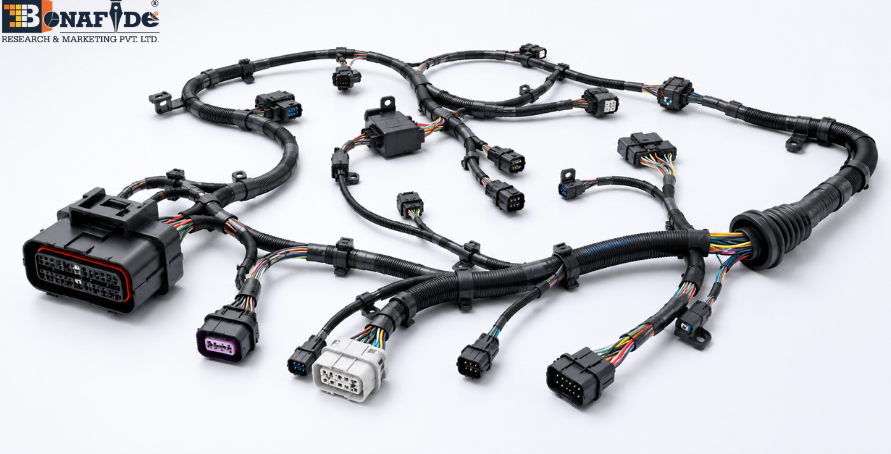
automotive wiring harness market comprises the design, manufacturing, and supply of organized bundles of wires,
connectors, terminals, and protective coverings that transmit electrical power, signals, and data throughout a vehicle. Wiring harnesses serve as the electrical backbone of modern automobiles, connecting critical systems such as powertrains,
lighting, infotainment, sensors,
battery packs, electronic control units (ECUs), advanced driver-assistance systems (
ADAS), braking systems, steering systems, and communication networks. As vehicles become increasingly electrified and software-driven, the importance of wiring harnesses has expanded beyond simple power distribution to enabling connectivity, safety, and intelligent vehicle functions. Key growth drivers include rising
electric vehicle adoption, increasing integration of ADAS technologies, growing demand for connected vehicles, stricter vehicle safety regulations, and the proliferation of
electronic components across passenger and
commercial vehicles. EVs require more sophisticated high-voltage wiring architectures, battery management connections, and
power electronics integration, creating significant demand for advanced harness solutions. In addition, trends such as lightweighting, the adoption of
aluminum conductors, zonal electrical architectures, and smart diagnostic capabilities are reshaping product development across the industry. The market is supported by major industry participants including Yazaki Corporation, Sumitomo Electric Industries, Lear Corporation, Aptiv, and Leoni AG, which engage in product innovation, strategic partnerships, localization of production, and supply-chain optimization. Industry activities include harness design engineering, component manufacturing, assembly, testing, validation, and integration with vehicle electrical systems. The market also benefits from standards and regulations developed by organizations such as the SAE International and the International Organization for Standardization, which help ensure product quality, safety, and interoperability across global automotive platforms.
According to the research report "Global Automotive Wiring Harness Market Outlook, 2031," published by Bonafide Research, the Global Automotive Wiring Harness Market was valued at more than USD 73.96 Billion in 2025, and expected to reach a market size of more than USD 102.52 Billion by 2031 with the CAGR of 5.74% from 2026-2031. The global automotive wiring harness market is a critical segment of the automotive components industry, serving as the electrical and data-transmission backbone of modern vehicles. Wiring harnesses integrate wires, connectors, terminals, protective sleeves, and electronic interfaces that connect powertrains, lighting systems, infotainment units, sensors, battery packs, electronic control units (ECUs), and advanced driver-assistance systems (ADAS). The market is being driven by rapid vehicle electrification, increasing electronic content per vehicle, growing adoption of connected-car technologies, and the transition toward software-defined vehicle architectures. Major industry participants include Yazaki Corporation, Sumitomo Electric Industries, Aptiv PLC, Lear Corporation, Leoni AG, Furukawa Electric, and Samvardhana Motherson International, which collectively maintain extensive global manufacturing and OEM supply networks. Recent developments include expansion of EV-focused harness production capacity by Yazaki and Sumitomo Electric, while Aptiv has strengthened its position through high-voltage EV connector systems and multi-year supply agreements with major automakers. Opportunities are emerging from high-voltage harnesses for battery electric vehicles, zonal electrical architectures, lightweight aluminum wiring solutions, and high-speed data transmission systems required for autonomous and connected vehicles. From a supply-chain perspective, the industry begins with raw materials such as
copper, aluminum, plastics, and connector components, followed by wire and terminal manufacturers, harness assemblers, Tier-1 suppliers, and finally automotive OEMs. The sector remains highly labor-intensive, with many assembly processes still performed manually, prompting investments in automation and
robotics to improve quality and productivity. Supply-chain resilience has become increasingly important due to raw-material price fluctuations, geopolitical disruptions, and OEM efforts to localize production in North America, Europe, and Asia-Pacific.
Passenger cars have emerged as the most significant vehicle category for automotive wiring harnesses because they are at the center of technological transformation within the automotive industry. Modern passenger vehicles contain a far greater number of electronic systems than previous generations, requiring extensive networks of wires, connectors, terminals, sensors, and control modules to ensure seamless communication between components. Features that were once limited to premium vehicles, such as adaptive
cruise control, lane-keeping assistance, blind-spot monitoring, touchscreen infotainment systems,
wireless connectivity,
digital instrument clusters,
ambient lighting, powered seats, and advanced climate control systems, are now increasingly incorporated into mass-market passenger cars. Each of these functions depends on dedicated wiring systems for power distribution and data transmission. In addition, governments worldwide have implemented stricter vehicle safety regulations, encouraging automakers to integrate additional sensors, cameras,
radar systems, and electronic safety functions that increase wiring complexity. The growing adoption of electric and hybrid passenger vehicles further amplifies wiring requirements because battery packs, inverters, onboard chargers,
thermal management systems, and high-voltage power distribution networks require specialized harness assemblies. Passenger cars are also the primary focus of connected vehicle development, with manufacturers integrating vehicle-to-cloud communication, over-the-air software updates, navigation systems, and telematics platforms that depend on reliable electrical connectivity.
The rise of battery harness applications is closely linked to the transformation of vehicle
propulsion systems from conventional internal combustion engines toward electrified platforms. Unlike traditional vehicles, electric and hybrid vehicles depend on large battery systems that must continuously exchange power and information with numerous vehicle subsystems. Battery harnesses serve as the critical communication and power-transmission pathways linking battery cells, battery management systems, power control units, charging systems, inverters, converters, and thermal management equipment. Their importance extends beyond simple electrical connectivity because they also support voltage monitoring, temperature sensing, current measurement, fault detection, and safety isolation functions. As battery packs become larger and more sophisticated, harness designs must accommodate higher voltages, greater energy density, and stricter safety requirements. Automotive manufacturers are increasingly adopting advanced battery architectures that require numerous sensors and control interfaces distributed throughout the battery assembly, creating additional demand for specialized harness configurations. Fast-charging capabilities further increase design complexity because harnesses must withstand elevated electrical loads while maintaining reliability under demanding operating conditions. Battery systems are also subject to rigorous safety regulations, requiring robust
insulation materials, shielding technologies, and thermal protection features integrated into harness assemblies. Another important factor is the growing use of battery management systems that continuously monitor cell performance and health, generating significant data traffic that relies on dependable wiring infrastructure.
Battery electric vehicles represent the most wiring-intensive propulsion category because their entire operating architecture revolves around electrical power. Unlike internal combustion vehicles, which rely on mechanical systems for many functions, BEVs depend extensively on electrical networks to power propulsion, charging, thermal management, safety systems, and onboard electronics. High-voltage battery packs must be connected to electric motors, inverters, onboard chargers, DC-DC converters, battery management systems, and auxiliary electrical systems through complex wiring networks. These vehicles also require sophisticated communication pathways to coordinate energy flow, monitor battery performance, and manage charging operations. In addition, BEVs commonly incorporate advanced thermal management systems that regulate battery temperature and maintain optimal operating conditions, creating additional wiring requirements for pumps, sensors,
valves, and control units. Vehicle manufacturers are also equipping BEVs with advanced digital technologies, including large infotainment displays, software-defined vehicle platforms, over-the-air update capabilities, and intelligent driver assistance systems, all of which depend on robust electrical architectures. Charging infrastructure compatibility further contributes to wiring complexity because vehicles must support communication between charging stations and onboard charging systems. Safety considerations are equally important, requiring specialized shielding, insulation, and isolation technologies to protect occupants and electronic systems from high-voltage circuits. The transition toward 800-volt vehicle architectures in several next-generation electric vehicles has created demand for even more advanced harness solutions capable of handling higher power loads.
Connectors play a fundamental role in automotive electrical systems because they provide the physical interface through which power and data are transferred between vehicle components. As modern vehicles become increasingly dependent on electronics, the number of required connections rises substantially. Advanced driver-assistance systems, cameras, radar modules, lidar units, infotainment platforms, battery management systems, telematics devices, electric motors, and charging systems all rely on connectors to ensure secure and reliable communication. Unlike wiring alone, connectors must withstand vibration, moisture, temperature fluctuations, electromagnetic interference, and long-term mechanical stress while maintaining signal integrity. The growing adoption of connected vehicles has intensified demand for high-speed data connectors capable of supporting complex communication protocols. Electric vehicles present additional challenges because connectors must safely handle high-voltage power transmission while preventing electrical leakage and maintaining thermal stability. Manufacturers are therefore developing smaller, lighter, and more durable connector technologies to meet evolving vehicle requirements. Another contributing factor is the increasing modularization of vehicle production, where connectors simplify assembly, maintenance, and replacement procedures. Vehicle platforms are also incorporating greater numbers of electronic control units and distributed
sensor networks, creating a larger quantity of connection interfaces throughout the vehicle. Waterproof and sealed connectors are becoming particularly important as electrification expands and electronic content moves into exposed vehicle environments.
The increasing adoption of electrified powertrains has fundamentally changed vehicle electrical architecture, creating strong demand for high-voltage harness systems. Traditional automotive wiring was primarily designed for low-voltage applications such as lighting, infotainment, and engine controls. In contrast, electric vehicles require high-voltage circuits to transfer energy between battery packs, electric motors, charging systems, inverters, and power electronics. These applications involve substantially higher electrical loads, requiring specialized
cables, insulation materials, shielding technologies, and safety mechanisms. High-voltage harnesses must withstand demanding operating conditions while preventing energy losses and ensuring occupant safety. They are engineered to resist heat, vibration, electromagnetic interference, moisture exposure, and mechanical stress over extended vehicle lifecycles. Another factor contributing to their growth is the industry's transition toward faster charging technologies, which require harnesses capable of handling elevated current levels without compromising reliability. Advanced battery systems also require extensive communication between battery management systems and other vehicle control units, further increasing harness sophistication. Regulatory requirements surrounding electric vehicle safety have encouraged the adoption of robust insulation and fault-protection technologies integrated into high-voltage wiring systems. Automotive manufacturers are additionally pursuing lightweight harness designs to improve vehicle efficiency, leading to innovation in conductor materials and cable construction. Emerging vehicle architectures that operate at higher voltage levels further increase technical requirements for harness suppliers.
Automotive manufacturers face constant pressure to improve vehicle efficiency, reduce emissions, and extend driving range in electrified vehicles. One of the most effective approaches is reducing vehicle weight, which has brought increased attention to aluminium conductors in wiring harness applications. Aluminium offers a considerably lower density than copper, enabling substantial weight savings when used in appropriate sections of vehicle electrical systems. These reductions contribute directly to improved energy efficiency and enhanced battery utilization in electric vehicles. Although aluminium has lower electrical conductivity than copper, advancements in conductor design, terminal technology, and connection engineering have enabled manufacturers to overcome many traditional performance limitations. Modern harness systems increasingly incorporate aluminium conductors in power distribution circuits where weight reduction benefits outweigh conductivity differences. The material also provides economic advantages because aluminium prices are generally less volatile and lower than copper prices, helping manufacturers manage raw material costs. In addition, global concerns regarding resource availability and supply-chain resilience have encouraged diversification away from complete dependence on copper-based solutions. Automotive engineering teams have developed specialized crimping technologies, corrosion-resistant connectors, and hybrid conductor designs that improve the reliability of aluminium-based harnesses. Electric vehicles have further accelerated adoption because their large wiring networks create significant opportunities for weight reduction. As vehicle architectures become increasingly electrified, even small weight savings can contribute to measurable improvements in efficiency and performance. Automakers are therefore evaluating aluminium across a broader range of applications than in previous generations of vehicles.
The automotive aftermarket has become increasingly important for wiring harness suppliers as vehicles remain in service longer and contain more sophisticated electrical systems than ever before. Wiring harnesses are exposed to continuous vibration, temperature fluctuations, moisture, corrosion, mechanical wear, and environmental contaminants throughout a vehicle's life. Over time, these factors can degrade wires, connectors, insulation materials, and terminals, creating a need for repair or replacement. Modern vehicles contain significantly more electronic systems than previous generations, increasing the number of potential failure points and maintenance requirements. Electrical issues associated with sensors, infotainment systems, lighting systems, battery management units, power accessories, and safety technologies often require harness-related service interventions. Another major contributor is the growing global vehicle parc, which creates a large installed base requiring ongoing maintenance support. Vehicle owners are also keeping cars for longer periods, increasing the likelihood that wiring systems will require refurbishment during the ownership cycle. Independent repair facilities and authorized service centers frequently replace damaged harness sections rather than entire vehicle electrical systems, supporting demand for aftermarket products. Furthermore, collisions, environmental exposure, rodent damage, and unauthorized modifications often necessitate replacement harness assemblies. The rise of electric vehicles introduces additional aftermarket opportunities because high-voltage systems require specialized service components and certified replacement parts. Manufacturers are responding by expanding replacement-part portfolios, improving diagnostic capabilities, and offering vehicle-specific harness solutions.

























 We are friendly and approachable, give us a call.