The global
transmission fluid market comprises the production, formulation, distribution, and sale of specialized
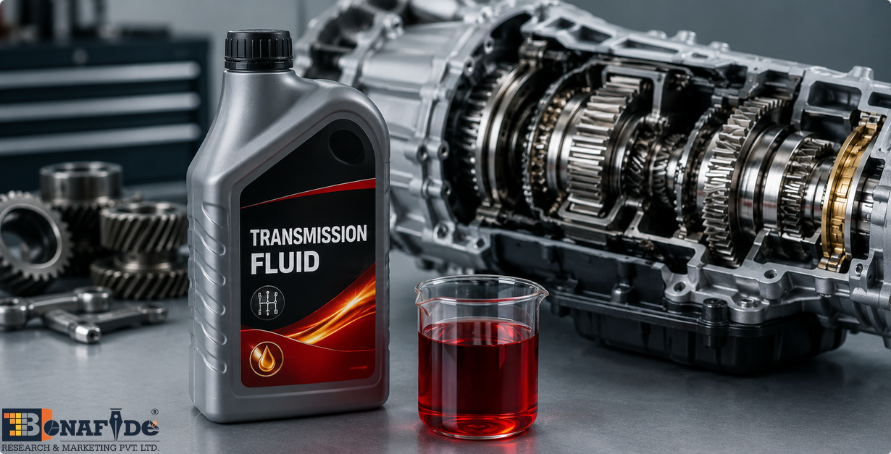
lubricants designed for automatic transmissions (ATF), manual transmissions (MTF), continuously variable transmissions (CVT), dual-clutch transmissions (DCT), and increasingly hybrid and electric driveline systems. These fluids perform critical functions by lubricating
gears and bearings, reducing friction and wear, dissipating heat, preventing corrosion, maintaining hydraulic pressure, and ensuring smooth gear engagement, thereby extending transmission life and improving vehicle efficiency. The market serves original equipment manufacturers (OEMs) for factory-fill applications as well as the extensive automotive aftermarket for routine maintenance and fluid replacement. Growth is being driven by rising global vehicle production, increasing adoption of automatic, CVT, and dual-clutch transmissions, expanding passenger and
commercial vehicle fleets, longer vehicle ownership cycles, and growing demand for high-performance synthetic lubricants capable of operating under severe thermal and mechanical conditions. The increasing penetration of hybrid vehicles has also accelerated the development of specialized e-transmission fluids that provide electrical compatibility while maintaining superior lubrication and cooling performance. In addition, stringent fuel economy and emission regulations have encouraged automakers to adopt advanced transmission technologies that require premium transmission fluids with enhanced oxidation stability, friction characteristics, and extended drain intervals. Continuous research and development activities by
lubricant manufacturers focus on improving viscosity control, thermal stability, anti-wear protection, and compatibility with next-generation transmission materials and seals. The industry is supported by organizations such as the American Petroleum Institute (API), SAE International, ASTM International, and OEM-specific performance specifications that establish testing standards, quality requirements, and fluid performance benchmarks. Market participants also collaborate with automobile manufacturers to develop proprietary formulations for modern transmissions.
According to the research report "Global Transmission Fluid Market Outlook, 2031," published by Bonafide Research, the Global Transmission Fluid Market was valued at more than USD 13.32 Billion in 2025, and expected to reach a market size of more than USD 17.36 Billion by 2031 with the CAGR of 4.62% from 2026-2031. The global transmission fluid market is a vital segment of the
automotive lubricants industry, encompassing the manufacturing, blending,
packaging, and distribution of fluids designed for automatic transmissions (ATF), manual transmissions (MTF), continuously variable transmissions (CVT), dual-clutch transmissions (DCT), and emerging electric driveline systems. The market is characterized by the presence of multinational lubricant producers including Shell, ExxonMobil, bp Castrol, Chevron, TotalEnergies, Valvoline, Phillips 66, FUCHS, Idemitsu Kosan, ENEOS, and Petro-Canada Lubricants, which compete through OEM approvals, advanced synthetic formulations, extensive distribution networks, and multi-vehicle compatibility. Growth opportunities are expanding with increasing production of passenger and
commercial vehicles, rising penetration of automatic and hybrid transmissions, growing demand for extended-drain synthetic fluids, and the development of dedicated e-transmission fluids for
battery electric and hybrid vehicles. Manufacturers are investing heavily in research and development to improve oxidation stability, friction durability,
thermal management, wear protection, and fuel efficiency. Recent developments include Shell's introduction of Shell EV-Plus Thermal Fluid for immersive battery
electric powertrain cooling, Castrol's expansion of its Castrol ON EV transmission fluid portfolio for wet e-motors, and ENEOS' adoption of AI-driven lubricant formulation technologies to accelerate next-generation fluid development. The market's supply chain begins with crude oil extraction or synthetic base stock production, followed by base
oil refining, additive manufacturing by specialty chemical suppliers, lubricant blending, quality testing, packaging, warehousing, and distribution through OEM channels, independent distributors, workshops, retailers, and
e-commerce platforms before reaching end users.
Dual-clutch transmissions differ fundamentally from conventional automatic and manual transmissions because they combine two independent clutches with electronically controlled gear selection systems that enable rapid and uninterrupted gear changes. This operating principle places exceptional demands on the transmission fluid, making DCTF a highly engineered lubricant rather than a conventional gear oil. Wet dual-clutch systems rely directly on the fluid to cool clutch packs, transfer hydraulic pressure, minimize friction losses, and protect gears, bearings, synchronizers, and mechatronic components from wear. Even small deviations in friction characteristics can affect shift quality, clutch engagement, and transmission efficiency, leading vehicle manufacturers to specify dedicated DCT fluids instead of universal lubricants. Automotive manufacturers such as Volkswagen Group, Mercedes-Benz, Hyundai, Kia, Ford, BMW, Porsche, and several Chinese vehicle manufacturers have incorporated dual-clutch transmissions into numerous vehicle platforms because they deliver fast gear shifts, improved fuel economy, and responsive driving performance. As transmission designs become more compact and operate at higher temperatures, lubricant formulators have introduced advanced additive systems that provide oxidation resistance, shear stability, anti-foam performance, corrosion protection, and seal compatibility over extended service intervals. DCT fluids are also engineered to maintain stable viscosity across wide temperature ranges, allowing consistent hydraulic performance during both cold starts and high-load driving conditions.
Modern transmissions operate under conditions that are substantially more severe than earlier drivetrain systems, with higher operating temperatures, increased hydraulic pressures, tighter manufacturing tolerances, and electronically controlled shifting mechanisms that demand exceptionally stable lubricant performance. Synthetic base oils, particularly polyalphaolefins (PAO) and esters, possess molecular structures specifically engineered to maintain consistent viscosity while resisting oxidation, thermal degradation, and deposit formation throughout extended operating periods. Unlike many conventional mineral oils that contain a broad distribution of hydrocarbon molecules, synthetic base stocks exhibit greater uniformity, resulting in improved lubricity, lower volatility, enhanced low-temperature fluidity, and stronger resistance to viscosity breakdown under mechanical shear. These characteristics enable transmission fluids formulated with synthetic base oils to provide smoother gear engagement, more reliable hydraulic control, and superior protection for gears, bearings, seals, and clutch materials. Automotive manufacturers increasingly specify synthetic transmission fluids to satisfy stringent durability and efficiency requirements established for modern automatic, CVT, DCT, hybrid, and electrified drivetrain systems. Ester chemistry also contributes natural lubricity and excellent
detergent properties, helping reduce sludge formation while improving cleanliness within complex hydraulic circuits. Synthetic formulations are particularly beneficial for vehicles operating in extreme climates because they remain fluid during cold starts while retaining protective film strength during sustained high-temperature operation. Lubricant manufacturers continue investing in advanced additive technologies that complement PAO and ester base oils to achieve improved friction control, oxidation stability, and compatibility with evolving transmission materials.
Transmission fluid is a consumable lubricant whose performance gradually declines due to oxidation, thermal stress, contamination, and additive depletion during normal vehicle operation, making periodic replacement essential for maintaining transmission reliability and operating efficiency. Although many modern transmissions are promoted as having extended service intervals, automotive manufacturers continue to recommend fluid inspection or replacement under severe operating conditions such as towing, stop-and-go driving, mountainous terrain, or commercial use. As vehicles remain in service for longer periods, maintenance activities increasingly shift from original equipment manufacturers to independent workshops, quick-lube centers, authorized service providers, fleet maintenance operators, lubricant distributors, and online automotive parts retailers. This broad service ecosystem has significantly strengthened the aftermarket channel by improving accessibility to OEM-approved and multi-vehicle transmission fluids. Independent lubricant manufacturers have also expanded product portfolios covering automatic, manual, CVT, DCT, and hybrid transmission applications, enabling repair facilities to service a wider variety of vehicles with fewer inventories. Growing consumer awareness regarding preventive maintenance has further supported demand because neglected transmission fluid can contribute to overheating, harsh shifting, clutch wear, and premature component failure.
Digital service reminders, electronic maintenance records, and diagnostic systems integrated into modern vehicles also encourage timely fluid replacement. Fleet operators increasingly prioritize scheduled transmission maintenance to minimize downtime and extend vehicle operating life, particularly in
logistics, public transportation, and commercial delivery applications.
Off-road vehicles used in construction, mining, agriculture, forestry, quarrying, and industrial material handling function in operating environments that place extraordinary mechanical stress on transmissions compared with conventional on-road vehicles. These machines routinely carry heavy loads, climb steep grades, operate at low speeds with high torque, and remain in continuous service for extended working hours, all of which generate substantial heat and mechanical loading within transmission systems. Transmission fluids in these applications perform multiple critical functions, including lubrication, hydraulic power transfer, cooling, corrosion prevention, wear protection, and contamination control despite constant exposure to dust, mud, moisture, and vibration. Equipment manufacturers such as Caterpillar, Komatsu, John Deere, CNH Industrial, Volvo
Construction Equipment, and Hitachi Construction Machinery specify high-performance transmission fluids designed to withstand severe duty cycles while maintaining stable viscosity and friction characteristics. Modern off-road transmissions increasingly incorporate electronically controlled powershift systems, hydrostatic drives, continuously variable transmissions, and integrated hydraulic circuits that demand highly specialized lubricants with excellent oxidation resistance and shear stability. Preventive maintenance is particularly important because unexpected transmission failure can halt construction projects, mining operations, or harvesting activities, resulting in costly operational interruptions. Fleet owners therefore prioritize routine fluid analysis and scheduled lubricant replacement to maximize equipment reliability and component life. The expansion of infrastructure projects, mechanized agriculture,
surface mining,
renewable energy construction, and large-scale earthmoving activities has increased utilization of
heavy equipment worldwide, creating greater demand for transmission fluids formulated specifically for severe operating environments.


















 We are friendly and approachable, give us a call.