The global
RF interconnect market has undergone a significant transformation over the past five years, evolving from conventional RF connectivity used primarily across cellular and electronic equipment toward increasingly sophisticated interconnection architectures supporting 5G networks, connected vehicles, industrial wireless systems, aerospace and defense equipment,
satellite communications, semiconductor testing, and advanced electronic systems. The expansion of wireless infrastructure has increased the number of RF signal paths required between antennas, radios, filters, modules, circuit boards, and other
electronic components, while increasing equipment density has created greater demand for compact, low-loss, shielded, and mechanically reliable interconnection solutions. The International Telecommunication Union reported that global 5G population coverage reached 55.1% in 2025, while Asia and the Pacific reached 70.4%, demonstrating the continued expansion of advanced wireless infrastructure. The development of RF systems is also extending beyond
telecommunications as automotive manufacturers integrate increasingly sophisticated connectivity, sensing, radar, navigation, and communication electronics, while industrial operators deploy wireless technologies across manufacturing,
logistics, ports, and connected machinery. China reported 4.838 million 5G base stations at the end of 2025, while its national industrial strategy continues to promote the integration of 5G with industrial applications. The market is consequently experiencing increasing demand for RF
connectors, RF
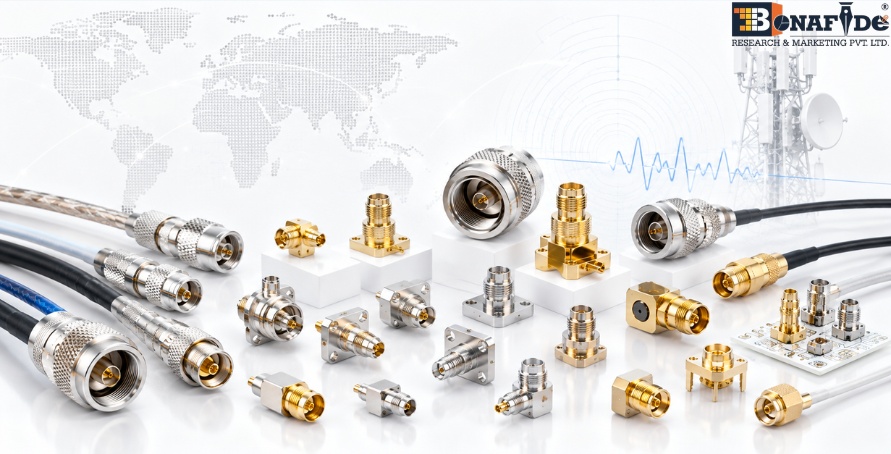
cables, RF cable assemblies, and coaxial adapters capable of supporting diverse frequency ranges and demanding electrical and environmental conditions. Product development is increasingly focused on miniaturization and high-density architectures, with manufacturers developing compact board-to-board and board-to-module RF interfaces for applications such as active MIMO antennas and 5G radios. Rosenberger's EBC platform, for example, is designed for 5G board-to-board and board-to-module applications while supporting blind mating and high packing density. At the same time, factory-terminated RF cable assemblies are gaining importance because they simplify system integration and provide more consistent electrical performance than field-terminated connections. Molex's 5G RF cable assemblies incorporate low-PIM characteristics,
weather-resistant construction, and factory-controlled assembly for cellular infrastructure applications. Aerospace, defense, semiconductor testing, and advanced measurement applications are further increasing requirements for ruggedized and precision-engineered RF interconnects. These developments are shifting the industry toward a combination of standardized high-volume RF products and customized high-performance interconnection solutions.
According to the research report, "Global RF Interconnect Market Outlook, 2031," published by Bonafide Research, the Global RF Interconnect Market Outlook was valued at more than USD 35.42 Billion in 2025, and expected to reach a market size of more than USD 52.98 Billion by 2031 with the CAGR of 7.12% from 2026-2031. The competitive ecosystem of the global RF interconnect market encompasses connector manufacturers, RF component suppliers, cable-assembly specialists, electronic interconnection companies, and high-reliability technology providers serving telecommunications, automotive, aerospace, defense, industrial, medical, and testing applications. Major participants include Amphenol Corporation, TE Connectivity, Molex, Rosenberger, HUBER+SUHNER, and Smiths Interconnect, alongside specialized suppliers focused on specific frequency ranges and end-use requirements. Competition increasingly depends on frequency capability, signal integrity, insertion loss, impedance control, shielding effectiveness, miniaturization, environmental durability, customization, qualification, and manufacturing consistency. Strategic acquisitions are reshaping the competitive environment as larger connectivity companies expand into specialized RF and high-reliability technologies. Molex completed its acquisition of Smiths Interconnect in April 2026, adding ruggedized connectors, RF components,
optical transceivers, and semiconductor-test capabilities to its portfolio. Amphenol completed its approximately USD 1 billion acquisition of Trexon in November 2025, strengthening its high-reliability cable-assembly capabilities, particularly for defense applications. Amphenol subsequently completed the acquisition of CommScope's Connectivity and Cable Solutions business in January 2026, further expanding its connectivity and cable portfolio. Product development is simultaneously moving toward higher-density and higher-bandwidth architectures. TE Connectivity's MULTIGIG HD connector was selected by the VITA Standards Organization as a next-generation VPX connector standard and supports data rates up to 112 Gb/s for demanding defense and embedded-computing applications. The competitive environment is also being influenced by increasing demand for factory-terminated cable assemblies, particularly where telecommunications, automotive, aerospace, and industrial equipment manufacturers require repeatable electrical performance and simplified integration. High-frequency applications are increasing the importance of precision manufacturing and electrical testing, while ruggedized applications require greater resistance to vibration, temperature variation, moisture, and other environmental stresses. The value chain therefore extends from RF cable and connector manufacturing through assembly, testing, system integration, and application-specific engineering. Entry barriers remain higher for aerospace, defense, medical, and semiconductor applications because suppliers must meet stringent qualification and reliability requirements. Future investment priorities are centered on high-frequency capabilities, miniaturization, low-loss materials, automated assembly, ruggedized products, advanced testing, manufacturing capacity, and application-specific RF engineering.
The expansion of 5G and advanced wireless infrastructure continues to create sustained demand for RF interconnect products. Global 5G population coverage reached 55.1% in 2025, while Asia and the Pacific reached 70.4%, creating a substantial installed base of advanced wireless equipment requiring RF connections between antennas, radios, filters, and related components. The growing integration of wireless technologies into industrial systems is further expanding the addressable application base. China's national 5G infrastructure reached 4.838 million base stations at the end of 2025, while the country continues to promote 5G-enabled industrial applications. The automotive industry is another important application environment as connected vehicles increasingly incorporate antennas, wireless communication modules, radar, navigation, cameras, and other electronic systems. Aerospace and defense applications are simultaneously increasing requirements for ruggedized, lightweight, high-density, and high-frequency interconnections. The development of advanced electronic equipment is also increasing demand for precision RF interfaces within semiconductor
testing and measurement systems. These applications require controlled impedance, low insertion loss, high shielding effectiveness, mechanical reliability, and repeatable electrical performance. The increasing complexity of equipment is also encouraging OEMs to adopt customized RF cable assemblies rather than independently sourcing and terminating cables and connectors. This approach can simplify equipment integration and improve manufacturing consistency. At the same time, regional differences in
telecommunications infrastructure maturity create varied requirements across the global market, ranging from established high-density 5G infrastructure to emerging wireless-network deployments. Asia Pacific represents the leading regional environment because of its combination of extensive wireless infrastructure, large electronics and
semiconductor manufacturing capabilities, automotive production, and industrial technology adoption. ITU reported 70.4% 5G population coverage across Asia and the Pacific in 2025, while China alone accounted for 4.838 million 5G base stations at the end of 2025. The convergence of telecommunications infrastructure, manufacturing ecosystems, and advanced electronic applications is creating a broad customer base for RF connectors, RF cable assemblies, adapters, and specialized high-frequency interconnect solutions.
The global RF interconnect market is also being influenced by the transition toward more compact and application-specific connectivity architectures. RF connectors are increasingly being designed for high-density board-to-board and board-to-module applications where limited physical space must be balanced against electrical and mechanical performance requirements. Rosenberger's EBC platform illustrates this trend by supporting compact RF interfaces for active MIMO antennas and radios with blind-mating capability. RF cable assemblies are similarly evolving toward factory-terminated and application-specific configurations, with Molex offering 5G assemblies designed around low-PIM performance, weather protection, and controlled manufacturing. Higher-frequency applications are increasing the technical importance of connector geometry, impedance control, material selection, and manufacturing tolerances. Advanced radar, millimeter-wave communications, high-frequency testing,
semiconductor equipment, and future wireless architectures are creating specialized requirements that cannot always be addressed through conventional RF products. At the same time, aerospace and defense systems are increasing demand for ruggedized interconnects capable of supporting high data rates under demanding environmental conditions. TE Connectivity's MULTIGIG HD development demonstrates the broader movement toward higher-bandwidth interconnection architectures in defense and
embedded systems. As RF systems become more integrated with
digital, optical, sensing, and high-speed electronic technologies, suppliers are increasingly required to provide complete interconnection solutions rather than individual components. This is encouraging investment in advanced manufacturing, automated assembly, electrical testing, material engineering, product customization, and global supply-chain capabilities. The competitive environment is consequently expected to remain dynamic, with established connectivity manufacturers expanding through acquisitions while specialized suppliers continue developing differentiated technologies for high-frequency and high-reliability applications.








 We are friendly and approachable, give us a call.