The global
nanophotonics industry is undergoing a fundamental structural transformation, driven by concurrent secular trends across
artificial intelligence infrastructure,
quantum technology development,
renewable energy expansion, and advanced
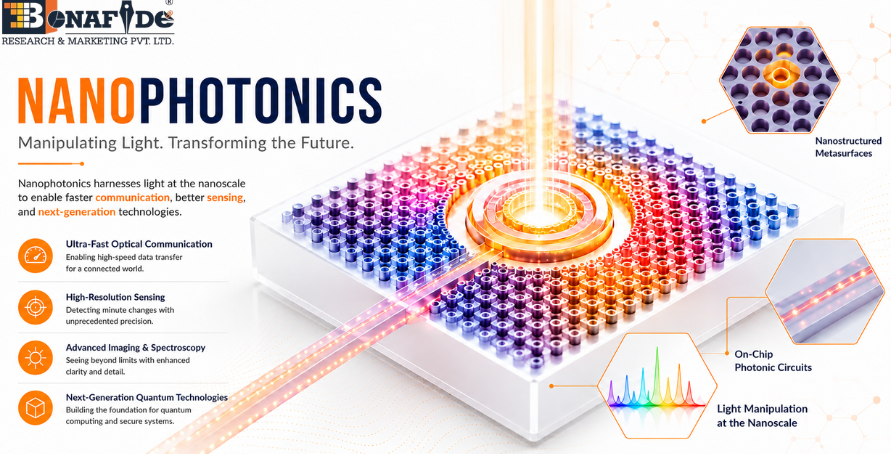
telecommunications. Nanophotonics the science of manipulating light at the nanometer scale has evolved from a specialized research discipline into a commercially scaled technology sector enabling next-generation
data transmission, medical diagnostics, advanced sensing, and
high-efficiency
lighting. Unprecedented demand has emerged from hyperscale
data center construction, automotive LiDAR deployment, quantum communication networks, and industrial laser manufacturing, fundamentally reshaping the competitive landscape.
The industry has witnessed extraordinary demand acceleration as global
silicon photonics wafer processing capacity increased by over 340% since 2020, with 22 dedicated fabrication lines now operational across Asia, North America, and Europe. Semiconductor foundries have jointly invested over $1.2 billion in
photonics-specific fabrication equipment, with silicon photonics wafer starts reaching 380,000 units in 2024. Photonic
integrated circuit shipments exceeded 2.4 million units in 2024, representing a 420% increase over 2021 volumes, while optical transceiver production reached 28.8 million units annually. Global
optical fiber production exceeded 600 million fiber-kilometers in 2025, highlighting the scale of infrastructure expansion supporting telecommunications networks worldwide. Hyperscale data centers, numbering over 1,200 globally, contain hundreds of thousands of optical interconnects each, with AI training clusters utilizing specialized photonic configurations supporting high-speed data transfer between processor arrays. Global internet bandwidth expanded at approximately 25% annually through 2025, with fiber optic infrastructure providing the capacity backbone for streaming services, cloud computing, and distributed AI workloads. Quantum photonics research funding exceeded $4.2 billion since 2021, with 340 distinct quantum photonic device prototypes developed across 180 research institutions, while commercial quantum photonic installations reached 44 units across banking, defense, and telecommunications sectors. Automotive LiDAR shipments exceeded 4.4 million units in 2024, integrated into 78 vehicle models across 22 automotive manufacturers, with optical component costs declining by 62% since 2020 through volume manufacturing and design optimization. The global photovoltaic module production incorporating nanophotonic light-trapping technologies reached 440 gigawatts in 2024, representing 68% of total solar cell manufacturing capacity.
According to the research report "Global Nanophotonics Market Outlook, 2031," published by Bonafide Research, the Global Nanophotonics market was valued at more than USD 17.19 Billion in 2025, and expected to reach a market size of more than USD 25.99 Billion by 2031 with the CAGR of 7.32% from 2026 to 2031. The competitive landscape has intensified significantly as global manufacturers accelerate innovation cycles to address escalating performance requirements. Silicon photonics commercialization has become a critical differentiator, with CMOS-compatible manufacturing substantially reducing optical component costs compared to traditional approaches. The industry has witnessed profound consolidation as larger players acquire specialized technology innovators to expand portfolio breadth across optical communications,
lasers, and compound
semiconductor materials. Design innovation has shifted toward heterogeneous integration combining III-V materials with silicon photonics platforms, achieving industry-leading coupling efficiency and reducing optical interconnect power consumption. The procurement landscape has evolved toward strategic supplier partnerships rather than transactional purchasing, with OEMs seeking collaborative development arrangements for custom photonic solutions. Manufacturing ecosystems have responded through significant capacity expansions across Southeast Asia, Eastern Europe, and Mexico, while supply chain resilience initiatives have accelerated regionalization strategies. Standardization through organizations including the International Electrotechnical Commission (IEC) and IEEE continues to facilitate interoperability across global supply chains. Sustainability has emerged as a decisive competitive factor, with manufacturers optimizing production energy efficiency and developing environmentally conscious manufacturing processes in response to evolving regulatory frameworks.
Optical communication components constitute the largest product segment, reflecting their fundamental role in enabling global telecommunications and data center infrastructure. Optical transceiver production reached 28.8 million units in 2024, with 400G and 800G modules representing over 58% of new deployments as telecommunications operators and cloud providers upgrade network capacity. Optical
amplifiers, with production reaching 4.4 million units annually, have become essential for long-haul and
submarine cable systems, with erbium-doped fiber amplifiers accounting for over 58% of production. Submarine cable systems incorporating nanophotonic components have achieved design capacities exceeding 200 terabits per second across 22 new cable systems since 2021. Coherent optical transmission technology utilizing silicon photonic modulators has extended reach to 1,200 kilometers without regeneration, enabling efficient long-haul communication. Global fiber-to-the-home connections exceeded 800 million households, with each installation requiring multiple optical terminations for subscriber access networks. Optical switching capacity deployed globally reached 340 terabits per second in 2024, with data center operators installing 1.4 million optical interconnects utilizing 100G and 400G transceivers. The emergence of 1.6T
optical transceivers has driven demand for advanced connector configurations and higher fiber counts in reduced form factors, with industry roadmaps indicating volume production by 2026.
Photonic integrated circuits (PICs) have emerged as a transformative product category, integrating multiple optical functions onto a single chip analogous to electronic integrated circuits. Commercial PIC shipments exceeded 2.4 million units in 2024, with design starts originating from non-traditional photonics companies increasing from 180 to 840 annually. Heterogeneous integration approaches combining III-V materials with silicon have achieved 94% coupling efficiency, narrowing the performance gap between monolithic and hybrid solutions. Design automation tools have dramatically reduced PIC layout cycles from 12 weeks to 2 weeks through machine learning-assisted optimization, democratizing photonic circuit design for over 340 fabless design firms. Wafer-scale testing throughput increased from 40 to 340 wafers per month through parallel optical probe systems, while manufacturing yield rates improved from 68% to 92% for standard modulator structures. Electronic design automation vendors have introduced advanced PIC design platforms, with leading EDA companies occupying a significant market position and enabling rapid prototyping for diverse applications. PIC design teams at leading semiconductor companies have grown substantially as the technology gains mainstream adoption across telecommunications, data center, and sensing applications. The technology roadmap targets further integration density and cost reduction through 2031.
The quantum photonics segment has emerged as the fastest-growing category, driven by unprecedented government and private sector investment in quantum information technologies. Single-photon source efficiencies have improved from 12% to 68% since 2020 through quantum dot and spontaneous parametric down-conversion optimization, enabling practical quantum communication systems. Quantum key distribution systems incorporating nanophotonic components have achieved secure key rates exceeding 10 megabits per second over 100-kilometer fiber spans, with commercial installations reaching 44 units across banking, defense, and telecommunications sectors. Patent filings for quantum photonic technologies increased 580% since 2020, with 340 patents granted in 2024 alone, while research has produced extensive publications on quantum photonic materials and devices. Academic institutions have established numerous quantum photonic research centers globally, with industry participation growing from 44 to 340 active corporate research collaborations. The technology roadmap targets 1,000-kilometer quantum repeater networks by 2028, with quantum photonic computing advancing from theoretical frameworks to experimental prototypes. Government programs including the European Union's Quantum Flagship, the United States' National Quantum Initiative, and China's quantum research programs have collectively accelerated development through substantial funding commitments.
Automotive LiDAR and sensing technologies have experienced extraordinary demand acceleration, driven by
autonomous vehicle development and advanced driver assistance system deployment. Solid-state optical phased array LiDAR has achieved 220-meter detection range at 0.1-degree angular resolution, with manufacturing automation reducing assembly time from 340 minutes to 28 minutes per unit. Automotive LiDAR shipments exceeded 4.4 million units in 2024, integrated into 78 vehicle models across 22 automotive manufacturers, with optical component costs declining by 62% since 2020. VCSEL-based illumination systems achieved 44% wall-plug efficiency, improving range and reliability across automotive applications. The average
sensor count per vehicle has increased to over 20 sensors, with premium vehicles containing up to 40 individual sensing devices, each requiring reliable interconnect solutions. Global EV production has exceeded 18 million units annually, with each vehicle containing advanced sensing and communication systems requiring photonic components for autonomous and semi-autonomous operation.
ADAS sensors, including radar, LiDAR, ultrasonic sensors, and cameras, require dedicated photonic solutions for signal transmission with high integrity.
Silicon photonics commercialization has accelerated as manufacturing processes mature across multiple global fabrication facilities. Wafer processing capacity increased 340% since 2020, reaching 380,000 wafer starts annually, with CMOS-compatible manufacturing substantially reducing optical component costs compared to traditional approaches. Manufacturing yield improvements from 68% to 92% have enabled cost-effective volume production, driving adoption across telecommunications and data center applications. The technology has achieved 1.6 terabits per second transmission speeds across 44 commercial products since 2022, with industry roadmaps targeting 3.2T solutions by 2026. Foundry utilization rates have reached industry-leading levels for qualified silicon photonics processes, with capacity expansions continuing across all regions. Heterogeneous integration combining III-V materials with silicon has achieved 94% coupling efficiency, while electronic-photonic integration has reduced optical interconnect power consumption from 12 to 2.4 picojoules per bit. Design automation tools have reduced PIC layout cycles from 12 weeks to 2 weeks, with the design ecosystem growing substantially as the technology matures toward mainstream adoption.
The telecommunications and data center end-user segment has emerged as the primary growth driver, driven by global bandwidth expansion,
edge computing deployment, and
AI infrastructure buildout.
Hyperscale data center operators have invested over $100 billion annually in infrastructure expansion, with each facility containing 100,000 to 500,000 server units and corresponding optical interconnect requirements. AI training deployments, consuming approximately 30% of new data center capacity, utilize high-speed optical interconnects supporting data transfer rates exceeding 224 Gbps, with each additional exabyte of data center traffic requiring approximately 25,000 optical component installations. Global internet traffic is projected to reach 5 zettabytes annually by 2028, continuing to drive infrastructure investment with connectivity component providers benefiting from consistent, long-term demand. The transition to 5G and 6G networks has increased optical component requirements, with 5G network expansion progressing to over 5 million base stations globally, each requiring high-speed backhaul connectivity. Coherent optical transmission has extended reach to 1,200 kilometers without regeneration, enabling efficient long-haul communication across telecommunications networks. Global telecommunications operators have deployed 180,000 optical line terminal ports with 400G and 800G capabilities since 2021, with 1.6T transceivers entering commercial production.
Healthcare and biosensing applications have demonstrated substantial growth as nanophotonic technologies enable early disease detection, personalized medicine, and non-invasive treatment monitoring. Optical coherence tomography installations exceeded 24,000 units in 2024, with swept-source OCT systems achieving 8-micrometer axial resolution for clinical diagnostics. Nanophotonic
biosensors have achieved single-molecule detection sensitivity through plasmonic nanostructuring, with biosensor manufacturing capacity increasing to 4.4 million cartridges annually through automated optical assembly. Label-free detection sensitivity has improved to parts-per-trillion levels for cancer
biomarkers, with point-of-care testing systems achieving 88% accuracy in detecting biomarkers with results delivered within minutes. FDA-cleared optical
diagnostic devices incorporating nanophotonic technologies increased by 340% since 2021, while new diagnostic devices utilizing photonic technologies have achieved 94% specificity in cancer detection. Photodynamic therapy systems have shown significant response rates in
clinical trials, with nanophotonic drug delivery platforms entering clinical evaluation across numerous
oncology applications. The global
medical device sector continues expanding as diagnostic and therapeutic applications increasingly incorporate photonic technologies.








 We are friendly and approachable, give us a call.