The Global
Building Insulation Materials Market is gaining momentum as building owners, developers, contractors, and governments put greater focus on energy efficiency, indoor comfort, and the long-term performance of buildings.
Insulation is now being considered as an important part of the overall building system rather than simply a material placed inside walls or roofs. Demand is coming from residential, commercial, institutional, and industrial construction, as well as from the growing need to improve older buildings. Climate conditions, rising energy costs, construction activity, building regulations, and the age of existing properties are all influencing purchasing decisions. In colder regions, insulation helps reduce heat loss, while in warmer markets it helps keep heat out and lowers cooling requirements. At the same time, developers are increasingly looking at insulation together with fa?ades, roofing, windows, air barriers, moisture-control systems, and
HVAC equipment. This broader approach is creating opportunities for products that can deliver reliable performance while remaining practical to install and cost-effective over the life of a building.
According to the research report, "Global Building Insulation Materials Market Outlook, 2031," published by Bonafide Research, the Global Building Insulation Materials Market Outlook was valued at more than USD 32.10 Billion in 2025, and expected to reach a market size of more than USD 43.38 Billion by 2031 with the CAGR of 5.28% from 2026-2031. Competition in the market is also becoming more focused on the specific needs of each building project. Manufacturers are developing solutions that balance thermal performance with fire safety, acoustic control, moisture resistance, durability, installation time, and overall project cost. Glass wool and
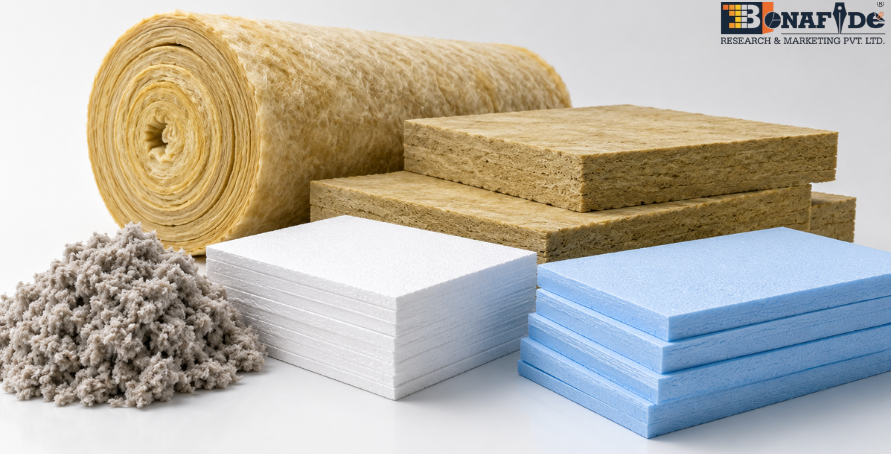
mineral wool continue to have a strong presence because contractors are familiar with their installation and distribution networks are well established. EPS and other rigid insulation products remain popular in fa?ades, floors, foundations, and below-grade applications, while PUR/PIR is gaining attention in projects where high thermal performance is needed without adding significant thickness to walls or roofs. Spray and foamed products are finding more opportunities in difficult cavities and complex building details where conventional insulation can be harder to install. Sustainability is becoming another consideration, with developers increasingly looking at recycled content, manufacturing efficiency, product durability, and lifecycle performance. Manufacturers are also dealing with changing energy and raw-material costs, transportation expenses, and the need to maintain reliable regional supply. As a result, suppliers are increasingly competing on product quality, technical support, availability, and ease of installation rather than price alone.
PUR/PIR is the fastest-growing material segment in the Global Building Insulation Materials Market, supported by its ability to provide high thermal resistance without requiring thick insulation assemblies. This characteristic is particularly useful in walls, roofs, fa?ades, and other areas where construction space is limited. As developers look for ways to improve building efficiency without sacrificing usable space, PUR/PIR is gaining attention in higher-performance construction and renovation projects. The material can also support designs where improved thermal performance needs to be achieved within relatively compact assemblies. Glass wool remains widely used in conventional construction because it is readily available and familiar to contractors, while mineral and stone wool remain important where fire and acoustic performance are key considerations. EPS and XPS continue to compete strongly in applications where affordability, moisture resistance, and rigid construction are important. The growing focus on energy-efficient envelopes and space-efficient construction is expected to create further opportunities for PUR/PIR across both new buildings and refurbishment projects.
Wall insulation represents the largest application segment globally because walls cover a substantial portion of the
building envelope and have a direct effect on indoor temperatures and energy use. The segment includes cavity walls, masonry construction, external insulation systems, internal insulation, continuous insulation, and specialized fa?ade assemblies. Different construction methods call for different products, with glass wool and mineral wool widely used in framed walls, EPS and rigid boards common in fa?ade and masonry systems, and PUR/PIR increasingly selected where high thermal performance is needed within limited wall thickness. Spray and foamed products can also be useful around irregular cavities, penetrations, and difficult building details. Renovation is adding further demand as building owners look for practical ways to improve the performance of existing walls without completely rebuilding the structure. Insulation is increasingly being planned together with windows,
cladding, air barriers, and moisture-control systems, making wall performance an important part of the overall building-envelope strategy. The combination of large wall areas, new construction, and retrofit activity gives the application a broad and durable demand base.
Non-residential buildings are the fastest-growing building-type segment, supported by investment in offices, hotels, retail properties, warehouses,
logistics facilities, healthcare buildings, schools, industrial sites, and other commercial and institutional structures. These projects often have more demanding insulation requirements because owners are concerned not only with energy use but also with fire safety, noise control, moisture, durability, and long-term operating costs. Large warehouses and logistics facilities can create significant demand because of their extensive roof and wall areas, while offices, hotels, hospitals, and educational buildings increasingly require better thermal and acoustic performance to improve occupant comfort. Industrial and specialized facilities can also require insulation products designed for more demanding operating conditions. Residential buildings continue to account for a large share of overall demand, particularly in markets with strong housing construction, but non-residential projects are creating attractive growth opportunities as businesses and institutions invest in modernizing their properties. Renovation is also becoming important as owners upgrade older commercial buildings to improve energy performance, reduce operating costs, and maintain property value.
Batt and
blanket insulation is the largest product form globally, supported by its straightforward installation, broad availability, and compatibility with conventional construction methods. These products are widely used in framed walls, ceilings, attics, partitions, and roof assemblies, where they can be fitted between or across structural members. Glass wool is especially prominent in this format, while mineral wool and other fibrous materials are also available for projects requiring additional fire, acoustic, or thermal performance. Contractors generally have extensive experience working with batt and blanket products, and the materials can be installed without the specialized equipment often required for spray-applied systems. Different thicknesses and densities also allow contractors and designers to select products according to the performance requirements of individual assemblies. Spray and foamed insulation is gaining ground in applications involving irregular spaces, difficult access, or air-sealing requirements, while rigid boards are useful where moisture resistance, compressive strength, or continuous insulation is needed. Even with these developments, the simplicity, flexibility, and established supply network of batt and blanket products continue to support their leading position.
Renovation and retrofit is the fastest-growing construction-stage segment as building owners increasingly look for ways to improve the performance of existing properties. A large number of older buildings were constructed with insulation levels that no longer meet current expectations, creating opportunities for upgrades to walls, roofs, fa?ades, ceilings, floors, and foundations. Insulation work is often carried out alongside roof replacement, fa?ade refurbishment, interior modernization, or wider energy-efficiency improvements, allowing owners to address several building-performance issues within the same project. Retrofit work can be more complicated than new construction because contractors may have to deal with occupied spaces, existing finishes, irregular cavities, limited access, and unknown conditions within the building envelope. This is increasing interest in products that are flexible and easier to adapt to existing structures. Spray and foamed systems can be useful in difficult areas, while rigid boards and fibrous products can support a range of external and internal upgrade approaches. Europe is particularly well positioned for renovation-driven demand because of its large and relatively old building stock, while North America also offers significant opportunities through residential refurbishment and commercial property upgrades. Although new construction remains a major source of insulation demand, renovation provides a growing long-term opportunity as building owners seek lower energy costs, improved comfort, and better-performing assets.
Europe leads the Global Building Insulation Materials Market, supported by its large existing building stock, established construction industry, strong focus on energy-efficient buildings, and substantial renovation requirements. Germany, France, Italy, the United Kingdom, and Spain remain important markets, while colder Northern European countries continue to require effective thermal protection during winter and Southern European markets are placing greater emphasis on reducing cooling demand and managing overheating. The region has a well-developed market for glass wool, mineral and stone wool, EPS, PUR/PIR, and other insulation systems, allowing products to be selected according to individual building and performance requirements. Renovation is particularly important because many European buildings were constructed before today's energy-performance expectations and require improvements to walls, roofs, fa?ades, floors, and other envelope components. Commercial and institutional buildings are also creating opportunities as owners modernize offices, hotels, schools, public buildings, retail properties, and industrial facilities. Buyers are increasingly considering thermal performance alongside fire safety, acoustic properties, moisture control, sustainability, durability, and long-term operating costs. This combination of renovation activity, technical expertise, established supply networks, and growing demand for better-performing buildings is expected to keep Europe at the forefront of the global insulation materials market.
















 We are friendly and approachable, give us a call.