The global
optoelectronics industry finds itself at an inflection point, propelled by an insatiable global appetite for bandwidth and the escalating computational demands of
artificial intelligence. Over the past five years, this sector has undergone a profound metamorphosis, transitioning from a component supplier into the fundamental nervous system of the
digital economy. This evolution is largely fueled by the relentless expansion of 5G networks and the proliferation of data centers, which are consuming optical components at an unprecedented rate. The Photonics21 technology platform highlights this shift, noting that China's
photonics industry share has surged from 10% to over 30% globally in two decades, challenging traditional strongholds. However, this rapid ascent is not without friction; the industry grapples with complex geopolitical fragmentation exposing critical supply chain vulnerabilities. Furthermore, the transition towards quantum photonics, moving from laboratories to commercial deployment, presents both a monumental opportunity and a significant technical hurdle. The sector is increasingly defined by the imperative for lab-to-fab acceleration, demanding substantial investment to bridge the gap between cutting-edge research and scalable manufacturing. This dynamic environment, where innovation races against infrastructural and geopolitical constraints, is shaping a market that is becoming as much about strategic resilience as it is about technological prowess. The push for domestic production in key regions, exemplified by policies like China's push for self-sufficiency, is fundamentally altering global trade flows and investment strategies within the optoelectronics ecosystem.
According to the research report "Global Optoelectronics Market Outlook, 2031," published by Bonafide Research, the Global Optoelectronics market was valued at more than USD 49.57 Billion in 2025, and expected to reach a market size of more than USD 83.12 Billion by 2031 with the CAGR of 9.23% from 2026-2031. Dominated by a mix of established semiconductor giants and agile photonics specialists, the competitive landscape is characterized by fierce rivalry and relentless innovation. Companies like Intel, through its
silicon photonics endeavors, and Coherent are actively deploying photonic integrated circuits (PICs) within their transceivers, setting the pace for technological advancement. The value chain is complex, spanning from raw material suppliers of gallium arsenide and silicon carbide to equipment manufacturers and final system integrators. A significant barrier to entry is the immense capital expenditure required for state-of-the-art fabrication facilities, alongside the scarcity of specialized talent in optical engineering and RF design. Recent supply chain disruptions, particularly the shortage of 100G EML and InP-based laser chips, have exposed the fragility of the ecosystem, creating bottlenecks for 400G and 800G module production essential for AI data centers. Investment is flooding into the sector, driven by the need to overcome these constraints. Government initiatives are pivotal; for instance, South Korea's plan to invest $520 billion by 2047 to build the world's largest semiconductor cluster and China's directives to promote domestic electronics manufacturing are reshaping the investment and funding landscape. This influx of capital is accelerating the adoption of
advanced packaging and heterogeneous integration techniques, signaling a future where photonics and electronics are inextricably linked.
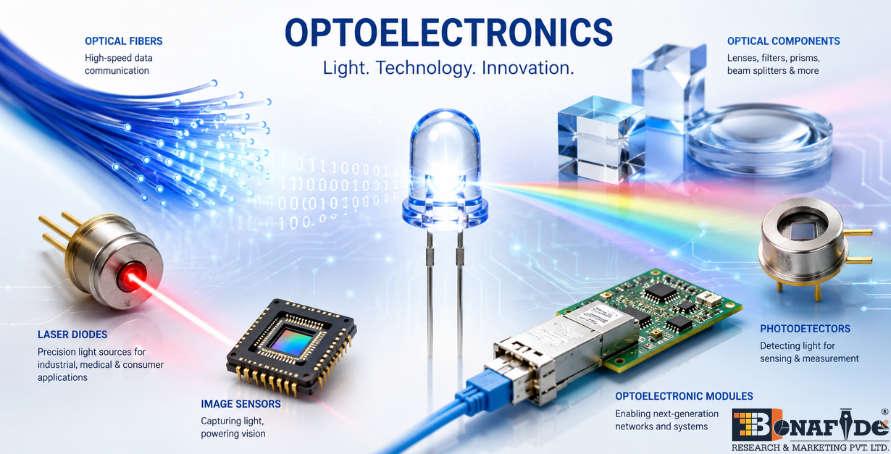
Laser diodes dominate due to their unmatched precision, speed, and efficiency in converting electricity into focused light, making them indispensable for high-bandwidth data transmission and advanced sensing. Laser diodes are the critical enablers of modern fiber-optic communication networks, forming the backbone of the internet and global data exchange. Their ability to modulate light at gigahertz frequencies is essential for the 800G and 1.6T transceivers powering AI data centers. In the automotive sector, they are the core component of LiDAR systems, providing the high-resolution 3D mapping necessary for autonomous driving. The industrial sector relies on them for precision manufacturing, from cutting and welding to additive manufacturing, where their focused energy allows for unprecedented accuracy. In consumer electronics, they are fundamental to 3D sensing for
facial recognition and augmented reality applications, driving demand in smartphones. The defense and aerospace industries depend on them for range-finding, targeting, and secure communications, highlighting their strategic importance. Their scalability and decreasing cost per unit of output, driven by advancements in
semiconductor manufacturing, continue to expand their addressable market into new applications like medical diagnostics and therapy. Finally, the push for energy efficiency in all sectors favors laser diodes, which can achieve higher electro-optical conversion efficiencies than many alternative light sources.
The communication segment's rapid growth is driven by the insatiable need for bandwidth from AI, cloud computing, and 5G, making optical interconnects the bottleneck and primary solution for modern networks. The exponential increase in global data traffic, fueled by
video streaming, cloud services, and the Internet of Things, places immense pressure on network infrastructure. Optical communication, using light to transmit data through fiber-optic
cables, offers virtually unlimited bandwidth compared to traditional
copper wiring. Data centers, the physical hubs of the cloud, are undergoing massive upgrades to their internal networks, with
optical transceivers being the key to connecting thousands of
servers at high speeds. The deployment of 5G networks relies on a dense fiber-optic fronthaul and backhaul infrastructure to connect base stations, creating a massive demand for
optoelectronic components. Within these data centers, the rise of AI workloads, which require vast amounts of data to be moved between processing units, has made networking the primary bottleneck. This has accelerated the adoption of advanced optical technologies like co-packaged optics (CPO) to overcome these limitations. Furthermore, the ongoing expansion of
submarine and terrestrial fiber-optic cables to connect continents and countries ensures a steady, long-term demand for high-performance communication components. The industry consensus is that photonics holds the key to providing the necessary freedom to scale computing power across multiple racks.
Silicon carbide (SiC) is the fastest-growing device material because its superior thermal conductivity and wide bandgap enable smaller, more efficient, and higher-power optoelectronic devices than traditional silicon. The wide bandgap of SiC allows it to operate at much higher voltages and temperatures than silicon, a critical advantage for
power electronics in electric vehicles and industrial drives. This property makes it ideal for high-power LEDs and laser diodes that generate significant heat, as SiC can dissipate this heat more effectively, improving reliability and longevity. The material enables the miniaturization of devices, as components can be made smaller without sacrificing performance, a key trend in portable and space-constrained electronics. SiC-based devices exhibit lower switching losses, leading to higher overall system efficiency, which is paramount for
battery-powered applications like EVs. The material's robustness is essential for optoelectronic components used in harsh environments, such as aerospace, defense, and deep-well drilling. Government initiatives, such as South Korea's plan to create a "southern semiconductor innovation belt" connecting Gwangju (advanced
packaging), Busan (power semiconductors), and Gumi (materials), are directly fostering SiC development. Major manufacturers are investing heavily in SiC production capacity, driving down costs and making it more competitive with traditional materials. The automotive industry's commitment to electrification creates a massive and sustained demand for SiC power devices, providing a solid
foundation for its market growth.
Telecommunications leads the optoelectronics market as the fundamental driver is the relentless pursuit of higher bandwidth and lower latency, which are only achievable through advanced photonic technologies. The entire telecommunications industry is undergoing a massive infrastructure upgrade cycle to support 5G and prepare for 6G, which is inherently photonics-intensive. Telecommunication networks represent the largest single installation base for fiber-optic cables and components globally, providing a constant, high-volume demand. The shift towards all-optical networks, like NTT's IOWN initiative in Japan, aims to replace electronic switching with photonic technology, promising a revolutionary leap in speed and energy efficiency. The capacity of telecommunications networks directly fuels the growth of all other digital sectors, making investment in this vertical a foundational priority for national economies. Governments worldwide classify robust telecommunication infrastructure as a matter of national security, leading to strategic funding and policy support that de-risks investment. The industry has a well-established and highly consolidated supply chain, capable of deploying new technologies at a massive scale, which accelerates the adoption of next-generation components. And as the demand for video, AR/VR, and
cloud gaming explodes, telecom operators are forced to continuously upgrade their networks, ensuring a persistent and growing market for optical components. The consensus at OFC 2025 highlighted that the photonics community has a vital role to play, but it requires a fundamental change in how networks are architected.








 We are friendly and approachable, give us a call.