The Global
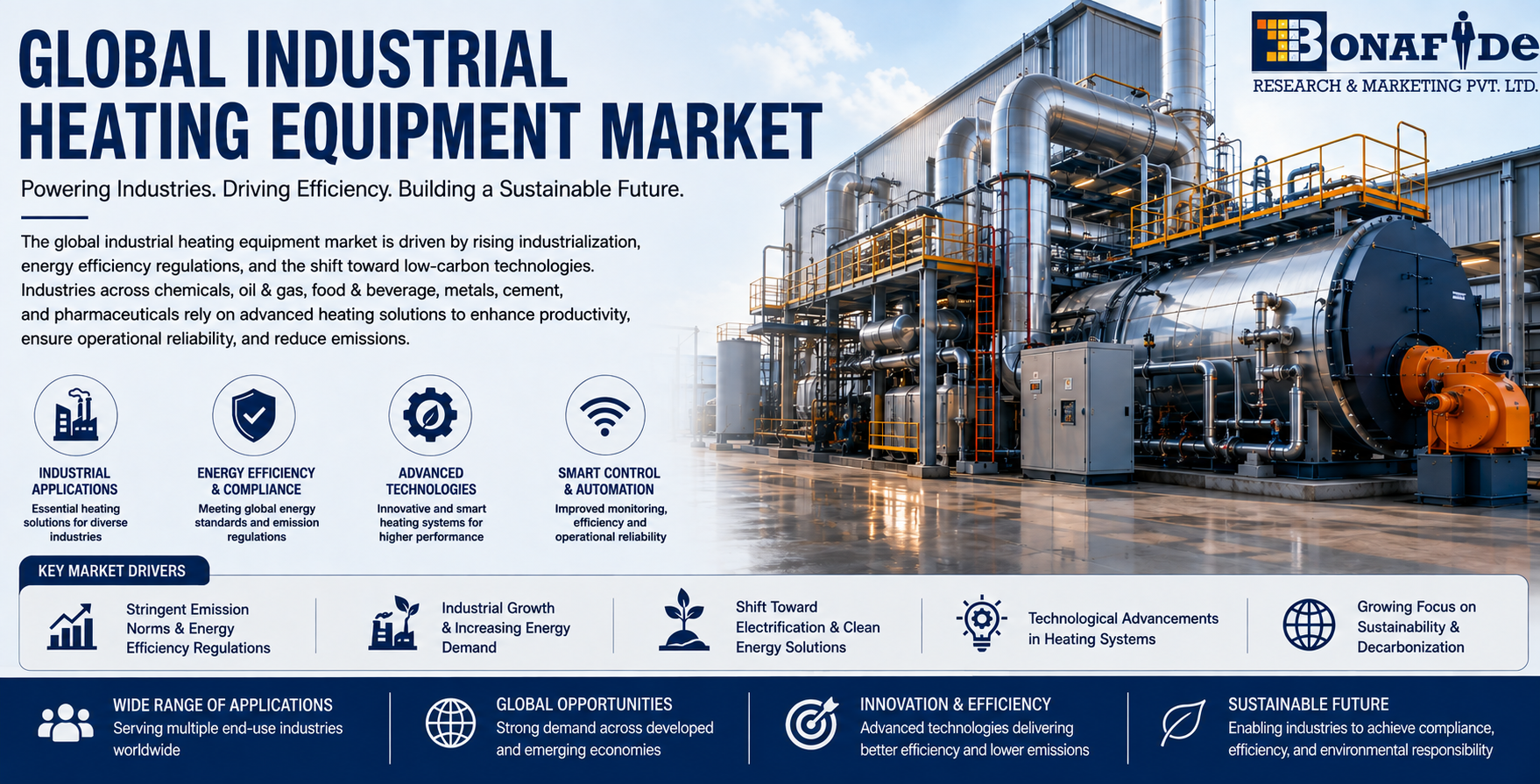
Industrial Heating Equipment Market is undergoing a fundamental transformation as industries worldwide confront the dual imperatives of decarbonization and operational efficiency in thermal energy management. The market encompasses a comprehensive portfolio of solutions including
industrial boilers, furnaces, process heaters, industrial ovens, thermal fluid heaters, and electric industrial heaters deployed across chemicals, petrochemicals, food &
beverage, pharmaceuticals, metals & mining, power generation, and other energy-intensive industries. Process heating accounts for approximately two-thirds of final industrial energy consumption, making the sector a primary focus of global decarbonization efforts. The regulatory landscape has accelerated dramatically in recent years, creating both compliance imperatives and market opportunities. The European Union's Medium Combustion Plant Directive (MCPD) has applied to existing plants between 5 and 50 MW since January 2025, requiring compliance with stringent Emission Limit Values (ELVs) for NOx, SO?, and dust. In the United States, the Environmental Protection Agency (EPA) enforces National Emission Standards for Hazardous Air Pollutants (NESHAP) for industrial, commercial, and institutional boilers and process heaters, while the Department of Energy (DOE) continues updating federal energy conservation standards for commercial
heating equipment and related thermal systems. Canada continues strengthening minimum energy-efficiency requirements for commercial boiler equipment through federal regulations and provincial decarbonization initiatives. Across Asia Pacific, China's "Dual Carbon" goals are driving the phase-out of small coal-fired boilers, India's Perform, Achieve, and Trade (PAT) scheme requires designated consumers to reduce specific energy consumption, and Japan's 7th Strategic Energy Plan sets ambitious emissions reduction targets. Beyond regulatory factors, the market is evolving through strategic consolidation, technological innovation, and the accelerating transition toward electrification and hydrogen-ready systems.
According to the research report "Global Industrial Heating Equipment Market Outlook, 2031," published by Bonafide Research, the Global Industrial Heating Equipment Market was valued at more than USD 50.84 Billion in 2025, and expected to reach a market size of more than USD 69.78 Billion by 2031 with the CAGR of 5.56% from 2026-2031. Rapid innovation and strategic consolidation are reshaping the competitive landscape. Manufacturers are integrating IoT-enabled controls, AI-assisted optimization,
predictive maintenance, and advanced combustion technologies to improve efficiency and reduce lifecycle costs. In November 2025, Watts Water Technologies completed the acquisition of Superior Boiler, a manufacturer of customized steam and hot water boilers with annualized sales of approximately $60 million, expanding its capabilities across firetube, watertube, and condensing boiler systems. The Industrial Heating Equipment Association (IHEA) announced its 2025-26 Board of Directors in May 2025, with Gary Berwick of Dry Coolers, Inc. serving as president, reflecting the industry's focus on sustainability and decarbonization. Major players including Bosch Industrial Heat, Thermax, Babcock Wanson, Miura, Cleaver-Brooks, and Fulton continue to strengthen their market positions through continuous innovation, strategic partnerships, and geographic expansion. Companies are focusing on integrating smart technologies such as IoT and AI to enhance system performance and reduce operational costs. Product portfolio diversification and customized solutions tailored to specific industry requirements further support competitive differentiation and sustained market growth.Wet
dust control systems lead the Global Industrial Heating Equipment Market because they deliver superior efficiency in managing particles across varying sizes and operating conditions, while utilizing water-based suppression techniques that effectively capture airborne particles and support improved air quality. The dominance of wet systems is not a recent development but a result of their cost-effectiveness, ability to function efficiently in large operational areas, and suitability for demanding industrial environments. Venturi wet scrubbers, a key wet technology, are gradually replacing traditional dry dust collection equipment, particularly in industries such as chemical, pharmaceutical, metallurgy, food, and waste incineration. The equipment achieves high dust collection efficiency and is suitable for handling fine dust particles across a wide diameter range. Their ability to handle sticky, explosive, and high-temperature dusts makes them a superior choice for challenging applications across chemical processing, metalworking, mining, and waste-to-energy operations. This combination of proven performance, cost-effectiveness, and operational reliability makes wet dust collection the preferred solution for the world's most demanding dust control applications.
Industrial boilers lead the Global Industrial Heating Equipment Market because they support the world's extensive chemical, food processing, and power generation infrastructure across all major regions, while advancing condensing and electric technologies enable compliance with tightening emissions and efficiency regulations. The dominance of industrial boilers is rooted in their unparalleled versatility and the extensive installed base across industrial facilities worldwide. Boilers provide the steam and hot water essential for a vast array of industrial processes, from distillation and sterilization to drying and cleaning. The sector is undergoing significant transformation, with a pronounced shift from conventional fire-tube and water-tube designs toward high-efficiency
condensing units capable of achieving thermal efficiencies above 90%. Electrode boilers and electric steam generators are gaining traction in clean manufacturing applications, driven by regulatory pressure and corporate sustainability commitments. In February 2025, Bosch Industrial Heat presented the new ELHB electric boiler, generating 250 to 5,500 kilowatts with efficiencies up to 99.6 percent, utilizing surplus green electricity for sustainable industrial heating applications. The aftermarket for boiler replacements, burner upgrades, and control system retrofits represents a substantial and recurring revenue stream, as the global installed base ages and faces tightening emission standards.
Electric industrial heaters are the fastest-growing equipment type globally as industrial decarbonization initiatives expand and electrification strategies accelerate across major economies. Electric boilers, electrode boilers, and electric steam generators offer high efficiency, fast thermal response, and precise control. The European Commission's Innovation Fund Heat Auction (IF25), launched with a budget of up to €1 billion, provides substantial funding for projects that decarbonise industrial process heat through electric boilers, resistance heating, and induction heating. In May 2026, the Commission selected 65 projects to receive nearly €400 million in funding across ten European countries, expected to avoid more than 6.6 million tonnes of CO? emissions. South Korea announced a "
Heat Pump Deployment Activation Plan" in December 2025 targeting 3.5 million units by 2035. India's National Green Hydrogen Mission and Japan's Green Innovation Fund project "Decarbonization of Thermal Processes in the Manufacturing Sector" are developing carbon-neutral compatible
industrial furnaces. This convergence of regulatory pressure, technological maturity, and financial incentives is accelerating the adoption of electric industrial heaters across the globe.
Replacement and retrofit activities constitute the dominant mode of operation globally, driven by the vast aging installed base of industrial heating equipment and tightening emission standards across major economies. Thousands of boilers, furnaces, and process heaters installed during the industrial expansions of the 1990s and early 2000s are now reaching the end of their service life. Rather than undertaking costly full-system replacements that require extended production shutdowns, operators are increasingly opting for targeted upgrades retrofitting existing units with high-efficiency burners, advanced combustion controls, heat recovery systems, and
electric heating elements. This approach extends equipment life, improves efficiency, and achieves regulatory compliance at a fraction of the cost of new installations. The MCPD's phased compliance deadlines in Europe, the EPA's NESHAP requirements in the United States, Canada's MSAPR compliance requirements, and China's industrial energy efficiency standards are driving significant retrofit activity. Government-funded industrial decarbonization programs across North America, Europe, and Asia are providing financial support for such retrofit projects, further sustaining demand for modernization services and replacement components.
Combustion heating remains the dominant heating technology globally, as fossil fuels natural gas, coal, and oil continue to power the majority of industrial thermal processes due to extensive infrastructure and regional resource availability. Despite the accelerating transition toward electrification, the sheer scale of the installed combustion equipment base and the economic advantages of established fuel supply chains ensure that combustion heating will retain its leadership position for the foreseeable future. Natural gas dominates in North America and parts of Europe, coal remains a significant fuel in Asia, and oil and gas are prevalent in the Middle East. However, the combustion landscape is evolving, with manufacturers introducing alternative-fuel-compatible burners capable of operating on hydrogen,
biofuels, and blended fuels. Bosch boiler technology enables the integration of alternative fuels, with hydrogen boilers already in use in chemical companies for many years. H?-ready systems, which can be retrofitted when hydrogen becomes available, are another example of the industry's forward-looking approach. Low-NOx burner technologies are increasingly specified for new installations, while emissions regulations continue to tighten requirements for existing combustion equipment.
Asia Pacific leads the global industrial heating equipment market, underpinned by the world's largest manufacturing base, the most extensive installed capacity of industrial boilers, and rapid industrialization across emerging economies. China operates the world's largest installed base of industrial boilers, with continuous efficiency improvements driven by the country's "Dual Carbon" policy framework and industrial modernization programs. India's rapidly expanding manufacturing sector, supported by the National Green Hydrogen Mission and energy efficiency programs, is creating sustained demand for industrial heating equipment across chemicals, food processing, and textiles. Japan and South Korea continue to lead in advanced combustion and hydrogen-ready technologies, while ASEAN nations particularly Vietnam, Thailand, Indonesia, and Malaysia are experiencing robust industrial growth that drives new equipment installations. North America remains a significant market, driven by the United States' extensive manufacturing base, stringent emissions regulations, and infrastructure investment. Europe continues to lead in industrial decarbonization policy, with comprehensive regulatory frameworks and substantial funding for electrification projects. The Middle East and Africa are experiencing rapid industrial expansion under national diversification strategies, while South America's market is shaped by Brazil's sugar-
ethanol sector and emerging decarbonization initiatives. Collectively, these regional dynamics position Asia Pacific as the dominant force in the global industrial heating equipment market, accounting for the largest share of worldwide demand for industrial boilers, furnaces, process heaters, and electric heating systems.










 We are friendly and approachable, give us a call.