The Global
Laser Cutting Equipment Market is undergoing significant transformation as manufacturers increasingly require reliable, high-speed, high-precision, and flexible cutting technologies across automotive, aerospace and defense, electronics, industrial machinery,
metal fabrication, construction,
shipbuilding,
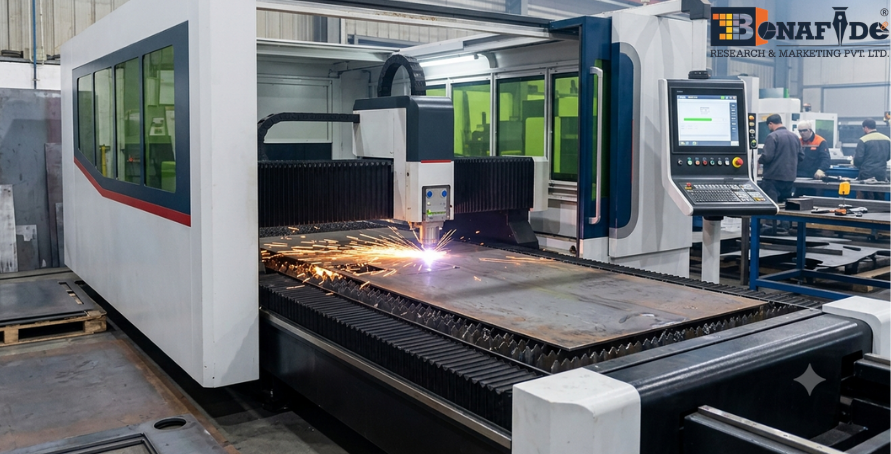
medical equipment, and other manufacturing applications. Laser cutting equipment plays a critical role in processing metals and selected non-metallic materials, enabling manufacturers to achieve improved cutting accuracy, faster production, reduced material waste, complex geometries, and greater manufacturing flexibility. The market includes 2D flatbed laser cutting machines, tube and pipe laser cutting machines, sheet and tube laser cutting machines, 3D laser cutting machines, automated laser cutting cells, laser sources, cutting heads, automation and material-handling systems, control software, and associated equipment. Demand is evolving beyond conventional flat-sheet cutting toward fiber
laser technology, high-power systems, tube and profile processing, 3D cutting, automated cutting cells, and digitally connected production systems. Manufacturers are increasingly focusing on higher laser power, improved beam quality, energy efficiency, automation compatibility, intelligent process controls, real-time monitoring,
predictive maintenance, and Industry 4.0 connectivity to improve productivity and reduce operating costs. Fiber laser cutting machines represent a major market opportunity because of their high energy efficiency, faster processing capabilities, relatively low maintenance requirements, compact design, and suitability for a broad range of metals including mild steel,
stainless steel,
aluminum,
copper, brass, and other alloys. High-power laser systems are becoming increasingly important as manufacturers seek faster processing and higher throughput for medium and thick material applications. Systems in the 6–12 kW, 12–20 kW, and above 20 kW categories are gaining attention across heavy fabrication, industrial machinery, structural components, automotive manufacturing, and large metal-processing applications. Higher power enables manufacturers to increase cutting speeds, improve productivity, and process thicker materials while supporting greater automation and production efficiency. The market is also being transformed by increasing automation. Automatic loading and unloading, robotic material handling, automated part sorting, machine vision, sensors, process monitoring, and integrated production-management software are increasingly being incorporated into laser cutting systems. These technologies reduce manual intervention, improve machine utilization, increase production consistency, and support unmanned or minimally attended manufacturing operations. Automated laser cutting cells are particularly relevant for high-volume automotive and industrial manufacturing environments. Automotive and industrial manufacturing remain major demand centers, while
electric vehicle production,
battery manufacturing, aerospace and defense, electronics, semiconductor-related applications, medical devices,
construction equipment, and advanced metal fabrication are creating additional opportunities. The growing use of
lightweight materials, high-strength steels, aluminum alloys, and other advanced materials is also increasing demand for flexible and high-precision laser cutting technologies.
According to the research report, "Global Laser Cutting Equipment Market Outlook, 2031," published by Bonafide Research, the global laser cutting equipment market was valued at more than USD 7.27 Billion in 2025 and is anticipated to grow at more than 7.61 % CAGR from 2026 to 2031. Market estimates can vary depending on the definition of laser cutting equipment, equipment categories included, geographic coverage, and whether laser sources, automation systems, software, accessories, and related services are included in the market value. For this analysis, the market is defined around commercially manufactured equipment specifically designed for laser-based cutting and processing applications. The scope includes 2D flatbed laser cutting machines, tube and pipe laser cutting machines, sheet and tube laser cutting machines, 3D laser cutting machines, automated laser cutting cells, fiber laser cutting machines, CO? laser cutting machines, solid-state laser cutting machines, other laser technologies, cutting heads, automation systems, material-handling equipment, control software, and associated accessories. The material scope includes mild steel, stainless steel, aluminum, copper, brass, titanium, other metals, and selected non-metallic materials depending on laser type and application. This definition provides a focused assessment of equipment directly associated with industrial laser cutting while minimizing overlap between machine systems, laser sources, and related components. The competitive landscape includes global machine-tool manufacturers, specialized laser cutting equipment suppliers, laser-source manufacturers, cutting-head suppliers, automation providers, software developers, and regional equipment manufacturers. Competition is increasingly shifting from basic equipment pricing toward cutting speed, laser power, precision, energy efficiency, automation, software integration, customization, reliability, technical support, and lifecycle services. Manufacturers are expanding their portfolios across different machine configurations and power ranges to serve customers ranging from small fabrication shops to large automated production facilities.
Automotive and electric vehicle manufacturing provide significant commercial opportunities because laser cutting is used for body components, chassis parts, brackets, structural components, battery enclosures, and lightweight materials. Aerospace and defense applications create demand for highly precise cutting of titanium, aluminum alloys, nickel-based materials, and other specialized materials. Electronics and semiconductor-related manufacturing contributes through precision processing of thin materials and specialized components, while industrial machinery and
general metal fabrication provide a broad and diversified customer base. The transition toward electric vehicles, lightweight structures, high-strength steels, and advanced manufacturing processes is creating additional cutting requirements that favor fiber laser systems. Manufacturers are increasingly replacing conventional technologies such as plasma, oxy-fuel, and mechanical cutting where laser systems can provide improved precision, productivity, flexibility, and material utilization. Tube and profile cutting is also expanding as manufacturers seek to process increasingly complex structural and tubular components using a single advanced production platform. Digitalization is changing laser cutting equipment design as manufacturers integrate sensors, cameras, machine connectivity, remote monitoring, data analytics, intelligent process controls, and predictive-maintenance technologies. These capabilities can improve cut quality, reduce downtime, optimize cutting parameters, increase machine utilization, and support data-driven production.
Artificial intelligence and software-based process optimization are also creating opportunities for automated parameter selection, defect detection, production monitoring, and cutting-performance optimization. Automation represents another major development area. Manufacturers are increasingly integrating automatic sheet loading and unloading, robotic handling, automated sorting, storage systems, and connected production lines. These systems help address labor shortages while improving throughput and production consistency. Fully integrated cutting cells can connect laser cutting with material storage, part handling, inspection, and downstream manufacturing operations, supporting the development of smart factories and lights-out production environments.
Overall, the global laser cutting equipment market is positioned for sustained expansion through 2031, supported by the transition from conventional cutting technologies toward laser-based systems, increasing adoption of fiber
lasers, rising demand for high-power equipment, automation and robotic integration, electric vehicle manufacturing, aerospace production, electronics manufacturing, and factory modernization. Fiber laser technology, high-power systems, automated cutting cells, tube and profile processing, intelligent software, and digitally connected equipment are expected to remain the most important areas of market development through the forecast period. These developments are expected to strengthen the strategic importance of laser cutting equipment across the global manufacturing and industrial landscape.
















 We are friendly and approachable, give us a call.