The global
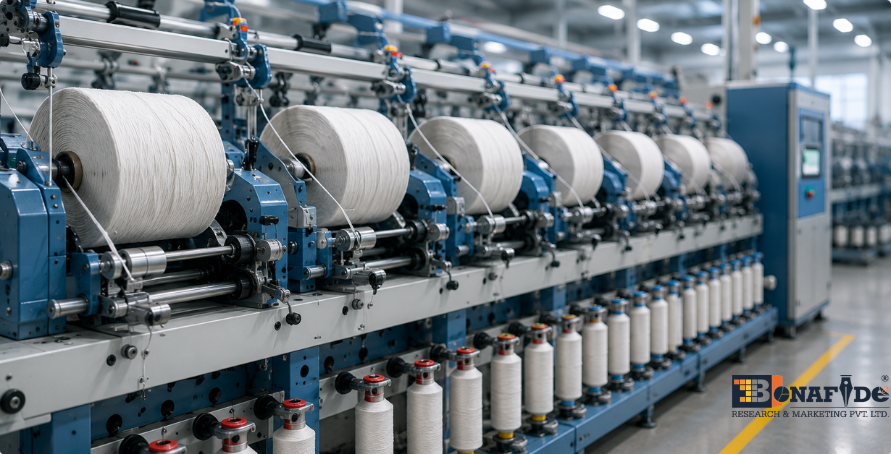
spinning machinery market forms the foundational infrastructure of the
textile industry, transforming raw fibres cotton, polyester, wool, and viscose into continuous yarn through a sequence of processes including blow room, carding, drawing, roving, spinning, and winding. The Indian Omnibus Technical Regulation mandates compulsory Bureau of Indian Standards (BIS)
certification for
textile machinery including spinning and weaving machines, with implementation beginning August 2025. Tamil Nadu's Integrated Textile Policy 2025–26 commits ?500 crore over the next decade for spinning sector modernization, offering interest subvention for replacing ageing capacity 60% for ring frame spinning mills, 15% for air-jet/electrospinning, and 25% for open-end spinning rotor kits. A national spinning mills modernization scheme provides interest subsidy for five years to replace machinery over five years old. In the EU, the Eco-Design Regulation, Waste Framework Directive, and Product Environmental Footprint Category Rules are reshaping equipment requirements. CEMATEX has registered with the EU Transparency Register to actively engage in these legislative consultations. Opportunities ahead include increasing adoption of automation and digitalization in spinning mills, rising demand for sustainable and eco-friendly fibres requiring modern machinery, and significant growth potential in emerging Asia-Pacific and African markets driven by expanding textile industries. In a landmark development, Rieter Holding AG received approval from the Competition Commission of India in September 2025 to acquire OC Oerlikon Textile Holding AG and Oerlikon Textile Inc. The transaction was expected to receive all regulatory approvals and complete in the fourth quarter of 2025.
According to the research report "Global Spinning Machinery Market Outlook, 2031," published by Bonafide Research, the Global Spinning Machinery Market was valued at more than USD 5.78 Billion in 2025, and expected to reach a market size of more than USD 7.73 Billion by 2031 with the CAGR of 5.09% from 2026-2031.Jakob M?ller Group acquired 100% of MEI International effective January 2025. The market is experiencing steady growth driven by increasing textile demand across apparel,
home furnishings, and automotive sectors. Technological advancements in automation and digitalization are enhancing productivity and efficiency. The rising trend of sustainable and eco-friendly fibres is leading to the adoption of modern spinning machinery capable of processing these materials effectively. Raw materials for spinning machinery primarily include steel, aluminium, electronics, and precision components. The 2025 tariff environment has introduced new frictions in sourcing patterns, with cost increases for imported machinery prompting firms to reassess supplier portfolios, prioritise local and regional suppliers, and invest in modular architectures that reduce dependence on specific imported parts. International trade in spinning machinery is substantial, with major exporting nations including Switzerland, Germany, Japan, Italy, and China. India's textile machinery sector is subject to evolving import regulations, including mandatory BIS certification and local retesting requirements. The air-jet spinning machine J 70, designed for cost-effective carded fibre spinning, features a newly developed twist element that takes production speed to new levels. The OMEGAlap E 40 combing preparation machine produces 800 kg/h 33% more than its predecessor with 30% lower energy consumption and 63% lower compressed air consumption.
Ring spinning machines continue to dominate the global spinning machinery landscape due to their proven ability to produce yarn that satisfies the demanding quality requirements of a broad range of textile products. The spinning principle employed in these machines creates strong fiber cohesion through continuous drafting and twisting, resulting in yarn with excellent tensile strength, uniformity, smoothness, and durability. These characteristics are highly valued in the production of woven fabrics, knitted garments,
denim, shirting, home furnishings, industrial textiles, and specialty fabrics where yarn performance directly influences the final product's appearance, longevity, and processing efficiency. One of the defining strengths of ring spinning technology is its remarkable adaptability to numerous fiber materials, including cotton, polyester, viscose, wool, linen, acrylic, and various
blended fibers, allowing manufacturers to respond to changing material availability and customer preferences without replacing core production systems. In addition, ring spinning machines are capable of producing an extensive range of yarn counts, from coarse yarns for heavy-duty fabrics to extremely fine yarns required for premium apparel and luxury textiles, making them suitable for diverse manufacturing requirements. The yarn produced through ring spinning also demonstrates superior dye absorption, better fabric feel, and improved resistance to mechanical stress during subsequent weaving, knitting, finishing, and garment production processes. These qualities help textile manufacturers maintain consistent product standards while minimizing defects during downstream operations.
The rapid expansion of technical and industrial textiles has significantly increased the demand for sophisticated spinning machinery capable of producing specialized yarns that meet strict functional and engineering requirements rather than aesthetic expectations alone. Unlike conventional apparel textiles,
technical textiles are designed to deliver specific performance characteristics such as high tensile strength, dimensional stability, flame resistance, chemical resistance, abrasion resistance, filtration efficiency, thermal
insulation, electrical conductivity, or moisture management, depending on their intended application. These products are extensively utilized across industries including automotive, construction, agriculture, healthcare, aerospace, defense, energy,
geotextiles, filtration systems, transportation,
packaging, and protective equipment, where reliability and performance are essential. Producing such specialized textiles requires yarns manufactured with exceptional consistency, controlled fiber orientation, and precise structural properties, placing greater emphasis on advanced spinning technologies capable of processing high-performance fibers such as aramid, carbon fiber precursors, glass fibers, ultra-high molecular weight
polyethylene,
polypropylene, polyester, viscose, and engineered fiber blends. Modern spinning machinery supports these requirements through accurate drafting systems, electronic monitoring, optimized tension control, and automated quality inspection, ensuring that yarn properties remain consistent throughout production. In addition,
technical textile manufacturers frequently require customized yarn specifications to satisfy industry regulations, product certifications, and demanding operational environments, encouraging continuous investment in versatile spinning equipment capable of accommodating different fiber types and production parameters.
Synthetic fibers have become the dominant fiber type driving demand for spinning machinery because their engineered characteristics offer manufacturers greater control over yarn quality, production efficiency, and end-product performance than many naturally occurring fibers. Materials such as polyester,
nylon, acrylic, and polypropylene are produced under controlled industrial processes, resulting in fibers with highly uniform length, diameter, strength, and cleanliness. This consistency minimizes variations during spinning, allowing machinery to operate at stable speeds with fewer interruptions and improved process reliability. Unlike
natural fibers that are influenced by
weather conditions, soil quality, harvesting methods, and seasonal availability, synthetic fibers provide predictable raw material properties throughout the year, enabling textile manufacturers to maintain standardized production and consistent yarn specifications. Their excellent mechanical properties, including high tensile strength, abrasion resistance, elasticity, dimensional stability, and resistance to moisture, make them suitable for an extensive range of textile products, from apparel and home furnishings to automotive fabrics, industrial textiles, filtration materials, ropes, geotextiles,
sportswear, and
protective clothing. Synthetic fibers also possess favorable thermal and chemical resistance characteristics, allowing fabrics to perform effectively in demanding industrial and outdoor environments. Another important advantage is their compatibility with advanced fiber engineering techniques, enabling manufacturers to modify cross-sectional shapes, filament fineness, crimp, luster, moisture management, flame resistance, ultraviolet protection, antimicrobial properties, and conductivity according to specific application requirements.
Automatic spinning machinery has become the preferred automation level across the global spinning industry because it combines advanced process control with high operational efficiency, enabling manufacturers to achieve consistent yarn quality while reducing dependence on manual intervention. Modern spinning facilities operate under demanding production schedules where maintaining uniform yarn characteristics is essential for downstream weaving, knitting, dyeing, and finishing operations. Automatic machines address this requirement by integrating electronic drafting controls, automatic doffing systems, yarn piecing mechanisms, spindle monitoring, bobbin transport, tension regulation, and real-time quality inspection into a synchronized production environment. These technologies reduce process variability and ensure that yarn properties remain within precise specifications throughout extended production cycles. Unlike manually operated systems, automatic machinery can continuously detect yarn breaks, correct operational irregularities, restart production quickly, and monitor machine performance without requiring frequent operator involvement, thereby reducing downtime and improving equipment utilization. Another important advantage is the ability to collect production data through integrated sensors and
digital monitoring platforms, allowing manufacturers to analyze machine performance, identify maintenance requirements before failures occur, optimize energy consumption, and maintain stable operating conditions. Automatic systems also improve workplace safety by minimizing direct interaction with rapidly rotating spindles and moving mechanical components while reducing repetitive manual handling tasks associated with bobbin replacement and material movement.
















 We are friendly and approachable, give us a call.