The global
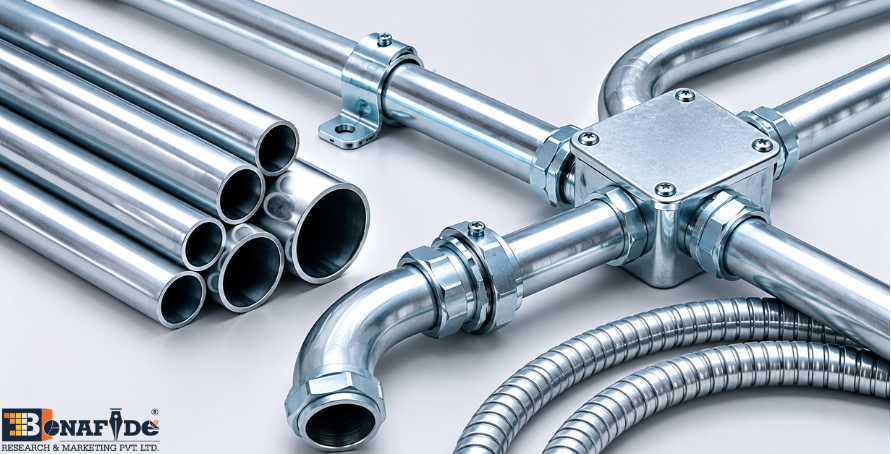
electrical conduit market comprises the manufacturing, distribution, and installation of conduit systems used to protect, route, and organize electrical wiring in residential, commercial, industrial, utility, and infrastructure applications. The market generated USD 8.45 billion in revenue and accounted for a total volume of 1,269.64 million meters. Electrical conduits are produced from metallic materials such as steel and
aluminum as well as non-metallic materials including PVC, HDPE, and fiberglass, providing mechanical protection, fire resistance, moisture resistance, and enhanced electrical safety. These systems are essential components of modern electrical networks because they reduce the risk of cable damage, electrical faults, and fire hazards while ensuring compliance with increasingly stringent building and safety regulations. The market plays a critical role in supporting urbanization, industrialization, and infrastructure modernization projects worldwide. Key growth drivers include rising investments in power transmission and distribution networks, expansion of
renewable energy installations such as solar and wind farms, increasing construction of commercial buildings and data centers, growth in
industrial automation, and the deployment of
smart grid and
smart building technologies. The growing adoption of
electric vehicle charging infrastructure and energy storage facilities is further increasing demand for reliable conduit systems capable of protecting complex wiring networks. Industry activities include product innovation in flexible, corrosion-resistant, flame-retardant, and halogen-free conduits, along with the development of prefabricated solutions that reduce installation time and labor costs. The market is supported by electrical safety standards and regulatory organizations such as the National Fire Protection Association and its National Electrical Code framework, which influence conduit specifications and installation practices globally.
The global electrical conduit market is a critical segment of the electrical infrastructure industry, encompassing metallic and non-metallic conduit systems used to protect, route, and organize electrical wiring across residential, commercial, industrial, utility, transportation, and renewable energy applications. The market is benefiting from rapid urbanization, grid modernization programs, expansion of data centers, industrial automation, and increasing investments in renewable energy projects worldwide. Electrical conduits play a vital role in ensuring electrical safety, regulatory compliance, fire protection, and long-term reliability of power distribution networks. The industry’s value chain begins with raw material suppliers providing steel, aluminum, PVC, HDPE, fiberglass, and
specialty polymers, followed by conduit manufacturers, fittings and accessories producers, distributors, electrical wholesalers, engineering contractors, and finally end users in construction, manufacturing, energy, and infrastructure sectors. Fluctuations in steel, aluminum, and polymer prices remain important supply-chain considerations because they directly affect production costs and profitability. Major participants include Atkore, ABB, Schneider Electric, Eaton Corporation, Hubbell Incorporated, Southwire Company, and Legrand, all of which continue to strengthen manufacturing capabilities and distribution networks. Significant opportunities are emerging from smart buildings, electric vehicle charging infrastructure,
battery energy storage systems, and hyperscale
data center construction, which require advanced conduit solutions for complex cabling systems. Recent developments include Atkore’s introduction of halogen-free and flame-retardant flexible conduit systems in 2025, targeting commercial buildings, transportation infrastructure, and data centers, while ABB partnered with Wieland Electric to launch a modular electrical distribution platform designed to reduce installation time and lower project costs.
Flexible conduit has gained significant traction across modern construction and industrial projects because electrical systems are becoming increasingly complex and distributed. Unlike rigid conduit systems, flexible conduits can bend around obstacles, fit into confined spaces, and accommodate frequent equipment movement without requiring extensive cutting, threading, or custom fittings. This characteristic is particularly valuable in manufacturing facilities, data centers, transportation infrastructure, renewable energy installations, and commercial buildings where electrical layouts often change during installation or expansion phases. Industrial machinery,
HVAC equipment,
robotics, automated production lines, elevators, and rail systems generate constant vibration and movement, creating conditions where rigid conduit may experience stress at connection points. Flexible conduit helps absorb these mechanical forces while maintaining cable protection and electrical integrity. Another important factor is labor efficiency. Electrical contractors increasingly prioritize products that reduce installation time and simplify maintenance activities, especially in regions facing skilled labor shortages. Flexible conduit systems can often be installed with fewer tools and less structural modification, lowering project complexity and minimizing downtime during repairs or upgrades. The growing deployment of rooftop solar systems, battery storage facilities, electric vehicle charging infrastructure, and modular construction methods has further strengthened demand because these applications frequently require adaptable wiring pathways. Flexible conduit is also available in metallic and non-metallic forms, enabling its use across indoor, outdoor, corrosive, wet, and high-temperature environments.
The energy and utility sector relies heavily on conduit systems because electrical networks must operate safely and reliably under demanding environmental and operational conditions. Around the world, utility operators are upgrading aging transmission and distribution infrastructure to improve grid resilience, accommodate growing electricity demand, and integrate new energy sources. These modernization projects require substantial volumes of conduit systems to protect power
cables, communication lines, control wiring, and monitoring systems from moisture, corrosion, physical impact, and environmental degradation. Renewable energy facilities such as solar farms, wind power plants, hydroelectric stations, and battery energy storage systems have become particularly important drivers of conduit demand because they contain extensive electrical networks spread across large geographic areas. In addition, the expansion of smart grid technologies requires sophisticated communication and control systems that depend on secure cable routing and protection. Governments and utilities are also investing in underground power distribution to improve reliability and reduce vulnerability to extreme
weather events, increasing the need for durable conduit solutions. Electrification initiatives, including electric vehicle charging infrastructure, railway electrification, and industrial decarbonization projects, further contribute to conduit consumption because each installation requires protected electrical pathways. Utility environments often expose electrical systems to harsh conditions such as temperature fluctuations, chemical exposure, UV radiation, and mechanical stress, making conduit protection essential for long-term operational performance.
Non-metallic conduit materials, particularly PVC, HDPE, fiberglass, and other engineered polymers, have become increasingly preferred across construction, utility,
telecommunications, and industrial projects because they address many of the practical challenges associated with modern infrastructure development. One of their most significant advantages is resistance to corrosion. Unlike metallic conduits, which may require protective coatings or additional maintenance in corrosive environments, non-metallic products naturally withstand moisture, chemicals, salts, fertilizers, and various industrial contaminants. This characteristic makes them especially suitable for underground installations, wastewater facilities, coastal developments, renewable energy projects, and utility networks. Their lightweight nature also simplifies transportation, handling, and installation, reducing physical labor requirements and improving job-site productivity. Contractors often benefit from easier cutting, joining, and routing processes, which can shorten installation schedules and reduce project complexity. Non-metallic conduits additionally provide excellent electrical
insulation properties, helping prevent unintended current conduction and enhancing overall system safety. Telecommunications networks, fiber-optic deployments, and data communication infrastructure increasingly utilize non-metallic conduit because of its compatibility with sensitive communication cables and its resistance to environmental degradation. Material innovations have further expanded their use by improving impact strength, UV resistance, flame retardancy, temperature tolerance, and structural durability. Urban infrastructure expansion and underground utility installations have also favored non-metallic solutions because they perform well in buried environments where corrosion can significantly affect metallic alternatives.















 We are friendly and approachable, give us a call.