The Global
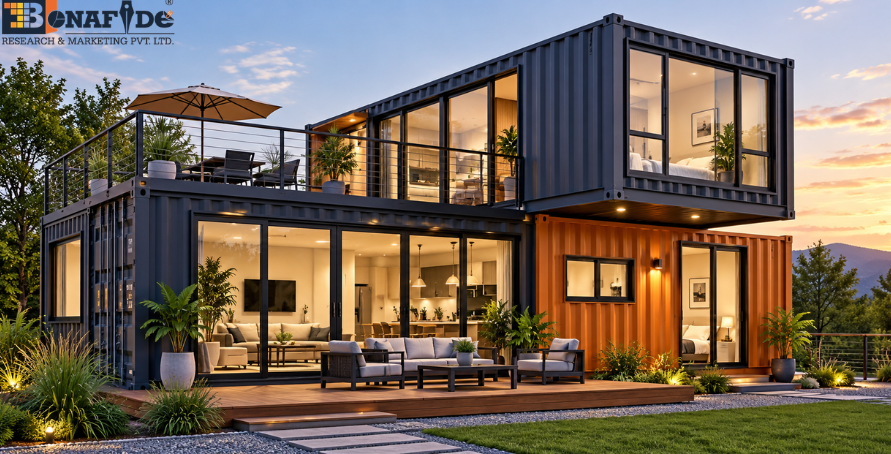
Container Homes Market is experiencing strong growth as the construction industry increasingly embraces modular and prefabricated housing solutions to address rising housing costs, rapid urbanization, and sustainability goals. Built from repurposed or purpose-built steel
shipping containers, container homes offer faster construction timelines, lower material waste, and greater design flexibility than conventional housing, making them an attractive option for residential, commercial, emergency, and recreational applications. Growing investments in green building technologies and factory-built construction methods are further strengthening market expansion. Increasing housing affordability challenges across developed and developing economies are encouraging governments, developers, and private homeowners to adopt alternative housing models. Container homes have emerged as a practical solution due to their shorter construction periods, modular scalability, and ability to be customized for diverse applications, including single-family homes, multi-storey apartments, student housing, disaster relief shelters, and tourism accommodations. Their reduced construction waste and compatibility with energy-efficient technologies align well with global sustainability initiatives and circular economy objectives. Technological advancements in modular construction are transforming the industry by improving structural durability, thermal
insulation, energy efficiency, and architectural flexibility. Manufacturers are increasingly integrating
smart home technologies,
renewable energy systems, and factory-controlled production processes to enhance quality while minimizing on-site labor requirements. These innovations are enabling container homes to compete more effectively with traditional residential construction, particularly in regions facing skilled labor shortages and increasing construction costs.
North America continues to lead the global container homes market due to strong demand for affordable housing, widespread acceptance of modular construction, and supportive investments in sustainable residential infrastructure. Europe is witnessing increasing adoption driven by stringent environmental regulations and circular construction initiatives, while Asia Pacific is emerging as a high-growth region supported by rapid urbanization, population growth, and expanding investments in prefabricated housing solutions. The growing emphasis on resilient housing for disaster recovery and climate adaptation is also creating new opportunities for container home developers worldwide. Industry participants are actively expanding their product portfolios through innovative container home designs, strategic partnerships,
digital customer platforms, and international expansion initiatives. Recent developments, including hurricane-resistant container home solutions, eco-friendly modular housing launches, affordable housing projects, and new supportive housing developments, demonstrate the market's continued evolution toward sustainable, resilient, and cost-effective construction solutions. As governments and developers seek scalable approaches to address global housing shortages, the container homes market is expected to witness sustained long-term growth driven by innovation, affordability, and environmental sustainability.
According to the research report "Global Container Homes Market Outlook, 2031," published by Bonafide Research, the Global Container Homes market was valued at more than USD 68.21 Billion in 2025, and expected to reach a market size of more than USD 100.03 Billion by 2031 with the CAGR of 6.76% from 2026-2031.
New and idle container solutions hold the largest market share and represent the fastest-growing segment in the global container homes market as the industry matures and consumer expectations for quality, aesthetics, and performance increase worldwide. New containers, also referred to as one-trip containers, have been used only once for shipping and are in near-original condition, providing superior structural integrity, consistent dimensions, and unblemished surfaces ideal for high-end finishing that meets international design standards. These containers are particularly attractive for premium residential projects, commercial developments, architectural showcase projects, and government sector developments where quality and appearance are paramount. The segment dominance is driven by the growing number of global homeowners, developers, housing authorities, and commercial investors willing to invest in higher-quality containers that offer predictable performance, reduced maintenance concerns, superior aesthetic outcomes, and compliance with demanding local building standards. Consumer purchasing behavior is characterized by increasing demand for customized container specifications, including custom openings, factory-applied insulation appropriate for diverse global climates, pre-installed utility roughers, and high-quality finishes.
Factory-built container homes represent the dominant construction method and the fastest-growing segment in the global container home market, offering advantages that align with the core value proposition of container construction: speed, quality, and cost predictability. Off-site fabrication allows container homes to be built in climate-controlled facilities where quality control, precision cutting, consistent finishing, and rigorous quality assurance are achieved regardless of
weather conditions or site constraints that vary significantly across global climates. The factory environment enables sophisticated assembly line production, with skilled labor working efficiently in controlled conditions rather than navigating site-based challenges that slow traditional construction across different countries. The segment leadership is reinforced by the increasing preference among global buyers for predictable construction timelines, reliable quality standards, simplified project management, and documented compliance with local building regulations that factory building provides. Consumer purchasing behavior reveals strong preference for factory-built container homes among first-time buyers, investors, housing authorities, developers, and government clients who value predictability in construction timelines, costs, and regulatory compliance across different jurisdictions.
Fixed container homes represent the dominant installation type in the global container home market, with permanent foundations and conventional utility connections providing the stability and permanence associated with traditional housing and meeting local building code requirements. The permanence of fixed container homes addresses key consumer concerns about security, stability, community integration, and property value, making these structures acceptable in established residential neighborhoods where temporary structures would not be permitted and where planning regulations require permanent construction. Consumer purchasing behavior reveals strong preference for fixed container homes among families, couples, individuals seeking primary residences, and investors viewing container homes as long-term property assets across global markets. Adoption patterns indicate that fixed container homes are most common in suburban, peri-urban, and urban applications where zoning requirements, community standards, planning regulations, and homeowner expectations align with permanent construction and where property ownership and real estate investment are valued. Product innovations in the fixed segment include advanced
foundation systems optimized for container support across different soil conditions and global climates, integrated utility connections that conceal mechanical systems within the container structure, and landscaping solutions that integrate container homes into established neighborhoods
Multi-storey container apartment buildings represent the fastest-growing architecture type in the global container home market, addressing critical needs for affordable housing, social housing, and urban residential development in cities worldwide where land costs are high, housing demand is intense, and development opportunities are constrained. Shipping containers' inherent structural strength, standardized dimensions, and stackable design make them ideal for multi-story construction, with containers capable of supporting significant loads when properly engineered and designed to meet local structural standards including seismic and wind load requirements. The modular nature of container apartment construction enables faster completion compared to traditional multi-family construction, allowing developers, housing authorities, and government agencies to address housing shortages more quickly and efficiently. Consumer purchasing behavior in this segment is characterized by institutional buyers, including housing authorities, social housing providers, government agencies, non-profit developers, cooperative housing organizations, and commercial property investors seeking cost-effective, sustainable, rapidly deployable housing solutions for urban locations.
Residential homes represent the dominant end-user segment in the global container home market, driven by the fundamental need for housing, growing interest in alternative homeownership options, and increasing demand for sustainable, climate-appropriate housing worldwide. Single-family container homes appeal to a broad demographic spectrum globally, from first-time buyers seeking affordable entry into homeownership in high-cost urban markets to retirees looking to downsize, from environmental enthusiasts to architectural design lovers, and from urban professionals to rural property owners seeking distinctive, sustainable housing solutions. The residential segment encompasses a wide range of container home applications, from primary residences and second homes to accessory dwelling units, guest houses, and multi-generational living solutions that address diverse global housing needs. Consumer purchasing behavior in this segment is characterized by high emotional involvement, significant research and due diligence, strong emphasis on customization and personalization, and careful attention to climate-appropriateness and sustainability credentials. Adoption patterns indicate that residential container home buyers globally are typically motivated by a combination of factors, including cost savings, environmental considerations, design uniqueness, climate-appropriate design, and the satisfaction of participating in innovative housing solutions that align with sustainability values. Product innovations include comprehensive homeowner packages that guide buyers through the entire container home process, from site selection to move-in, consumer-friendly educational resources that demystify container home construction, and design studios that offer professional design services for residential container projects.
















 We are friendly and approachable, give us a call.