The Global
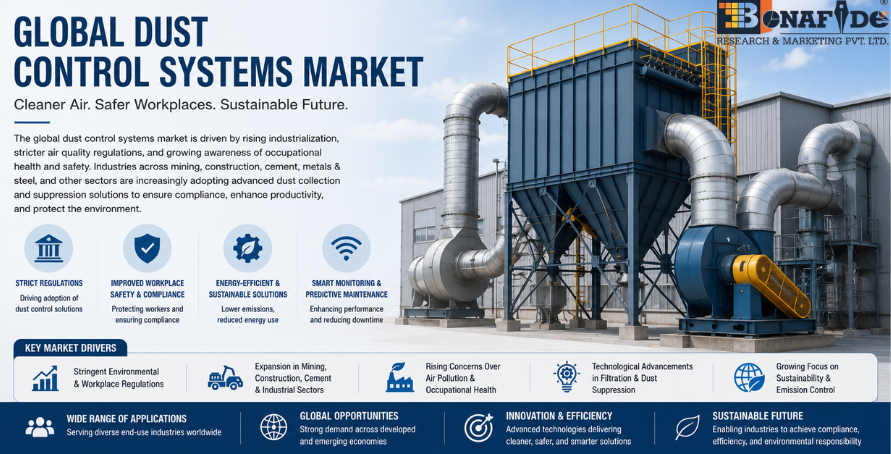
Dust Control Systems Market is undergoing a fundamental transformation as industries worldwide confront the dual imperatives of regulatory compliance and operational excellence in air quality management. The market encompasses a comprehensive portfolio of solutions including wet scrubbers, baghouse filters, cartridge collectors, electrostatic precipitators, and cyclone separators deployed across construction, mining, oil and gas, chemical, pharmaceutical, and
food and
beverage industries. The regulatory landscape has accelerated dramatically in recent years, creating both compliance imperatives and market opportunities. In the United States, the Mine Safety and Health Administration (MSHA) finalized its respirable crystalline silica rule in 2024, reducing the permissible exposure limit (PEL) and introducing stricter monitoring and action limits, with compliance deadlines for coal mines and metal and non-metal mining operations. The U.S. Environmental Protection Agency (EPA) strengthened the annual PM2.5 National Ambient Air Quality Standard in 2024, marking the first tightening in over eight years. In Europe, the revised Ambient Air Quality Directive (EU) 2024/2881 mandates a significant reduction in fine PM2.5 particles with transposition required by December 2026. Beyond regulatory factors, the market is evolving through strategic consolidation, technological innovation, and shifting raw material dynamics, with industry participants seeking to secure supply chains, access new technologies, and strengthen their positions in the rapidly evolving air quality management landscape.
According to the research report "Global Dust Control Systems Market Outlook, 2031," published by Bonafide Research, the Global Dust Control Systems Market was valued at more than USD 19.09 Billion in 2025, and expected to reach a market size of more than USD 25.35 Billion by 2031 with the CAGR of 4.97% from 2026-2031. The market encompasses a wide range of technologies including wet scrubbers, baghouse filters, cartridge collectors, electrostatic precipitators, and cyclone separators deployed across industries such as construction, mining, oil and gas, chemical, pharmaceutical, and food and beverage. The industry has made significant progress, with technological advancements such as automated controls, IoT-enabled monitoring, and enhanced filtration materials improving system performance. Strategic consolidation is reshaping the competitive landscape. In October 2024, ABB acquired Fodisch Group to enhance its capabilities in emissions monitoring and analytics, expanding its product portfolio in dust and fume extraction systems. In April 2024, Donaldson Company launched the Downflo Evolution Pre-assembled Small Dust Collector (DFPRE-2), featuring advanced filtration technology with
high dust-holding capacity, easy maintenance, and energy-efficient operation. In October 2020, Donaldson introduced the Torit rugged pleat baghouse industrial dust collector for
cement, mining, and food applications. Major players including Donaldson, Camfil, Nederman, Parker Hannifin, and AAF International continue to strengthen their market positions through continuous innovation, strategic partnerships, and geographic expansion. Companies are focusing on integrating smart technologies such as IoT and AI to enhance system performance and reduce operational costs. Product portfolio diversification and customized solutions tailored to specific industry requirements further support competitive differentiation and sustained market growth.
Wet dust control systems lead the Global Dust Control Systems Market because they deliver superior efficiency in managing particles across varying sizes and operating conditions, while utilizing water-based suppression techniques that effectively capture airborne particles and support improved air quality. The dominance of wet systems is not a recent development but a result of their cost-effectiveness, ability to function efficiently in large operational areas, and suitability for demanding industrial environments. Venturi wet scrubbers, a key wet technology, are gradually replacing traditional dry dust collection equipment, particularly in industries such as chemical, pharmaceutical, metallurgy, food, and waste incineration. The equipment achieves high dust collection efficiency and is suitable for handling fine dust particles across a wide diameter range. Their ability to handle sticky, explosive, and high-temperature dusts makes them a superior choice for challenging applications across chemical processing, metalworking, mining, and waste-to-energy operations. This combination of proven performance, cost-effectiveness, and operational reliability makes wet dust collection the preferred solution for the world's most demanding dust control applications.
Cartridge dust collectors are the fastest-growing technology segment in the Global Dust Control Systems Market because they deliver exceptional fine particulate capture efficiency within a compact, modular design that enables rapid deployment, easy maintenance, and operational versatility across diverse industrial applications. Cartridge collectors are increasingly adopted across pharmaceutical, food processing, metalworking, and welding applications where space constraints and fine particulate capture are priorities. Their pleated
filter design packs vast filtration
surface area into a compact footprint, making them ideal for space-constrained facilities in urban industrial zones. The lower energy consumption and extended filter life of modern cartridge collectors further enhance their appeal, helping operators manage operating costs while meeting stringent discharge limits. The integration of pulse-jet cleaning systems with intelligent monitoring platforms has improved dust collection efficiency while reducing operational and maintenance costs. This convergence of regulatory pressure, operational flexibility, and financial accessibility is cementing cartridge dust collectors as the fastest-growing technology segment in the global market.
Fixed and stationary dust control systems are the leading mobility segment globally because they provide the continuous, high-capacity performance essential for the world's immense, permanent industrial operations where 24/7 production cycles and massive dust loads demand infrastructure engineered for durability, integration, and long-term reliability. The fixed segment holds the dominant position in the global industrial dust collector market, primarily driven by its suitability for large-scale operations and various industrial applications. Unlike temporary construction sites, the cement plants, steel mills, refineries, and power generation stations that form the backbone of the global economy are permanent installations designed to operate continuously for decades. These facilities are connected to central dust collection systems through integrated ductwork networks designed to capture emissions from multiple points across the production process. Fixed systems are engineered to handle these demanding conditions with robust construction and high-capacity fans capable of managing the airflow demands of an entire facility. The integration of advanced control systems enables automated operation, optimal pulse-jet cleaning, and comprehensive system monitoring a level of control and reliability economically impractical with
mobile units. This convergence of industrial scale, regulatory pressure, and operational necessity has cemented fixed systems as the dominant mobility segment.
Construction is the fastest-growing end-use industry globally because the sector's extraordinary scale, fueled by massive urbanization and infrastructure investment across the world's largest economies, has created an unprecedented and sustained demand for dust control solutions on job sites that are both environmentally sensitive and heavily scrutinized by increasingly stringent regulations. The construction segment dominates the global dust control systems industry. Dust control systems are essential for minimizing the impact of airborne dust generated during planning, design, execution, and management of infrastructure, buildings, and related projects across residential, commercial, and civil engineering sectors. The expansion of construction activities is a primary driver of market growth, with increasing global construction activities and growing demand for high-quality construction materials driving the cement manufacturing sector. The Asia Pacific region leads global construction activity, driven by rapid urbanization in China and India. The regulatory response has been decisive, with major cities and nations implementing strict dust control regulations for construction. This enforcement has compelled contractors to deploy an array of portable control equipment, driving a high-volume market for mobile units. Public health awareness regarding air quality has turned construction dust into a primary concern, leading to formal requirements for comprehensive Dust Management Plans. This convergence of massive scale, strong regulation, public pressure, and financial risk has made construction the primary engine of growth for the Global Dust Control Systems Market.
















 We are friendly and approachable, give us a call.