The Global
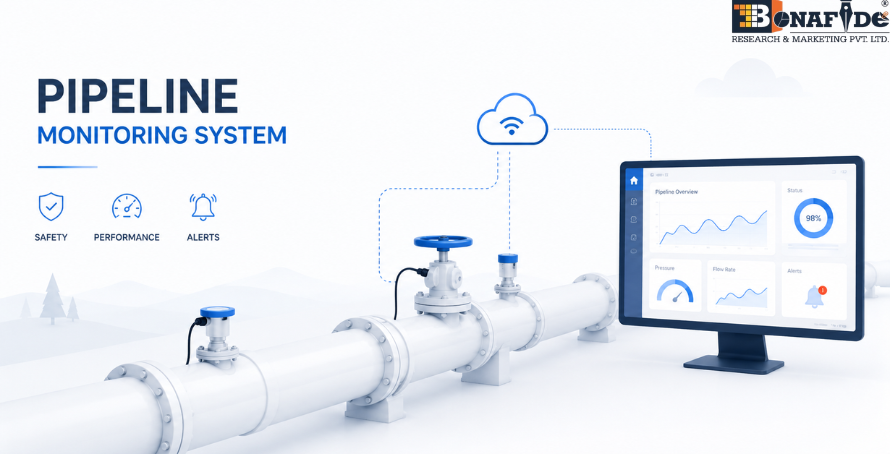
Pipeline Monitoring System Market is experiencing robust growth, driven by the critical need to ensure the safety, integrity, and efficiency of extensive pipeline networks worldwide. Regulatory frameworks and government policies play a pivotal role in shaping the market landscape. Governments worldwide are tightening regulatory scrutiny, demanding shorter detection-to-response intervals and more comprehensive environmental reporting. In India, the Ministry of Petroleum and Natural Gas introduced the Draft Petroleum and Natural Gas Rules, 2025, aimed at modernizing the upstream oil and gas framework with detailed requirements for monitoring and reporting greenhouse gas emissions. Additionally, the Petroleum and Natural Gas Regulatory Board is considering amendments to bring oil companies' dedicated pipelines under its regulatory purview to enhance monitoring and ensure safety compliance. In the United States, the proposed "PIPELINE Safety Act of 2025" seeks to leverage investments in the nation's energy infrastructure to assure safety. These regulatory developments create significant opportunities for market players, as operators are compelled to adopt integrated solutions that provide verifiable audit trails and automated compliance outputs. In a significant development, STATS Group, backed by parent company Mitsui & Co. Ltd, acquired Aberdeen-based pipeline intelligence and cleaning specialist Pipelines 2 Data in April 2026. This acquisition, which followed Mitsui's earlier acquisition of STATS Group in July 2023, is designed to expand STATS' global pipeline integrity and maintenance service offerings, creating a unique service offering that combines P2D's inspection and cleaning expertise with STATS' pipeline isolation and maintenance technologies.
According to the research report "Global Pipeline Monitoring System Market Outlook, 2031," published by Bonafide Research, the Global Pipeline Monitoring System Market was valued at more than USD 18.59 Billion in 2025, and expected to reach a market size of more than USD 27.90 Billion by 2031 with the CAGR of 7.18% from 2026-2031. In January 2025, Siemens entered into a strategic partnership with Atmos International to deploy advanced pipeline leak detection systems across North America and Europe, combining Siemens'
industrial automation expertise with Atmos International's proprietary pipeline monitoring software. The market also saw a major merger in February 2025 when TransCanada and Enbridge announced a merger to create a more robust and integrated pipeline safety solution provider, pooling resources to develop and deploy state-of-the-art pipeline monitoring systems and leak detection technologies. Additionally, Honeywell acquired Senstar in December 2024, a leading provider of physical security systems including perimeter intrusion detection for pipeline security, to expand its portfolio of pipeline safety products. In the realm of technology acquisitions, NDT Global announced the acquisition of Entegra, a premium technology company specializing in Ultra-High-Resolution Magnetic Flux Leakage in-line inspection services, in July 2025.At the 2026 API Pipeline Conference, KROHNE unveiled its next-generation pipeline leak detection and monitoring technology, which combines Computational Pipeline Monitoring based on Extended Real-Time Transient Models with
artificial intelligence and machine learning.
Non-metallic pipes are gaining rapid importance in the global pipeline monitoring system market as industries and utilities increasingly adopt materials that provide long service life, corrosion resistance, and improved performance in diverse operating conditions. Non-metallic pipeline materials such as
polyethylene, fiberglass-reinforced plastic, and composite-based solutions are being used across applications including water distribution, wastewater networks, oil and gas gathering systems, chemical transportation, mining operations, and industrial facilities. These materials offer significant advantages compared with traditional metallic pipelines, particularly in environments where corrosion, chemical exposure, and moisture can negatively affect pipeline performance. However, the growing installation of non-metallic pipes has also increased the need for reliable monitoring technologies that can evaluate pipeline conditions, identify failures, and support preventive maintenance activities. Unlike metallic pipelines, non-metallic pipes may require specialized monitoring approaches to detect issues such as deformation, stress changes, joint problems, pressure abnormalities, and leakage events. This requirement is encouraging the integration of advanced sensing technologies, including acoustic monitoring, pressure-based systems, fiber optic sensing, and
digital inspection platforms. The water and wastewater sector is one of the major areas supporting the increased use of non-metallic pipes because municipalities worldwide are focusing on reducing water losses, improving distribution efficiency, and upgrading aging infrastructure.
PIG-based monitoring remains the leading technology in the global pipeline monitoring system market because of its long-established role in maintaining the safety and reliability of critical pipeline infrastructure across multiple industries. Pipeline networks used for oil, gas, water, chemicals, and industrial materials require regular inspection to identify internal conditions that may affect operational performance. PIG-based monitoring systems provide an effective method for assessing pipeline health by using devices that travel inside pipelines to collect detailed information about internal surfaces, structural conditions, and potential defects. This technology is widely used because it can inspect long-distance pipelines without requiring extensive excavation or major modifications to existing infrastructure. One of the main reasons for its importance is the ability to detect problems such as corrosion, cracks, metal loss, dents, and deformation that may not be visible through external inspection methods. Energy companies around the world rely on pipeline networks that operate under high pressure and challenging conditions, making internal inspection an essential part of integrity management programs. The oil and gas industry is a major user of PIG-based monitoring because pipelines transport valuable and potentially hazardous materials over large distances, where failures can lead to environmental damage, safety risks, and operational interruptions. In addition, water utilities and industrial operators use inspection technologies to improve maintenance planning and extend the service life of pipeline assets.
Pipeline break detection is becoming one of the fastest-growing applications in the global pipeline monitoring system market due to the increasing need to protect essential pipeline infrastructure used across energy, water, industrial, and transportation sectors. Pipelines are critical assets that support the movement of oil, natural gas, chemicals, water, and other important materials over long distances, making their reliability essential for continuous operations. A pipeline break can create severe consequences, including environmental contamination, safety hazards, resource losses, operational interruptions, and expensive repair activities. Because of these risks, operators are increasingly focusing on technologies that can identify early warning signs and detect structural failures before they develop into major incidents. Pipeline break detection systems provide continuous monitoring by analyzing important operational factors such as pressure changes, flow variations, vibration patterns, acoustic signals, and other indicators associated with pipeline damage. These capabilities allow operators to respond quickly and reduce the impact of unexpected failures. The growing complexity of global pipeline networks is also supporting the adoption of break detection solutions. Many pipelines extend through remote locations, offshore areas, urban environments, and challenging geographic regions where traditional inspection methods may not provide immediate information about pipeline conditions. Real-time monitoring technologies improve visibility across these distributed assets and help maintenance teams make faster decisions.
The oil and gas sector represents the leading end-user segment in the global pipeline monitoring system market due to the extensive use of pipelines as a critical infrastructure component for energy production, transportation, and distribution. Across different regions, oil and gas companies operate large networks that connect exploration areas, production fields, processing facilities, refineries, storage terminals, and end consumers. These pipelines often transport high-value and potentially hazardous materials such as crude oil, natural gas, and refined petroleum products, making safety, reliability, and operational continuity essential priorities. Pipeline monitoring systems are widely adopted in this sector because they provide continuous information about pipeline conditions and help identify problems such as leaks, corrosion, pressure fluctuations, structural weaknesses, and external damage. Many oil and gas pipelines operate under high pressure and across challenging environments, including deserts, offshore locations, forests, mountainous regions, and remote areas where regular physical inspection can be difficult. Monitoring technologies allow operators to detect abnormal conditions earlier and take preventive measures before failures result in environmental damage, safety incidents, or production interruptions. The sector also manages many mature pipeline assets that require regular integrity assessments due to long operational periods and exposure to factors such as corrosion, material fatigue, and changing operating conditions.











 We are friendly and approachable, give us a call.