Over the last five years,
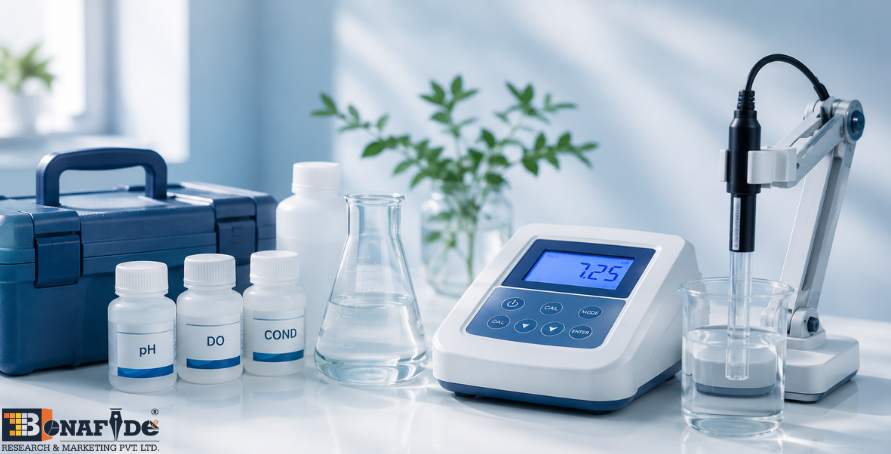
water testing equipment adoption has accelerated due to tightening water safety enforcement and rising contamination concerns across industrial and municipal ecosystems. Expansion of wastewater treatment capacity in Asia-Pacific megacities, combined with stricter discharge monitoring under frameworks such as the US Clean Water Act revisions and European Union Water Framework Directive updates, has reshaped demand patterns. Instrumentation leaders such as Thermo Fisher Scientific, Xylem Inc., and Danaher Corporation have expanded portfolios integrating optical sensing, electrochemical probes, and AI-enabled calibration systems. Municipal utilities and industrial operators increasingly rely on portable and field-deployable devices to reduce lab dependency and improve response time in contamination events. Growth is further reinforced by smart water grid investments, desalination expansion in Middle East-linked supply chains, and
semiconductor manufacturing clusters requiring ultra-pure water validation. Challenges persist in high calibration costs, skilled technician shortages, and inconsistent compliance enforcement across emerging economies. Competitive substitutes such as traditional laboratory chemical titration methods still remain relevant in cost-sensitive regions, though
digital sensor-based systems are steadily replacing them. Regulatory certifications including ISO 5667 water sampling standards and US EPA-approved analytical protocols remain essential for market entry, while trade fairs like IFAT Munich continue to shape technology diffusion and procurement decisions.
According to the research report "Global Water Testing Equipment Market Outlook, 2031," published by Bonafide Research, the Global Water Testing Equipment market was valued at more than USD 4.56 Billion in 2025, and expected to reach a market size of more than USD 6.17 Billion by 2031 with the CAGR of 5.29% from 2026-2031. Industrial water monitoring ecosystems are undergoing structural transformation driven by convergence of laboratory precision instruments and field-based smart analyzers. Companies such as Hach Company under Danaher and Merck KGaA have strengthened reagent-integrated platforms enabling faster biochemical
oxygen demand and heavy metal detection workflows. Enterprise adoption patterns show increasing procurement bundling across municipalities and private utilities, reducing lifecycle costs through integrated service contracts rather than standalone equipment purchases. Competitive intensity remains anchored in sensor accuracy, calibration stability, and interoperability with
SCADA systems used in industrial plants. Investment activity in water analytics startups is supported by environmental governance funding programs across OECD nations, while pricing structures are influenced by import duties on precision optical components and semiconductor-grade sensors. Laboratory modernization initiatives in food processing and pharmaceuticals are driving demand for hybrid benchtop and portable configurations. Entry barriers remain high due to intellectual property concentration in spectroscopy and ion-selective electrode technologies, along with stringent validation requirements under EPA and ISO
certification regimes.
Spectrometers dominate due to high precision multi-parameter detection capability across industrial compliance and
environmental monitoring frameworks globally. Spectrometers maintain leadership in water testing equipment due to their ability to simultaneously detect multiple contaminants including heavy metals, nitrates, and organic compounds with high sensitivity. Regulatory reliance on atomic absorption and UV-Vis spectroscopy methods under EPA-approved protocols has reinforced their widespread deployment. Industrial wastewater monitoring in sectors such as chemicals, oil and gas, and pharmaceuticals increasingly depends on spectrometric validation to meet discharge limits. Technological advancement from companies like Thermo Fisher Scientific and Agilent Technologies has improved detection limits and automation integration. Integration with laboratory information management systems enables real-time data traceability and compliance reporting. Growing environmental litigation risks across North America and Europe have pushed enterprises toward high-accuracy analytical instruments. Replacement cycles are supported by continuous innovation in portable spectrometers used in field testing applications. Rising demand for trace-level contaminant detection in drinking water infrastructure further strengthens adoption across municipal utilities and
bottled water industries.
Benchtop systems lead due to high analytical accuracy, multi-parameter lab integration, and widespread adoption in regulatory compliance testing environments. Benchtop instruments remain dominant as laboratories prioritize precision-driven water quality validation supported by standardized workflows. Centralized testing facilities in municipal utilities, food safety labs, and pharmaceutical industries depend on benchtop systems for reproducible results under controlled environments. Instruments from Hach Company and Metrohm AG integrate automated titration, ion chromatography, and conductivity analysis into unified platforms. Higher sample throughput capability compared to portable devices enhances operational efficiency in large-scale testing centers. Regulatory frameworks requiring documented calibration and audit trails further strengthen laboratory-based instrumentation preference. Capital expenditure justification is supported by longer equipment lifecycle and modular upgrade options. Technicians prefer benchtop systems due to reduced environmental interference and higher detection accuracy across complex water matrices.
Chemical test methods grow rapidly due to immediate contaminant detection capability and strong alignment with regulatory compliance monitoring requirements. Chemical testing dominates due to its ability to rapidly quantify parameters such as chlorine residuals, nitrates,
phosphates, and pH levels in water systems. Municipal treatment plants rely on reagent-based kits and automated chemical analyzers for continuous monitoring of potable water safety. Adoption is strengthened by standardized protocols under WHO drinking water quality guidelines and EPA monitoring requirements. Companies like Xylem Inc. have developed integrated chemical sensing platforms enabling real-time dosing control in treatment facilities. Industrial users prefer chemical testing for rapid process adjustments in cooling water and boiler feed systems. Lower operational complexity compared to spectrometric analysis increases accessibility for field technicians. Expansion
Industrial adoption accelerates due to strict discharge regulations, process water reuse requirements, and rising compliance-driven monitoring across manufacturing sectors. Industrial dominance is driven by tightening environmental compliance across chemical manufacturing, power generation, and food processing sectors. Large-scale plants require continuous monitoring of effluent discharge to comply with environmental protection regulations enforced by agencies such as the US EPA and European Environment Agency. Adoption of
smart sensors and inline analyzers enables real-time process optimization and wastewater reuse efficiency. Companies like Danaher Corporation and Xylem Inc. support industrial clients with integrated monitoring ecosystems. Increasing water scarcity has pushed industries toward closed-loop water recycling systems requiring advanced testing infrastructure. Automation integration with SCADA systems enhances operational control and reduces human intervention in critical monitoring processes.









 We are friendly and approachable, give us a call.