The global
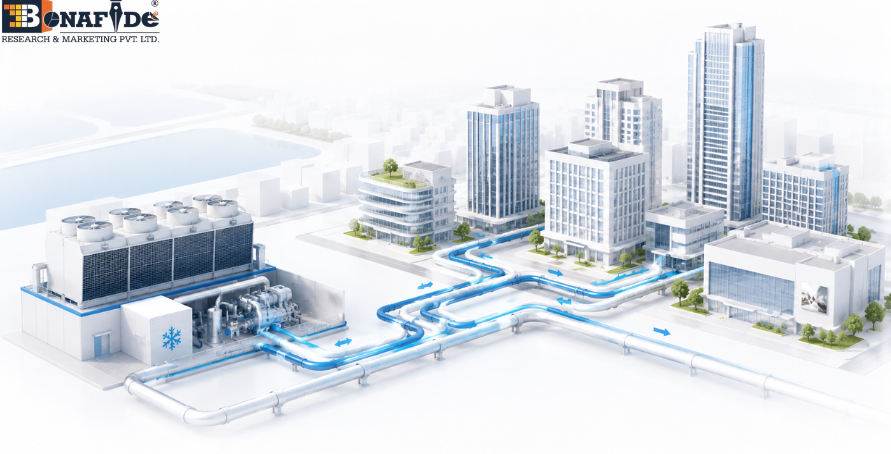
district cooling market is experiencing robust growth, driven by increasing urbanization, rising global temperatures, and a growing emphasis on energy efficiency and sustainability. This centralized system produces chilled water at a central plant and distributes it through an insulated network of pipes to cool multiple buildings, offering a highly efficient alternative to traditional, standalone air conditioning systems. In Hong Kong, the District Cooling Services Ordinance was amended in 2025 to include new development areas like Kwu Tung North and Tung Chung East. Singapore maintains its District Cooling Act and specific regulations to ensure service pricing remains competitive. India is actively advancing district cooling as essential urban infrastructure; in December 2025, stakeholders convened in New Delhi to launch a District Cooling Roadmap and a Virtual District Cooling Hub. This was complemented by the Government of India notifying a National Policy on Geothermal Energy , which supports the use of geothermal energy for district cooling. These regulatory frameworks, combined with government-backed energy efficiency programs and green construction standards, are creating significant opportunities for market expansion. The district cooling market has witnessed significant consolidation and strategic collaborations. The most notable transaction in 2025 was the acquisition of PAL Cooling Holding by a consortium of Tabreed and CVC DIF for AED 3.871 billion (approximately USD 1 billion). This acquisition added approximately 600,000 refrigeration tons (RT) of connected capacity to Tabreed, increasing its pro forma capacity by 13% to 1.55 million RT. The portfolio includes eight long-term concessions in Abu Dhabi with contracts averaging 25 years.
Developed by SP Group and Daikin Airconditioning in a joint venture, the system has a capacity of 36,000 RT. It is expected to reduce carbon emissions by up to 120,000 tonnes per year and enable 20% savings on cooling-related electricity consumption. In a significant international research collaboration, Nanyang Technological University, Aalborg University, and Aarhus University launched the five-year "Sustainable Water-based cooling in Megacities" (SWiM) project in September 2025. Supported by a USD 9.4 million grant from the Grundfos
Foundation its largest single research grant to date the project aims to develop intelligent cooling systems that can reduce energy consumption in large cities by up to 30%. Tabreed, the world's leading district cooling company, has pioneered the region's first geothermal-powered district cooling plant, G2Cool, in Abu Dhabi. The system uses two 2.5 km deep geothermal wells in a closed-loop system to produce chilled water, reducing electricity use by three times compared to traditional air-based cooling and saving 3,000 MWh and 1,000 tons of CO? annually. Another key innovation came from Nokia's R&D and manufacturing campus in Oulu, Finland, which features one of the world's largest CO?-based
district heating and cooling plants, supplying enough waste heat to warm up to 20,000 homes.
Electric chillers dominate the global district cooling landscape due to their fundamental role as the primary mechanism for producing chilled water in centralized cooling networks that serve high-density urban environments worldwide. These systems are widely deployed because they convert electrical energy into cooling using mature vapor-compression technology, which has been continuously refined over decades to improve efficiency, reliability, and performance under varying load conditions. In large metropolitan areas across North America, Europe, Asia-Pacific, the Middle East, and other regions, district cooling systems rely heavily on electric chillers to meet the substantial and continuous cooling demands generated by commercial buildings, airports, hospitals, residential complexes, and industrial facilities. One of the key reasons for their global leadership is their compatibility with increasingly electrified energy systems, as many countries transition toward lower-carbon electricity generation, making electric chillers more aligned with long-term sustainability objectives compared to fuel-based or thermally driven alternatives. Their ability to integrate with modern
smart grid infrastructure also allows operators to optimize energy consumption based on demand fluctuations, peak load management, and real-time pricing signals. Additionally, electric chillers offer high scalability, enabling district cooling operators to expand capacity incrementally as urban districts grow, without requiring fundamental redesign of the system architecture.
The rapid expansion of controls and monitoring systems in the global district cooling market is driven by the growing complexity and scale of modern urban energy infrastructure, where centralized cooling networks serve multiple high-density buildings through interconnected chilled water systems that must be continuously balanced for optimal performance. As district cooling expands across major urban centers in regions such as North America, Europe, Asia-Pacific, the Middle East, and Latin America, operators are increasingly dependent on advanced
digital technologies to manage temperature regulation, flow distribution, and energy consumption across widely distributed assets. These systems rely on supervisory control platforms, building automation systems, and IoT-enabled sensors that provide real-time data on
chiller performance,
pump efficiency, thermal load variations, and distribution network conditions. One of the key drivers behind this growth is the need for energy optimization in response to rising electricity costs and increasing pressure to reduce carbon emissions, which requires precise control over cooling production and distribution processes. In addition, district cooling systems often operate in environments with highly variable demand patterns influenced by
weather conditions, occupancy levels, and building usage, making automated control essential for maintaining system stability and efficiency. The integration of
predictive analytics and machine learning has further enhanced the ability of operators to anticipate equipment failures, optimize maintenance schedules, and reduce unplanned downtime, improving overall system reliability.
The residential application of district cooling across global markets is expanding at a moderate pace due to a combination of structural, economic, and urban planning factors that make centralized cooling less universally applicable in housing environments compared to commercial or institutional sectors. In many cities worldwide, residential buildings are widely dispersed or built in varying architectural styles and densities, which makes it technically challenging and financially intensive to implement district cooling networks at scale. Installing such systems requires significant capital investment in underground piping networks, centralized chilled water plants, and building-level integration infrastructure, which becomes difficult to justify in low-density or already developed residential areas. In contrast, commercial zones and mixed-use districts typically offer higher cooling load concentration and more predictable energy consumption patterns, making them more suitable for district cooling deployment. Another key factor is that a large portion of global residential stock was constructed before district energy systems became widely adopted, particularly in North America, Europe, and parts of Asia and Latin America, which means retrofitting these buildings requires complex engineering modifications and high upfront costs. In addition, individual cooling systems such as split air conditioners and
heat pumps remain widely available and relatively affordable, giving homeowners and residential developers flexible alternatives that do not require integration with centralized infrastructure.















 We are friendly and approachable, give us a call.