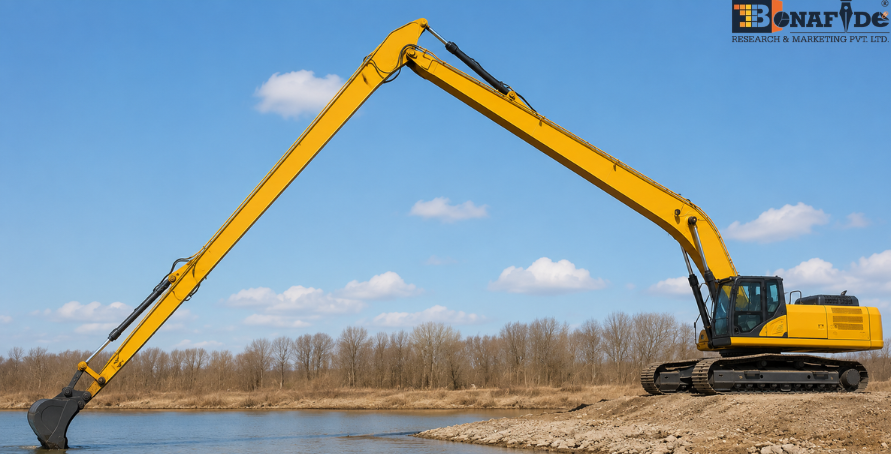
Long reach excavators are revolutionizing heavy construction and infrastructure maintenance by delivering reliable, efficient extended reach capability that enables safe access to difficult work areas from stable operating positions. The long reach
excavator industry has steadily advanced in line with growing infrastructure rehabilitation requirements and urban renewal activity, aiming to improve
dredging productivity, enhance demolition safety, and expand the reach envelope for specialized earthmoving applications across infrastructure, mining, and
environmental remediation sectors. Long reach excavators encompass various configurations including heavy duty demolition machines with reinforced booms, lightweight dredging platforms for canal cleaning, ultra long reach systems for port deepening, and telematics equipped units for
fleet management integration, where extended reach enhances the effectiveness of waterway maintenance, protects operator safety during building dismantlement, reduces environmental disturbance during dredging, and improves project economics across diverse operating conditions. The concept of long reach excavators first emerged in the late twentieth century, starting with field modified standard machines fitted with welded boom extensions for industrial dredging and demolition applications at manufacturing facilities and port operations.
According to the research report "Global Long Reach Excavators Market Outlook, 2031," published by Bonafide Research, the Global Long Reach Excavators market was valued at USD 7.24 Billion in 2025 and is expected to reach a market size of USD 10.66 Billion by 2031 and is anticipated to grow at 6.66% CAGR from 2026 to 2031. The long reach excavator market is witnessing steady expansion owing to the heightened demand for waterway rehabilitation, increasing building demolition in urban corridors, growing port deepening projects, expanding flood control investment, and the shift toward purpose built long reach configurations over field modified standard equipment that may lack proper engineering
certification. Recent innovations involve the launch of long reach excavators with telematics enabled hydraulic monitoring for
predictive maintenance, lightweight high strength boom sections using fabricated steel construction with improved weld integrity, electric hybrid powertrains for zero emission operation in sensitive environments, and quick coupler systems that enable rapid attachment changes between buckets, shears, and grapples without tools. Businesses are concentrating more on intelligent solutions that support remote monitoring, fuel efficiency, and compatibility with fleet management platforms that track utilization and maintenance schedules. Major companies are at the forefront of the market, providing a diverse array of systems including heavy duty demolition long reach configurations, lightweight dredging platforms, ultra long reach systems for port maintenance, and telematics equipped units for infrastructure applications requiring detailed operating data.
Long reach excavators exceeding twenty meter reach capacity enable operators to access work areas at depths exceeding fifteen meters or horizontal clearances beyond eighteen meters, making them essential for deep waterway dredging, tall building demolition, and large scale infrastructure rehabilitation where conventional equipment cannot achieve required positions. These extended reach configurations typically require additional counterweight packages, reinforced boom sections fabricated from high tensile steel, and specialized hydraulic systems that maintain adequate digging force despite the mechanical disadvantage of extended arm geometries compared to standard excavator configurations. Operators of ultra long reach platforms require advanced training and certification because machine stability characteristics change significantly with boom extension, including reduced lift capacity at full reach and amplified platform sway during slewing operations that demands greater operator skill and attention. Demolition contractors increasingly specify above twenty meter reach machines for dismantling structures exceeding ten stories, as these units can position shearing attachments at upper building elevations while maintaining safe standoff distances from unstable collapse zones that protect operators and ground personnel. Port and harbor authorities driving deepening projects for larger vessel accommodation require extended reach dredging equipment capable of removing accumulated sediments from navigation channels without entering sensitive aquatic environments.
Electric long reach excavators produce zero direct emissions and operate at significantly reduced noise levels compared to diesel counterparts, enabling urban demolition work during nighttime hours when noise restrictions would prohibit diesel operation, and operation in environmentally sensitive waterway dredging applications where emissions restrictions apply to protect air quality.
Lithium ion
battery technology has improved electric platform capabilities, delivering productive runtime on single charges with opportunity charging during breaks and between shifts for continuous operation throughout working days, addressing earlier concerns about range limitations. European municipalities with low emission zones and idle reduction policies increasingly restrict diesel demolition equipment operation in urban centers, forcing contractors serving these markets to evaluate electric long reach alternatives for regulatory compliance and continued access to urban project opportunities. Hybrid configurations that combine
diesel engines with electric swing motors and hydraulic systems offer transitional solutions, reducing fuel consumption and emissions while maintaining the power density required for heavy demolition and dredging applications where full electric power may be insufficient. Harbor authorities and port operators with electrified dock infrastructure represent early adopters of electric long reach technology for waterway maintenance applications where zero emission operation aligns with sustainability commitments and corporate environmental goals. Environmental remediation contractors working on sensitive aquatic habitats increasingly specify electric or hybrid long reach platforms to minimize fuel spill risks and reduce underwater noise impacts on protected species including marine mammals and migratory fish populations.
Long reach excavators exceeding five hundred horsepower include heavy duty demolition configurations with reinforced booms capable of supporting hydraulic shears and concrete crushers weighing several metric tons at full extension, enabling structural dismantlement from safe distances without risking boom failure or stability loss during demanding shear operations. These high power units generate exceptional hydraulic flow for rapid cylinder extension and retraction cycles, reducing cycle times for applications requiring frequent boom repositioning including bridge demolition, port wall dismantlement, and large scale dredging operations with extensive material movement requirements. Machines in this power category incorporate larger chassis components, heavier counterweight packages, and reinforced boom structures that increase overall machine weight significantly, requiring specialized transport trailers and oversize load permits for highway movement between project sites. Operators of above five hundred horsepower long reach platforms require advanced training and certification because machine dynamics differ substantially from standard equipment, including slower response rates due to larger moving masses and more complex stability calculations for operations at full extension. Industrial applications including large scale infrastructure demolition, deep waterway dredging for major ports, and heavy industrial facility dismantlement increasingly specify high power long reach platforms because standard units lack the hydraulic force or structural capacity required for these demanding tasks. Rental rates for above five hundred horsepower units command substantial premiums over smaller equipment, creating attractive return on investment for fleet owners willing to invest in these specialized, lower volume machines for niche applications such as major bridge demolition and deep navigation channel dredging.
Mining operations utilize long reach excavators for high wall stabilization where unstable vertical faces must be scaled from safe distances, bench cleaning to remove accumulated material from working benches, sediment pond maintenance for process water management, and drainage ditch construction requiring access from stable positions above or below working elevations.
Surface mining applications including coal,
copper, gold, and aggregate extraction require long reach excavators capable of accessing working faces from safe distances while maintaining production schedules and operator safety in environments with significant fall hazards and unstable ground conditions. High wall mining operations benefit from long reach configurations that extract coal seams from exposed vertical faces without requiring miners to work beneath unstable overburden that could collapse unexpectedly during extraction activities, representing a significant safety improvement over traditional mining methods. Sediment pond maintenance at mine sites requires long reach excavators capable of removing accumulated fines and solids from tailings storage facilities and process water ponds while operating from stable perimeter positions where operators are protected from pond instability and potential liquefaction hazards. Quarry applications including dimensional stone extraction, overburden removal, and final slope trimming benefit from long reach excavators that access working faces from bench tops above extraction levels without requiring equipment to operate on unstable slopes that could fail under machine weight.















 We are friendly and approachable, give us a call.