The global
cooling tower market is witnessing steady growth, driven by increasing demand for energy-efficient HVAC systems across commercial and industrial sectors. The rising need for effective heat management solutions in industries such as power generation, manufacturing, data centers, chemicals, and commercial infrastructure is supporting market expansion. Growing focus on sustainability, water conservation, and advanced cooling technologies is encouraging industries to adopt modern cooling tower systems. The Asia Pacific region holds a significant position in the global market due to rapid industrialization, infrastructure development, and increasing investments in energy and manufacturing facilities. In terms of regulations, governments worldwide are implementing policies to enhance energy efficiency and environmental compliance. In the United States, cooling tower operations that withdraw
surface water are regulated under Section 316(b) of the Clean Water Act, which mandates technologies to minimize the impingement and entrainment of aquatic organisms. India has been particularly active: on July 3, 2025, the government introduced the Environment (Protection) Third Amendment Rules, allowing for exemptions from cooling tower installations in thermal power plants under specific conditions. Additionally, starting January 1, 2026, India made energy efficiency star-labelling mandatory for cooling towers, among other appliances, reflecting a continued policy focus on energy efficiency and transparency. These regulatory developments create both compliance challenges and opportunities for innovation. Looking ahead, significant opportunities in the market include the adoption of smart and IoT-enabled cooling solutions, the expansion of data centers and cloud infrastructure, an increasing focus on sustainable and water-saving technologies, and emerging hydrogen and
renewable energy projects.
According to the research report "Global Cooling Tower Market Outlook, 2031," published by Bonafide Research, the Global Cooling Tower Market was valued at more than USD 4.28 Billion in 2025, and expected to reach a market size of more than USD 5.99 Billion by 2031 with the CAGR of 5.90% from 2026-2031.A landmark transaction occurred in June 2025 when CVC DIF partnered with Tabreed to acquire PAL Cooling Holding from Abu Dhabi’s Multiply Group for approximately $1.03 billion, encompassing long-term concessions on Abu Dhabi's main island and Al Reem Island. In another major deal, electrical equipment maker Eaton Corporation announced in November 2025 its acquisition of Boyd Corporation's thermal business from Goldman Sachs
Asset Management for $9.5 billion, a move that significantly expands Eaton's capabilities in
data center liquid cooling. The Lawson Group strengthened its HVACR presence by acquiring Tower Thermal, an Australian manufacturer of cooling towers, bringing its full product range including Quietflow, Quietline, Sidedraft, and ImpactDeck technologies. In a notable potential development, India's Paharpur Cooling Towers Limited is reported to be in talks to acquire the cooling business of SPX Corporation for approximately $500 million. Transrail
Lighting also approved the acquisition of a 100% stake in Gactel Turnkey Projects to strengthen its cooling tower engineering capabilities. Carrier Global Corporation announced a strategic partnership with SPX Cooling Technologies in March 2025 to co-develop advanced cooling tower solutions. Regarding raw materials, cooling towers are manufactured using a variety of materials including fiber-reinforced plastic, steel and high-density
polyethylene, with FRP holding the largest market share due to its superior corrosion resistance and extended lifespan.
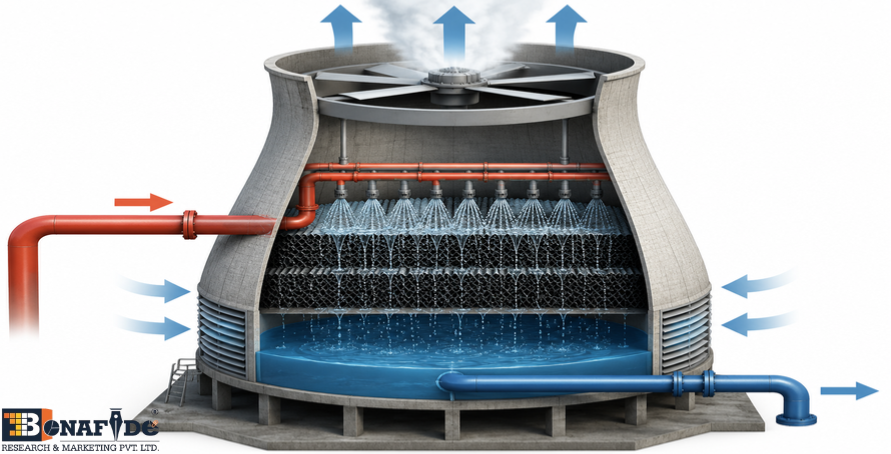
Open-circuit cooling towers maintain a leading position in the global cooling tower market because they provide an efficient and established method for removing heat from industrial processes and large-scale cooling systems. These towers operate by allowing warm circulating water to come into direct contact with air, enabling evaporation to transfer heat and reduce the water temperature before it is recirculated into the system. This simple operating mechanism allows open-circuit cooling towers to deliver effective cooling performance across a broad range of applications, including power generation plants, manufacturing facilities, petrochemical complexes, refineries, chemical processing units, food and
beverage plants, data centers, and large commercial buildings. Industries across different regions rely on these systems because they can manage substantial thermal loads while maintaining dependable operation under continuous working conditions. Power generation remains one of the major application areas, as thermal plants require efficient condenser cooling to maintain stable electricity production. Similarly, heavy industries such as steel,
cement, mining, and chemical manufacturing depend on open-circuit cooling towers to control process temperatures and protect equipment from overheating. The widespread use of these systems is also supported by their relatively straightforward design, which makes installation, operation, and maintenance easier for facility operators. Components such as fill media, fans, water distribution systems, and drift eliminators can be inspected, repaired, or replaced using established maintenance practices available in many regions worldwide.
The HVAC industry is the fastest-growing end-use segment in the global cooling tower market because modern commercial, institutional, and mixed-use developments increasingly depend on centralized cooling systems that require efficient heat rejection. Cooling towers are an integral part of water-cooled HVAC systems, where they remove heat from condenser water circuits, enabling chillers to operate effectively and maintain stable indoor temperatures in large buildings. As urban populations continue to expand and cities become more densely developed, the construction of high-rise office buildings, airports, hospitals, hotels, shopping malls, educational campuses, convention centers, data centers, and residential complexes has significantly increased the demand for large-capacity air conditioning systems. Water-cooled HVAC systems are frequently selected for these facilities because they provide dependable cooling for extensive floor areas while supporting continuous operation in buildings with high occupancy levels. Healthcare infrastructure has become another major contributor, as hospitals, laboratories, pharmaceutical facilities, and medical research centers require precise temperature and humidity control to protect sensitive equipment, maintain sterile environments, and ensure patient comfort. The rapid expansion of data centers worldwide has also accelerated cooling tower adoption because
servers,
networking equipment, and cloud computing infrastructure generate substantial heat that must be continuously removed to maintain operational reliability and prevent equipment failure.
Cross flow cooling towers have established a leading position in the global cooling tower market because their design provides a practical balance between operational efficiency, maintenance convenience, and application flexibility. In a cross flow configuration, warm water flows downward through the fill media from distribution basins located above the tower, while air moves horizontally across the falling water to create heat transfer through evaporation. This arrangement allows gravity-based water distribution, reducing the complexity of pressurized water spray systems and making critical components easier to inspect, clean, and maintain. The accessibility of internal sections such as fill assemblies, water basins, nozzles, and drift eliminators is a major advantage for facilities that require regular maintenance and continuous operation. Cross flow cooling towers are widely used across industries including power generation, manufacturing, chemical processing, oil and gas, mining, food and beverage, pharmaceuticals, data centers, and commercial buildings because they can support different cooling requirements through flexible designs and configurations. Large industrial facilities often select cross flow systems because multiple tower cells can be installed together, allowing operators to maintain cooling capacity while individual sections undergo maintenance activities. This operational flexibility is valuable in industries where production interruptions can affect overall performance.
Concrete continues to maintain a moderate growth position as a construction material for cooling towers worldwide because it provides the structural stability required for large and permanent cooling installations. Concrete cooling towers are commonly used in major power generation plants, industrial complexes, and large-scale infrastructure projects where strong structural performance and long operational life are essential. The material is particularly suitable for natural draft cooling towers and heavy-duty applications because it can withstand significant mechanical loads, temperature fluctuations, wind forces, and continuous exposure to moisture. Industries such as power generation, oil and gas, petrochemicals, metals, mining, and heavy manufacturing rely on cooling systems that must operate reliably for extended periods, and concrete provides the durability required for these demanding environments. One of the key advantages of concrete is its ability to maintain structural integrity under harsh outdoor conditions, including high humidity, coastal exposure, intense sunlight, and changing
weather patterns. Unlike some
lightweight materials, concrete offers strong resistance to fire, vibration, and physical stress, making it valuable for critical industrial facilities where safety and reliability are important considerations. Concrete structures are also capable of supporting very large cooling tower designs, allowing engineers to develop tall and stable structures that generate effective natural airflow for heat removal.
Mechanical draft cooling towers have become the leading and fastest-growing design type in the global cooling tower market because they provide precise control over airflow and cooling performance through the use of mechanically driven fans. Unlike natural draft cooling towers that depend on chimney effects and atmospheric conditions, mechanical draft systems actively move air through the tower, allowing operators to maintain stable heat rejection under different operating conditions. This ability to regulate airflow makes them highly suitable for industries where consistent cooling performance is critical, including power generation, oil and gas processing, chemical manufacturing, mining, steel production, food processing, pharmaceuticals, data centers, and large commercial facilities. Many industrial operations require cooling systems that can respond to changing process loads, seasonal temperature variations, and continuous production requirements, and mechanical draft towers provide the operational flexibility needed for these applications. Their compact design and modular construction also make them suitable for facilities where available space is limited or where cooling capacity needs to be expanded gradually. Compared with large natural draft structures, mechanical draft cooling towers can be installed in a wider range of locations because they require less land area and can be customized according to specific project requirements. This advantage supports their use in urban industrial zones, manufacturing facilities, and commercial complexes where space optimization is important.
















 We are friendly and approachable, give us a call.