The global
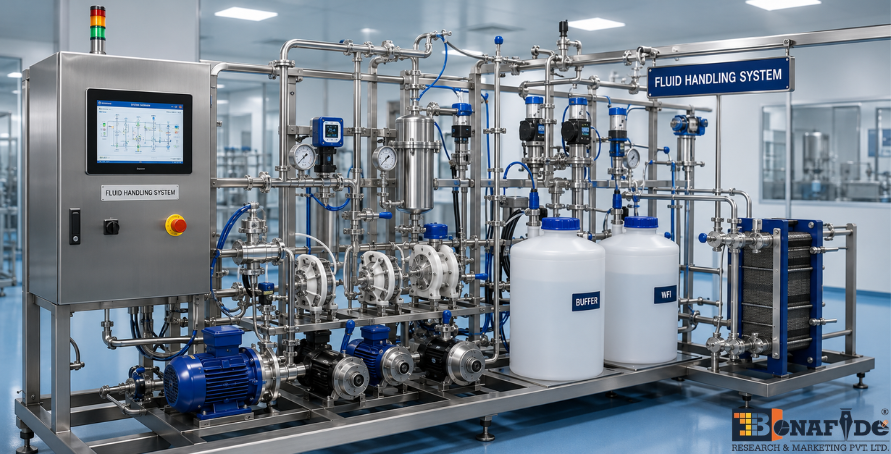
fluid handling system market stands at a critical inflection point, fundamentally reshaping how industries manage the movement, control, and monitoring of liquids and gases across production ecosystems. Over the past five years, this sector has undergone remarkable transformation, driven by the convergence of
industrial automation, stringent environmental mandates, and the relentless pursuit of operational efficiency. The Hydraulic Institute's projection that the global
pump market alone would approach USD 80 billion by 2025 underscores the immense scale of fluid handling requirements across manufacturing, energy, water treatment, and healthcare. Growth trajectories are being shaped by rapid urbanization, infrastructure modernization initiatives like India's Jal Jeevan Mission mapping drinking water assets on the PM Gati Shakti portal, and the accelerating adoption of smart technologies that enable
predictive maintenance and real-time flow optimization. However, the path forward is not without friction environmental compliance complexities, supply chain disruptions from geopolitical tensions and tariff measures, and the need for specialized workforce skills present formidable obstacles. Major industry gatherings such as FlowExpo China, now in its 27th edition, and the PTC ASIA 2025
Smart Manufacturing Display Area serve as vital platforms for showcasing innovations in
valves,
pipe fittings, and control systems. Regulatory frameworks, including American Petroleum Institute standards API 598 for valve inspection and ISO 8434 series for tube
connectors, establish the quality and safety benchmarks that govern equipment design and deployment.
According to the research report "Global Fluid Handling System Market Outlook, 2031," published by Bonafide Research, the Global Fluid Handling System market was valued at more than USD 66.96 Billion in 2025, and expected to reach a market size of more than USD 91.82 Billion by 2031 with the CAGR of 5.54% from 2026-2031. Strategic consolidation has emerged as a dominant theme, with the flow control sector recording 71 merger and acquisition deals through 2025, representing a 7.6% year-over-year increase. The proposed USD 19 billion all-stock merger between Chart Industries and Flowserve Corporation, alongside Baker Hughes' USD 13.6 billion acquisition of Chart Industries, signals intense competition for leadership in industrial cooling and fluid-handling solutions driven by
artificial intelligence infrastructure investments. AxFlow, a division of Axel Johnson International, has strengthened its North American presence through the acquisition of Jadler Industries, a Canadian fluid handling systems provider. The competitive landscape features established players including Thermo Fisher Scientific, Danaher, Eppendorf, Sulzer, Alfa Laval, and Graco, each pursuing distinct strategies across pumps, valves, filtration, and automated liquid handling systems. Enterprise adoption patterns reveal a decisive shift toward integrated, IoT-enabled solutions that deliver actionable intelligence rather than isolated components. End-users increasingly prioritize total cost of ownership over initial capital expenditure, driving demand for durable, low-maintenance equipment constructed from corrosion-resistant materials. The investment landscape remains robust, exemplified by India's INR 6,000 crore (USD 812 million) production-linked incentive scheme for pharmaceutical and
medical device manufacturing. Direct sales dominate distribution channels, though
digital commerce platforms are gaining traction among small and medium enterprises seeking streamlined procurement processes.
Flow meters have emerged as the fastest-growing component category due to their critical role in enabling precise measurement, regulatory compliance, and operational optimization across diverse industrial applications. Flow meters provide essential data for custody transfer, billing accuracy, and safety monitoring in petroleum operations, following American Petroleum Institute measurement standards that govern fluid quantification from wellhead to refinery. Advanced ultrasonic and magnetic flow meter technologies now deliver non-intrusive measurement capabilities, eliminating pressure drops and maintenance requirements associated with traditional mechanical devices.
Water and wastewater treatment facilities increasingly deploy flow meters for consumption monitoring, leak detection, and process efficiency optimization, aligning with municipal infrastructure modernization priorities. Pharmaceutical and biotechnology manufacturers require precise flow measurement for buffer preparation, filtration, purification, and final formulation applications to maintain product quality and regulatory compliance. Chemical processing plants utilize flow meters to monitor reaction feed rates, ensure proper ingredient ratios, and detect anomalies that could compromise product quality or pose safety hazards. The integration of flow meters with IoT platforms enables predictive maintenance algorithms that analyze flow patterns to identify equipment degradation before failure occurs. Emerging applications in
semiconductor manufacturing and high-purity fluid handling demand exceptional measurement accuracy, driving adoption of specialized flow metering solutions.
Chemical processing remains the dominant end-user industry for fluid handling systems due to the sector's unparalleled diversity of fluid types, extreme operating conditions, and stringent safety requirements that demand specialized equipment solutions. The chemical industry encompasses thousands of distinct substances requiring handling corrosive acids, volatile
solvents, viscous polymers, and hazardous intermediates each demanding pumps, valves, and piping systems engineered for specific material compatibility and operating parameters. Chemical plants operate continuously under high temperatures and pressures, necessitating robust fluid handling equipment constructed from corrosion-resistant alloys and advanced polymers that withstand aggressive media while maintaining integrity over extended service life. Safety considerations in chemical processing elevate equipment requirements, with API standards governing pressure-relieving systems, valve inspection protocols, and corrosion control guidelines that mandate specific design features and testing procedures. The sector's substantial capital expenditure budgets enable investment in premium fluid handling solutions, including advanced flow meters, automated control valves, and sophisticated monitoring systems that optimize production efficiency. Chemical manufacturers increasingly adopt digitalization strategies, integrating fluid handling equipment with process control systems to enable real-time adjustments, predictive maintenance, and remote operation capabilities. The transition toward sustainable chemical production drives demand for fluid handling systems that minimize fugitive emissions, reduce energy consumption, and enable closed-loop processing. Global chemical production capacity expansion, particularly in Asia-Pacific and the Middle East, continues to generate sustained demand for comprehensive fluid handling infrastructure.
Metering and dosing applications are experiencing the fastest growth due to the escalating demand for precision chemical injection, reagent addition, and ingredient proportioning across pharmaceutical, water treatment, and specialty chemical manufacturing processes. Pharmaceutical production increasingly relies on accurate metering and dosing systems for biologics manufacturing, where precise buffer and media preparation directly impacts product quality, yield, and regulatory compliance. Water treatment facilities deploy sophisticated dosing equipment for coagulant, flocculant, and
disinfectant addition, responding to tightening discharge standards and drinking water quality regulations. Specialty chemical manufacturers utilize metering pumps and dosing systems to achieve exact ingredient ratios in polymer production,
catalyst injection, and additive blending applications where minor deviations compromise product specifications. The integration of metering and dosing equipment with process analytical technology enables real-time adjustment based on upstream conditions, optimizing chemical usage while minimizing waste and environmental impact. Food and
beverage producers employ precision dosing systems for flavor incorporation, preservative addition, and nutritional fortification, driven by consumer demand for consistent product quality. Oil and gas operators utilize chemical injection systems for corrosion inhibition, scale prevention, and hydrate control in production and pipeline operations, where precise dosing prevents equipment failure and production interruptions. Mining and
mineral processing applications require metering systems for flotation reagent addition and pH control, supporting efficient ore beneficiation while managing environmental compliance.
Stainless steel dominates as the preferred material for fluid handling systems because its exceptional corrosion resistance, mechanical strength, and hygienic properties make it indispensable across chemical, pharmaceutical, food and beverage, and water treatment applications. Corrosion resistance represents stainless steel's defining advantage, enabling reliable handling of aggressive chemicals, acidic solutions, and saline environments that would rapidly degrade
carbon steel or polymeric materials. The material's high-temperature performance makes it suitable for steam sterilization in pharmaceutical and biotechnology applications, where equipment must withstand repeated autoclaving cycles without degradation. Stainless steel's smooth, non-porous
surface prevents bacterial colonization and product adhesion, making it the standard for food and beverage processing, dairy production, and
pharmaceutical manufacturing where hygiene is paramount. Mechanical strength allows stainless steel components to withstand high-pressure operations common in oil and gas production, hydraulic systems, and chemical processing plants. The material's durability translates to extended equipment lifespan and reduced lifecycle costs, justifying higher initial investment through lower maintenance requirements and fewer replacements. Stainless steel offers excellent weldability and formability, enabling fabrication of complex geometries including sanitary fittings, specialty valves, and custom piping configurations. Regulatory compliance across food contact materials, pharmaceutical grade standards, and pressure equipment directives consistently favors stainless steel, reinforcing its position as the material of choice for critical fluid handling applications.















 We are friendly and approachable, give us a call.