The global
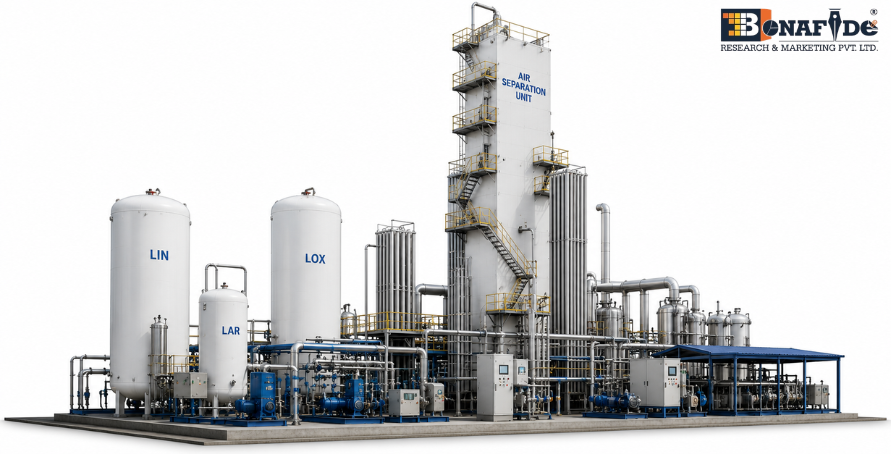
air separation unit (ASU) market comprises industrial systems that separate atmospheric air into its primary components
oxygen,
nitrogen, argon, and, in some cases, rare gases such as krypton, xenon, and neon. These gases are produced mainly through cryogenic distillation, while pressure swing adsorption (PSA), vacuum pressure swing adsorption (VPSA), and
membrane technologies serve smaller-capacity or lower-purity applications. ASUs form the backbone of the
industrial gases industry by ensuring a reliable supply of high-purity gases essential for steel manufacturing, chemical processing, oil and gas refining, electronics fabrication, healthcare, food preservation, glass production, and energy generation. The market is experiencing sustained growth due to rapid industrialization, expanding steel and chemical production, increasing demand for medical oxygen, and rising investments in clean hydrogen, gasification, and carbon capture projects. The global expansion of
semiconductor manufacturing is further accelerating demand for ultra-high-purity nitrogen, while the transition toward low-carbon industrial processes is encouraging the deployment of energy-efficient and digitally monitored air separation plants. Manufacturers are increasingly integrating automation,
predictive maintenance, advanced compressors, and renewable electricity to improve plant efficiency and reduce operating costs. On-site and pipeline-based gas supply models are also gaining importance as large industrial facilities seek uninterrupted gas availability and reduced
logistics dependence. The market is supported by major industrial gas companies, including Linde, Air Liquide, Air Products, Messer, and Taiyo Nippon Sanso, which continue to invest in new ASUs and technology upgrades across multiple regions. Industry organizations such as the Compressed Gas Association (CGA), European Industrial Gases Association (EIGA), and Asia Industrial Gases Association (AIGA) contribute by developing safety standards, operational guidelines, and best practices for industrial gas production and handling.
According to the research report "Global Air Separation Unit Market Outlook, 2031," published by Bonafide Research, the Global Air Separation Unit Market was valued at more than USD 5.43 Billion in 2025, and expected to reach a market size of more than USD 7.28 Billion by 2031 with the CAGR of 5.15% from 2026-2031. The market is led by established companies including Linde, Air Liquide, Air Products, Messer, Taiyo Nippon Sanso, Hangyang Group, and Sichuan Air Separation Group, which compete through advanced cryogenic technologies, engineering expertise, and long-term on-site gas supply contracts. The industry's supply chain begins with engineering design, compressors,
heat exchangers, cryogenic cold boxes,
valves, instrumentation, and automation systems, followed by plant construction, commissioning, gas production, storage, pipeline distribution, and merchant delivery to end users. Reliable electricity supply and specialized
cryogenic equipment remain essential because air separation is an energy-intensive process. Growing investments in hydrogen production, carbon capture and storage (CCS), semiconductor fabrication, and low-
carbon steel manufacturing are creating significant opportunities for new ASU installations, particularly large on-site plants integrated with industrial complexes. Recent developments highlight the market's expansion trajectory. Air Liquide announced a record investment backlog that includes new air separation units for electronics and industrial projects, while Linde expanded its portfolio through dozens of new small on-site gas generation projects supporting semiconductor and decarbonization applications. In Indonesia, Linde commissioned one of the country's largest oxygen and nitrogen production facilities to support
copper smelting operations, reflecting increasing demand from metal processing industries. Companies are also incorporating
digital monitoring, predictive maintenance, modular plant designs, and energy-efficient compressors to improve operational reliability and reduce lifecycle costs.
Non-cryogenic air separation technologies, primarily Pressure Swing Adsorption (PSA), Vacuum Pressure Swing Adsorption (VPSA), and membrane separation systems, are increasingly preferred in industries that require continuous gas supply without the complexity of operating large cryogenic facilities. Unlike cryogenic air separation plants, which involve liquefaction of air at extremely low temperatures and require significant capital investment, non-cryogenic systems operate at ambient temperatures and can be installed directly at customer sites with comparatively shorter commissioning periods. These systems are particularly suitable for hospitals, wastewater treatment plants,
food packaging facilities,
glass manufacturing,
metal fabrication, pharmaceutical production, and small steel plants where gas consumption is moderate and uninterrupted supply is more important than ultra-high purity. Advances in adsorbent materials such as
zeolites and carbon molecular sieves have improved oxygen and nitrogen recovery while reducing energy consumption and maintenance requirements. Many industrial users are shifting from delivered gas cylinders and liquid gas transportation to on-site generation because it eliminates logistics costs, reduces supply chain disruptions, and improves operational reliability. The expansion of decentralized manufacturing facilities and remote industrial operations has further strengthened the adoption of compact PSA and VPSA units. Healthcare facilities have also installed on-site oxygen generation systems following lessons learned during the COVID-19 pandemic to improve supply resilience. Equipment manufacturers continue introducing modular and containerized systems that simplify installation and future capacity expansion. Digital controls, remote monitoring, and predictive maintenance capabilities have enhanced operational efficiency, allowing smaller facilities to generate industrial gases independently.
The healthcare sector has become one of the most significant consumers of oxygen generated by air separation units because medical oxygen is indispensable across intensive care units, emergency medicine, surgical procedures, neonatal care, respiratory therapy, anesthesia delivery, and chronic disease treatment. The COVID-19 pandemic highlighted vulnerabilities associated with dependence on transported liquid oxygen and cylinder supplies, prompting governments and healthcare providers worldwide to invest in dedicated on-site oxygen generation infrastructure. Many hospitals have adopted PSA-based oxygen generation plants to ensure uninterrupted availability during emergencies while reducing dependence on external suppliers. In addition to emergency preparedness, the steady increase in respiratory disorders, chronic obstructive pulmonary disease, asthma, pneumonia, cardiovascular conditions, and aging populations has led to sustained demand for medical oxygen in everyday clinical practice. Expanding healthcare infrastructure in developing economies, including new hospitals, specialty clinics, trauma centers, and rural healthcare facilities, has further increased installation of air separation technologies. Regulatory authorities require medical oxygen to meet stringent purity standards, encouraging healthcare institutions to invest in reliable production systems equipped with continuous monitoring and quality assurance. Modern oxygen generation systems also incorporate automation, redundancy features, and remote diagnostics to maintain uninterrupted operation under varying demand conditions. Beyond oxygen, nitrogen generated by air separation units supports
pharmaceutical manufacturing, laboratory operations, cryopreservation, and
medical device production. Increased investment in healthcare resilience, disaster response planning, and localized gas generation has reinforced the importance of hospital-based air separation technologies.
Nitrogen has become the most extensively utilized product generated by air separation units because of its versatility, chemical inertness, and suitability for an exceptionally broad range of industrial processes. In semiconductor manufacturing, ultra-high-purity nitrogen is essential for wafer fabrication, cleanroom environments, oxidation prevention, and equipment purging, where even minimal contamination can affect product quality. The rapid expansion of electronics manufacturing has therefore significantly increased
industrial nitrogen demand. Food and
beverage companies rely on nitrogen for modified atmosphere
packaging to reduce oxidation, preserve freshness, and extend shelf life without altering product characteristics. Chemical manufacturers use nitrogen extensively for blanketing storage tanks, inerting reactors, purging pipelines, and maintaining safe operating conditions where combustible materials are handled. Oil and gas operators inject nitrogen for pipeline testing, pressure maintenance, enhanced oil recovery, and refinery maintenance activities. Pharmaceutical manufacturers utilize nitrogen during formulation, packaging, freeze drying, and sterile processing to protect sensitive products from moisture and oxygen exposure. Metal processing industries employ nitrogen in heat treatment, laser cutting, welding, and additive manufacturing to improve process quality and minimize oxidation. The growth of
lithium-ion
battery production and
electric vehicle manufacturing has created additional requirements for extremely dry and high-purity nitrogen during cell assembly. Many industrial facilities increasingly install on-site nitrogen generation systems to reduce transportation costs and ensure uninterrupted supply, particularly in remote manufacturing locations. Advances in membrane and PSA technologies have made decentralized nitrogen production more economical for medium-scale users, while cryogenic air separation remains indispensable for very large industrial consumers.














 We are friendly and approachable, give us a call.