The global
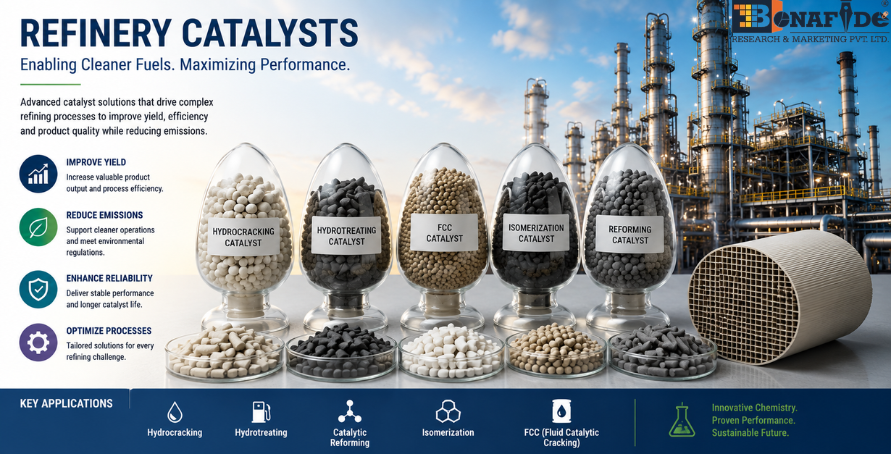
refinery catalyst market serves as the chemical bedrock of the modern petroleum industry, encompassing a diverse range of specialized materials including fluid catalytic cracking
catalysts, hydrotreating catalysts, hydrocracking catalysts, and reforming catalysts that are essential for converting crude oil into high-value transportation fuels, petrochemical feedstocks, and
lubricants. This market is currently navigating a complex transformation driven by the dual pressures of tightening environmental mandates and the fluctuating quality of globally sourced crude slates. Similarly, the European Union’s Fit for 55 legislative package and the stringent Euro VI standards have mandated drastic reductions in particulate matter and
nitrogen oxides, pushing refiners to adopt ultra-low sulfur diesel production routes that rely on advanced
catalyst beds. In the United States, the Environmental Protection Agency’s (EPA) Tier 3 gasoline sulfur standards continue to drive demand for selective hydrogenation catalysts, while China’s National VI emission standards and India’s BS-VI norms have replicated this stringent framework across Asia. The persistent global appetite for middle distillates, combined with the declining availability of light sweet crude, is compelling refiners to process heavier, sourer crude grades, thereby increasing the severity of operating conditions and creating a robust aftermarket for high-performance catalysts with longer lifecycles. Furthermore, the global push towards circular economies has opened a lucrative frontier in spent catalyst recycling and rejuvenation, allowing refiners to recover valuable metals like molybdenum, nickel, and vanadium. The shift towards integrated refining-petrochemical complexes, particularly in the Middle East and Asia, offers another growth vector, as these facilities demand specialized catalysts for maximum propylene and aromatics production.
According to the research report "Global Refinery Catalyst Market Outlook, 2031," published by Bonafide Research, the Global Refinery Catalyst Market was valued at more than USD 7.31 Billion in 2025, and expected to reach a market size of more than USD 9.89 Billion by 2031 with the CAGR of 5.32% from 2026-2031.The competitive landscape of the global refinery catalyst market has witnessed a profound restructuring through a series of blockbuster mergers, acquisitions, and strategic collaborations designed to consolidate technological expertise and secure supply chain resilience. In a landmark transaction concluded in late 2025, W. R. Grace & Co. finalized its acquisition of Chevron’s stake in the Advanced Refining Technologies joint venture, making ART a wholly owned subsidiary of Grace. This strategic move dramatically expanded Grace’s hydroprocessing catalyst portfolio, enabling it to offer integrated solutions that combine FCC and hydrotreating technologies for maximum refinery profitability. Concurrently, in October 2025, KPS Capital Partners struck a definitive agreement with Albemarle Corporation to acquire a controlling 51% stake in the Ketjen Corporation refinery catalyst solutions business, leaving Albemarle with a 49% minority interest; this financial restructuring allowed Ketjen to operate with greater agility while retaining deep technical ties to Albemarle’s materials science. In a closely related strategic realignment, Ketjen and Axens also restructured their joint ownership of Eurecat, with Ketjen divesting its 50% stake and isomerization catalyst business to Axens, granting Axens full ownership of Eurecat, which continues to serve the industry in spent catalyst regeneration, rejuvenation, and presulfiding services. Adding to this M&A fervor, Honeywell struck a deal in mid-2025 to acquire Johnson Matthey’s catalyst technology division, aiming to marry Johnson Matthey’s emissions-control expertise with Honeywell UOP’s refining process licensings.
Hydrotreating catalysts have become the most widely utilized catalyst type in the global refinery industry because they perform a fundamental purification role that is required across almost all modern refining systems. Refineries around the world process crude oils with different chemical characteristics, including varying levels of sulfur, nitrogen compounds,
oxygen-containing materials, and metallic contaminants, which must be removed to produce high-quality fuels and protect downstream processing units. Hydrotreating catalysts, typically based on nickel-molybdenum or cobalt-molybdenum active metals supported on alumina, enable hydrogen-based reactions that eliminate these unwanted compounds while improving the stability, performance, and environmental quality of refined products. The importance of these catalysts has increased as countries and regions implement stricter fuel standards requiring lower sulfur content in gasoline, diesel, marine fuels, and other petroleum products. Hydrotreating units are also critical because they prevent contamination of sensitive catalysts used in downstream processes such as fluid catalytic cracking, hydrocracking, and reforming, helping refineries maintain reliable production and reduce operational disruptions. The global refining industry processes a broad range of crude oil sources, including heavier and more complex feedstocks, which require advanced catalyst systems capable of maintaining activity under high temperatures, elevated pressures, and prolonged operating cycles. Continuous improvements in hydrotreating catalyst technology have enhanced active metal dispersion and catalyst life, allowing refiners to achieve better performance while processing challenging feedstocks.
Metallic materials hold the leading position in the global refinery catalyst market because they provide the active chemical properties required to accelerate and control important refining reactions that transform crude oil into valuable fuels and chemical products. Metals such as nickel, cobalt, molybdenum,
platinum,
palladium, and tungsten are widely used in refinery catalyst formulations because each metal offers specific advantages for different processing applications. Nickel and molybdenum combinations are commonly used in hydrotreating operations to remove sulfur, nitrogen, and other contaminants from petroleum streams, while cobalt-based systems improve desulfurization performance and platinum-based catalysts are essential for catalytic reforming processes that enhance gasoline quality and generate hydrogen. Refineries worldwide process increasingly diverse crude oil feedstocks, including heavier and higher-sulfur grades that require catalysts capable of maintaining high performance under severe operating conditions. Metallic catalysts provide strong reaction activity, thermal stability, and resistance to harsh refinery environments, allowing operators to improve conversion efficiency and maintain consistent product quality. Their ability to perform under high temperatures, elevated pressures, and continuous processing conditions makes them indispensable across multiple refinery units. Advances in catalyst manufacturing have improved the dispersion of metallic particles on support materials, increasing exposure of active sites and improving overall catalyst effectiveness.







 We are friendly and approachable, give us a call.