The global
power metering market has undergone a fundamental transformation over the past five years, shifting from basic consumption recording to intelligent, two-way communication networks that serve as the nervous system of modern electricity grids. The International Energy Agency documented global electricity grid investments surpassing USD 390 billion in 2024, with advanced metering infrastructure representing a substantial portion of these deployments. This evolution reflects the convergence of distributed energy resource integration, electrification of transportation and heating, and the imperative for real-time grid visibility. The International
Renewable Energy Agency reported global renewable power capacity exceeding 4,400 GW in 2024, creating unprecedented demand for smart metering solutions that can manage bidirectional power flows and variable generation. Regulatory frameworks across major economies have accelerated adoption the European Union's Directive 2019/944 mandates member states to deploy
smart metering systems in accordance with European standards, with several nations achieving near-total coverage. The United States Department of Energy has committed USD 10.9 billion through its Grid Resilience and Innovation Partnerships program for projects pairing smart meters with flexibility solutions. India's
Smart Meter National Programme under the Revamped Distribution Sector Scheme has sanctioned 203.3 million smart meters across 28 states and union territories. The market serves residential, commercial, industrial, and utility segments globally, with second-generation meters now representing more than 80% of shipments in advanced economies, featuring enhanced capabilities including high-resolution waveform data and distributed energy resource integration. Technical standards from the International Electrotechnical Commission and national bodies like the American National Standards Institute ensure interoperability and measurement accuracy, with NIST developing smart meter test beds to verify accuracy to 0.2% and ultimately 0.05%.
According to the research report "Global Power Metering Market Outlook, 2031," published by Bonafide Research, the Global Power Metering market was valued at more than USD 21.67 Billion in 2025, and expected to reach a market size of more than USD 37.48 Billion by 2031 with the CAGR of 9.81% from 2026-2031. The competitive ecosystem encompasses meter manufacturers, communication network providers, data analytics platforms, and system integrators, with significant regional variation in market structure. European markets feature strong presence of Landis+Gyr and Itron alongside regional specialists, while Asia-Pacific markets are characterized by dominant domestic manufacturers serving massive government-mandated rollout programs. China's State Grid Corporation and China Southern Power Grid drive procurement through centralized tendering, with the State Grid alone tendering 74.56 million smart meters in 2025. India's market is shaped by the Smart Meter National Programme, which has installed over 40 million smart meters as of August 2025. Entry barriers remain substantial given the capital-intensive nature of advanced metering infrastructure deployments and the requirement for compliance with diverse national standards North America follows ANSI C12 standards, while Europe and Asia utilize DLMS/COSEM standardized by IEC 62056. The value chain extends from component manufacturing through meter assembly, communication module integration, and head-end system deployment to data management and analytics. Consumer behavior patterns are shifting as smart meters enable time-of-use rates and demand response participation. The UK government reported 39 million smart meters in domestic and non-domestic premises across Great Britain as of March 2025, representing over two-thirds of all meters. Germany's Federal Network Agency documented 1.6 million intelligent measurement systems installed by June 2025. Transaction economics favor long-term utility procurement contracts, with second-generation deployments increasingly incorporating
artificial intelligence capabilities for
predictive maintenance and load forecasting. The IEA projects that widespread application of existing AI technology such as load forecasting and predictive maintenance could generate up to USD 110 billion in global annual savings by 2035.
Government-mandated smart meter rollouts across major economies create sustained demand visibility. The European Union's Directive 2019/944 obliges member states to deploy smart metering systems, with binding installation targets ensuring consistent deployment volumes. The EU Council adopted amendments updating the 20-year-old Measuring Instruments Directive in October 2025, addressing digitalization in smart metering. These regulatory frameworks transform what might be marginal cost-benefit decisions into compulsory infrastructure investments. The rapid proliferation of rooftop solar, electric vehicles, and
battery storage necessitates advanced metering capable of bidirectional power flow measurement and real-time grid-edge visibility. The IEA projects distributed energy resource additions surging from 2025 to 2030, including 20 GW to 90 GW of demand capacity from
EV charging infrastructure. Smart meters serve as the foundational sensing layer enabling utilities to monitor, validate, and control behind-the-meter resources. Despite massive smart meter deployments, the U.S. Department of Energy acknowledges a critical visibility and controllability gap at the distribution level. Many utilities lack the network infrastructure to fully leverage smart meter data for real-time grid management. The gap between meter deployment and actionable grid intelligence represents a significant obstacle to realizing the full value of advanced metering investments. The coexistence of multiple technical standards across regions ANSI C12 in North America versus DLMS/COSEM in Europe and Asia creates compatibility challenges for multinational utilities and equipment manufacturers. NIST analysis of 240
smart grid standards found that only one in five have independent
testing and certification programs, complicating vendor selection and system integration.
Advanced economies are transitioning to second-generation meters featuring enhanced capabilities including high-resolution waveform data, over-the-air firmware updates, and advanced
cybersecurity protocols. Finland is currently installing second-generation smart meters. These next-generation devices enable distributed energy resource management, outage automation, and real-time consumer engagement through mobile applications and in-home displays. Utilities are increasingly deploying artificial intelligence and machine learning algorithms to extract value from the massive datasets generated by smart meters. The IEA's Energy and AI report projects that existing AI technology such as load forecasting and predictive maintenance could generate up to USD 110 billion in global annual savings by 2035. Applications include theft detection, load forecasting, predictive maintenance, and personalized energy efficiency recommendations.
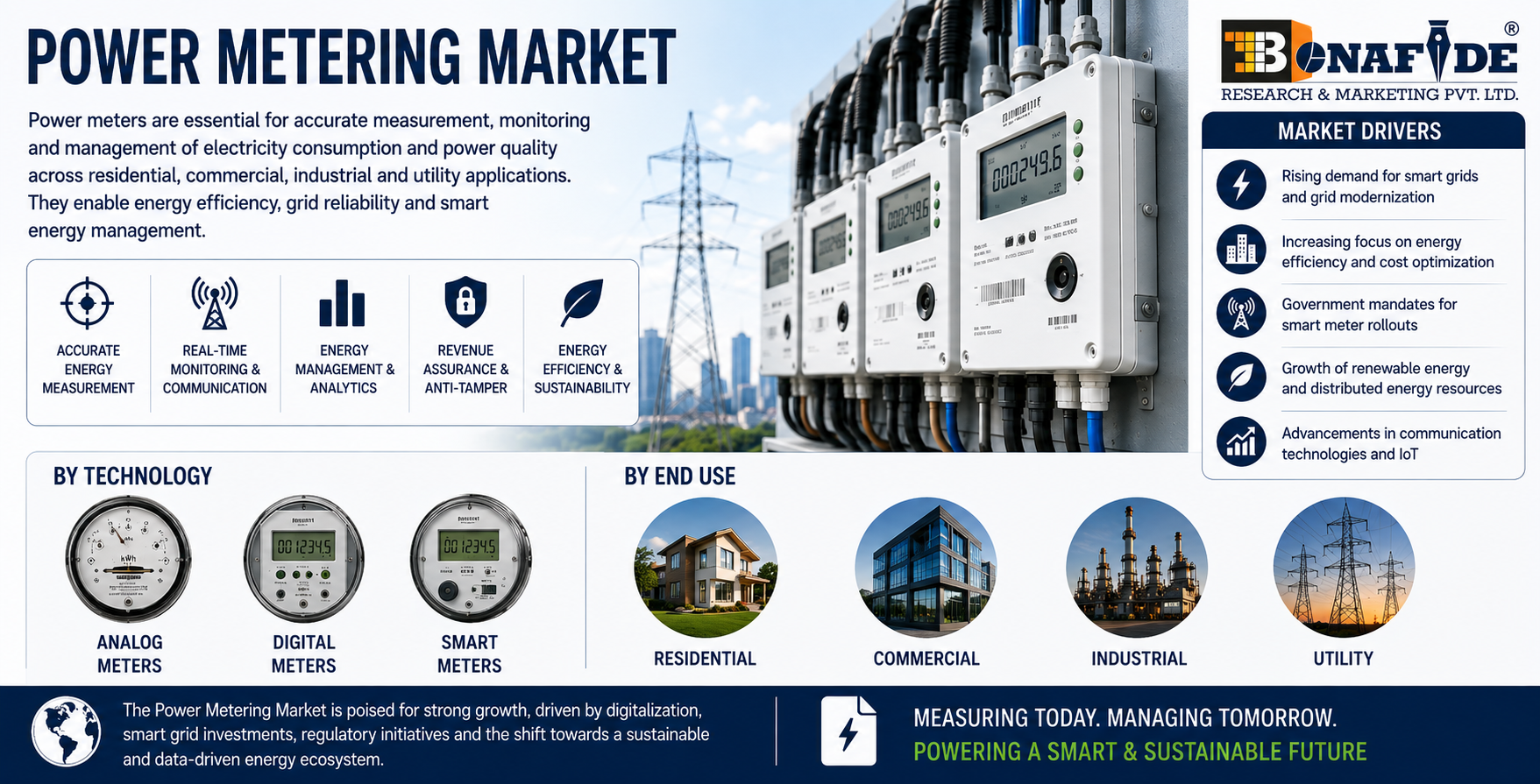
Single-phase meters dominate residential applications, serving the vast majority of households worldwide. India's Smart Meter National Programme specifically targets 10 million single-phase connections under its current deployment phase. These meters are typically rated for 120V or 230V service and represent the standard for residential electricity measurement. Three-phase meters serve commercial and industrial facilities with higher capacity requirements and greater precision needs. Commercial buildings, manufacturing facilities, and data centers utilize three-phase metering for accurate billing of large loads and sub-metering of tenant spaces. The U.S. Department of Energy mandates sub-metering for covered tenant spaces effective January 1, 2025. Analog meters, employing electromechanical induction mechanisms, represent legacy technology being rapidly phased out through government-mandated replacement programs. These meters offer basic consumption recording without communication capabilities.
Digital meters bridge the transition, providing electronic measurement and local
display without two-way communication. Smart meters represent the technological frontier, incorporating two-way communication, remote disconnect capabilities, time-of-use pricing support, and integration with home area networks. The UK government reported 21.8 million domestic
smart electricity meters in Great Britain operated by large energy suppliers at the end of 2025. Smart meter penetration in North America reached approximately 81% at the end of 2024, the highest globally.
Residential customers constitute the largest end-user segment, with smart meter deployment targeting household electricity consumers through national rollout programs. The EU mandates that member states equip at least 95% of metering points with smart meters. Commercial establishments utilize power metering for energy management, cost allocation, and demand response participation. Industrial facilities require precision metering for operational efficiency, load management, and regulatory compliance. Utilities deploy metering infrastructure for grid management, outage detection, and system planning. The U.S. DOE's Grid Modernization Initiative emphasizes the importance of distribution-level visibility for utility operations. Energy management applications leverage smart meter data for consumption optimization, demand forecasting, and efficiency program design. Billing and revenue assurance represent the foundational application, with smart meters enabling accurate, automated billing based on actual consumption. Load monitoring applications track consumption patterns to inform grid operations and capacity planning. Demand response applications utilize smart meter data to enable price signals and load reduction programs. Grid management applications incorporate synchrophasor technology and wide-area measurement for system reliability. The IEA ISGAN Policy Brief on Smart Distribution Grids outlines the critical role of advanced metering in long-term grid planning.











 We are friendly and approachable, give us a call.