The global
circuit breakers market stands at the intersection of unprecedented electricity demand growth and accelerating grid infrastructure renewal. International Energy Agency data reveals worldwide electricity consumption is poised for an extraordinary 3,500 TWh increase over the next three years, fundamentally reshaping the protection equipment landscape. This demand surge, propelled by industrial electrification, transportation sector transformation, and the proliferation of energy-intensive data centers, places circuit breakers as indispensable guardians of electrical networks. The United States Department of Energy has actively catalysed innovation through targeted funding mechanisms including the REIMAGINE BREAKERS initiative, allocating $8 million specifically for high-voltage direct current power circuit breaker research and development. This federal commitment addresses a critical protection gap in HVDC systems essential for long-distance
renewable energy transmission. Meanwhile, European regulatory frameworks increasingly mandate SF6-free alternatives through initiatives like the LIFE SF6-FREE HV BREAKER project targeting 245 kV to 550 kV live tank circuit breaker applications. The National Electrical Manufacturers Association maintains rigorous standards including ANSI NEMA C37.50-2018 (R2025) governing low-voltage AC power circuit breaker test procedures, while NEMA US G 111-2021 provides procurement guidance for units rated 1000 V and above. Infrastructure modernization programmes across mature markets and capacity expansion efforts in developing economies collectively drive this market forward, though supply chain complexities and the technical challenge of developing cost-effective DC interruption solutions present persistent obstacles.
According to the research report "Global Circuit Breakers Market Outlook, 2031," published by Bonafide Research, the Global Circuit Breakers market was valued at more than USD 22.76 Billion in 2025, and expected to reach a market size of more than USD 35.92 Billion by 2031 with the CAGR of 8.10% from 2026-2031. Established electrical equipment manufacturers continue dominating the circuit breaker landscape, though the competitive dynamics increasingly favour companies demonstrating technological agility in solid-state and SF6-free innovations. The US Department of Energy's Office of Electricity, alongside the Wind Energy Technologies Office, has stimulated market activity through the REIMAGINE BREAKERS funding opportunity targeting cost reduction in high-voltage circuit breaker technology. This government-backed push aims to accelerate widespread
HVDC transmission system adoption, creating downstream demand for advanced protection equipment. The IEC 60947-2:2024 standard establishes baseline requirements for circuit breakers connected to circuits not exceeding 1,000 V AC or 1,500 V DC, shaping product development trajectories across manufacturers. Market entry barriers remain substantial, given the capital intensity of production facilities and the rigorous
certification processes mandated by bodies such as NEMA and the International Electrotechnical Commission. Pricing dynamics reflect underlying commodity costs, research and development investments in alternative
insulation technologies, and compliance expenses associated with evolving environmental regulations. Consumer behaviour patterns indicate growing preference for digitally-enabled circuit breakers equipped with IoT capabilities for remote monitoring and
predictive maintenance. Enterprise adoption rates correlate strongly with utility-scale infrastructure projects and industrial facility upgrades. The competitive landscape features intense differentiation around SF6-free offerings, with the European Commission's LIFE programme actively supporting green gas alternatives through demonstration projects. Investment flows increasingly target solid-state circuit breaker startups and manufacturers developing vacuum and air-insulated technologies compliant with emerging ecodesign requirements.
The fundamental challenge of direct current interruption lies in the absence of zero-crossing points that allow AC breakers to extinguish arcs naturally. DC fault currents generate persistent arcs that mechanical switches cannot readily interrupt, demanding fundamentally different protection approaches. Semiconductor-based solutions eliminate moving parts entirely, addressing the reliability concerns that plague mechanical systems subjected to repeated operations. These devices detect and isolate faults within microseconds, minimising equipment damage during electrical disturbances. The US Department of Energy's REIMAGINE BREAKERS initiative specifically targets cost reduction for high-voltage direct current circuit breakers, recognising their importance for renewable energy integration . Research indicates medium-voltage DC distribution enabled by solid-state breakers could save 1.1 quads of energy annually while reducing US emissions by 3% through transportation electrification. The technology supports bidirectional current flow essential for modern grids incorporating distributed generation and storage systems. Manufacturing costs continue declining as
power semiconductor fabrication scales, gradually improving economic viability across voltage ratings. Grid operators value the precision control and diagnostic capabilities that
digital solid-state designs provide over analog mechanical alternatives.
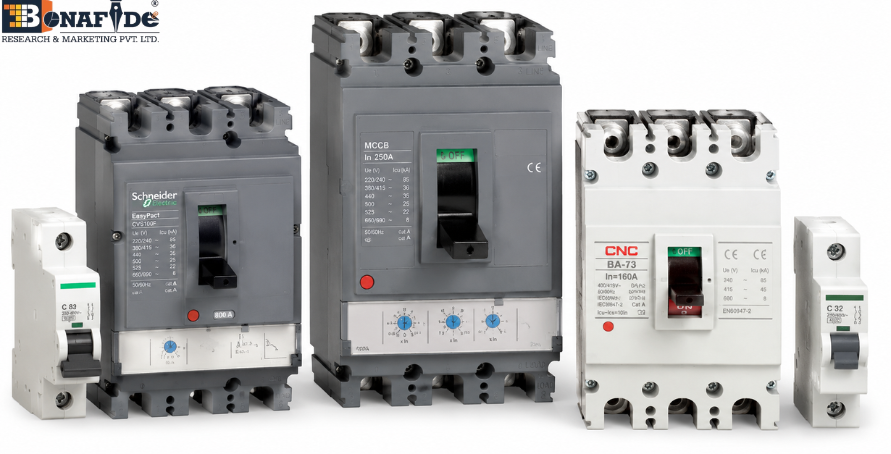
The sheer volume of low-voltage installations across residential, commercial and light industrial sectors creates enormous demand that high-voltage applications cannot match. Every commercial building, apartment complex and manufacturing facility requires hundreds of low-voltage protection devices throughout its electrical distribution system. Replacement cycles for low-voltage breakers occur more frequently than high-voltage equipment, generating consistent recurring revenue streams. The IEC 60947-2:2024 standard establishes baseline requirements for circuit breakers with rated voltages not exceeding 1,000 V AC or 1,500 V DC, providing the regulatory
foundation for this segment . Technological advancements in miniature circuit breaker designs have expanded application possibilities while reducing unit costs. Distribution boards and panelboards universally incorporate low-voltage breakers as standard components, ensuring baseline demand remains stable. The proliferation of data centres and
telecommunications facilities adds significant incremental volume to this segment. Emerging markets building out basic electrical infrastructure prioritise low-voltage distribution equipment as the foundation of electrification efforts.
Commercial office towers, residential complexes and institutional buildings universally require indoor circuit breakers within electrical rooms and distribution panels. Industrial manufacturing facilities house extensive
switchgear indoors to protect equipment from environmental exposure. Urban substations increasingly adopt indoor configurations to maximise land utilisation in dense city centres. Indoor installations benefit from controlled environmental conditions, extending equipment service life and reducing maintenance frequency. The proliferation of indoor data centre construction directly correlates with increased circuit breaker demand for facility protection. ANSI NEMA C37.50-2018 (R2025) provides test procedures for enclosed low-voltage AC power circuit breakers, establishing performance benchmarks for indoor equipment . Building codes and safety regulations mandate specific indoor protection configurations that create consistent replacement demand. Retrofitting existing indoor electrical infrastructure represents a substantial ongoing market opportunity.
Office buildings, retail centres, hotels and healthcare facilities each require comprehensive circuit protection across
lighting, HVAC and power distribution systems. Commercial construction activity in developing economies adds substantial new installation volume annually. Regulatory frameworks governing commercial building electrical safety mandate specific protection configurations, ensuring baseline demand. The commercial retrofit market for energy efficiency upgrades frequently includes circuit breaker replacement as part of broader modernisation efforts. Data centre expansion, concentrated in commercial real estate, drives significant additional demand for specialised protection equipment. Commercial facilities typically operate with professional
facility management that prioritises preventive maintenance and scheduled equipment replacement. The diversity of commercial applications from small retail to large institutional campuses creates broad market participation across voltage and insulation types.












 We are friendly and approachable, give us a call.