The global
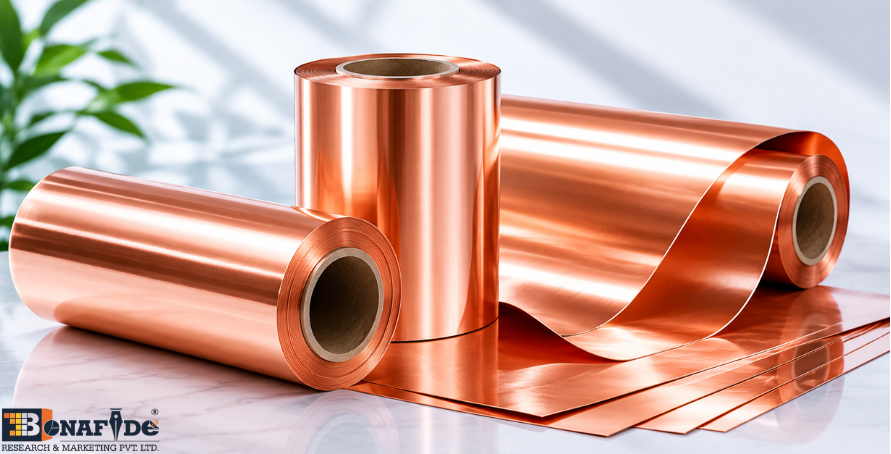
copper foil market is experiencing robust growth, primarily driven by the booming
electric vehicle (EV) industry, consumer electronics, and
renewable energy sectors. Government regulations and policies significantly shape the global
copper foil market landscape. These policies primarily focus on environmental protection, trade tariffs, and industry standards. In the environmental domain, sustainability mandates are becoming increasingly stringent worldwide. The European Union's Restriction of Hazardous Substances (RoHS) and Registration, Evaluation, Authorisation and Restriction of Chemicals (REACH) regulations impose strict limits on hazardous substances in
electronic components, directly impacting copper foil manufacturing processes. The most significant recent development was the United States' imposition of 50% tariffs on certain
copper products under Section 232 of the Trade Expansion Act of 1962, effective August 2025. This protectionist measure has compelled global copper foil value chain participants to reassess their sourcing strategies, cost structures, and market positioning. Similarly, the European Union has been considering anti-dumping duties on copper foil imports from certain Asian countries to protect domestic producers. The explosive growth of electric vehicles and energy storage systems continues to drive unprecedented demand for high-performance, ultra-thin
lithium battery copper foil. Industry projections indicate that
lithium battery copper foil demand will grow at over 20% CAGR through 2030, driven by global EV adoption targets.
According to the research report "Global Copper Foil Market Outlook, 2031," published by Bonafide Research, the Global Copper Foil Market was valued at more than USD 7.26 Billion in 2025, and expected to reach a market size of more than USD 9.78 Billion by 2031 with the CAGR of 5.23% from 2026-2031.The global copper foil market witnessed a landmark consolidation event in 2025 with China's Defu Technology acquiring Luxembourg-based Circuit Foil Luxembourg. On July 29, 2025, Defu Technology announced a definitive agreement with Volta Energy Solutions S.? r.l. to acquire 100% equity of CFL for €174 million. Founded in 1960, CFL is a global leader in high-end IT copper foil, possessing proprietary technologies in HVLP short for Hyper Very Low Profile and DTH segments. Its prestigious customer portfolio includes global industry leaders such as South Korea's Doosan, Japan's Panasonic, and America's Rogers Corporation. This acquisition catapults Defu Technology's total electrolytic copper foil production capacity from 175,000 tons/year to 191,000 tons/year, establishing it as the world's largest copper foil producer. China, as the world's largest copper foil producer and consumer, demonstrates revealing trade patterns. According to Chinese customs data for 2025, China imported 79,900 tons of unbacked refined copper foil, representing a 3.08% year-on-year increase, indicating persistent domestic dependency on high-end copper foil products where domestic production capabilities remain insufficient. More notably, exports demonstrated impressive growth, reaching 54,600 tons, a substantial 21.23% year-over-year increase.
The growth of battery-related copper foil demand in the Middle East and Africa reflects a developing transition toward electrification that is progressing at a measured and uneven pace across different countries. Copper foil is a key component in lithium-ion batteries used for electric vehicles and energy storage systems, where it functions as a current collector that enables efficient electron flow within the cell structure. In this region, however, the expansion of such applications is shaped by structural and industrial limitations that result in moderate rather than rapid growth. One major factor is the relatively limited presence of large-scale domestic battery manufacturing facilities, which mean that much of the battery supply is imported rather than produced locally, reducing direct regional consumption of copper foil in upstream manufacturing. In addition, electric vehicle adoption is still in early stages across many Middle Eastern and African countries, influenced by factors such as high vehicle costs, limited charging infrastructure, and strong reliance on internal combustion engine vehicles in transportation systems. While certain Gulf countries are actively investing in electric mobility initiatives and pilot programs, widespread consumer adoption remains gradual. In Africa, electrification is further constrained by infrastructure gaps, affordability challenges, and uneven access to reliable electricity in some areas, which slows the deployment of EVs and related battery systems.
The dominance of rolled copper foil in the Middle East and Africa region is closely linked to the industrial structure and application profile of copper usage, which is more concentrated in infrastructure, energy systems, and industrial equipment rather than mass consumer electronics manufacturing. Rolled copper foil is produced through mechanical rolling and annealing processes that refine its grain structure, resulting in a dense and durable material with excellent flexibility and strong resistance to mechanical stress. These properties make it particularly valuable in environments where equipment is exposed to harsh operating conditions, temperature variations, and long service lifecycles. In the Middle East, large-scale investments in energy infrastructure, including oil and gas facilities, power generation plants, desalination systems, and emerging renewable energy projects, rely heavily on electrical systems that demand robust conductive materials. Rolled copper foil is well suited for such applications because it offers stable conductivity and structural integrity in high-load electrical environments. In Africa, ongoing development of power grids, rural electrification projects, and industrial expansion also drives demand for reliable electrical materials that can perform consistently under variable infrastructure conditions. Additionally, the region’s growing focus on solar and wind energy integration has increased the need for
power electronics, inverters, and storage systems where durable copper materials are essential for efficient energy transfer.








 We are friendly and approachable, give us a call.