Chromatography reagents are highly purified chemical compounds essential for separating, identifying, and analyzing substances within mixtures across analytical and research procedures. The pharmaceutical and biotechnology industries represent the largest end-user segment, driven by rigorous quality control requirements, drug development activities, and the growing complexity of biologics such as monoclonal antibodies and
biosimilars. The need to comply with stringent regulatory frameworks including the U.S. FDA's cGMP standards, EMA guidelines, and various national pharmacopoeias has intensified demand for high-purity
solvents, certified reference materials, and validated reagent portfolios. The North American region currently holds the largest market share, with the United States leading global consumption due to its substantial
pharmaceutical manufacturing base and advanced research infrastructure, while the Asia-Pacific region is projected to experience the fastest growth, driven by expanding biopharmaceutical development and increasing environmental testing capacity. Government regulations worldwide mandate compliance with international quality standards for reagents used in drug manufacturing and analytical testing, including mandatory adherence to ISO standards, Good Manufacturing Practices, and hazardous materials regulations. The EU's REACH Regulation (EC No 1907/2006) imposes strict registration, evaluation, and authorization requirements for chemical substances, affecting the supply chain for many chromatography reagents, while the U.S. EPA enforces rigorous guidelines for analytical testing under environmental statutes, mandating high-purity reagents for compliance monitoring. Tariff adjustments and trade policy changes have introduced cumulative effects across reagent sourcing, import
logistics, and pricing structures, encouraging buyers to seek alternative origins or prioritize vendors with regional manufacturing footprints.
According to the research report "Global Chromatography Reagents Market Outlook, 2031," published by Bonafide Research, the Global Chromatography Reagents Market was valued at more than USD 7.61 Billion in 2025, and expected to reach a market size of more than USD 11.76 Billion by 2031 with the CAGR of 7.73% from 2026-2031. In October 2025, Merck KGaA announced the acquisition of JSR Life Sciences' chromatography business, with completion expected by mid-2026, integrating JSR's Amsphere
Protein A resin technology into Merck's portfolio to significantly strengthen its position in monoclonal antibody purification. Thermo Fisher Scientific's strategic acquisition of PPD in December 2021 expanded its clinical research services, enhancing its offering for pharmaceutical and biotechnology customers to facilitate innovation and increase productivity during drug development processes. Waters Corporation strategically invested in Megadalton Solutions for Charge Detection Mass Spectrometry technology, enhancing its capability in analyzing large proteins for cell and gene therapies, while also collaborating with the University of Delaware and BioInfra to advance analytical technology and expertise. In April 2026, Waters introduced next-generation microflow LC columns with MaxPeak Premier Technology, designed to support improved analytical sensitivity and efficiency with higher-resolution separation and reduced sample and solvent usage. These strategic moves demonstrate the industry's focus on downstream bioprocessing capabilities, as biologics manufacturing becomes increasingly central to pharmaceutical production. In January 2026, Thermo Fisher Scientific collaborated with NVIDIA to develop AI-enhanced scientific instrumentation aimed at optimizing reagent usage and analytical performance, leveraging advanced data processing to reduce analysis time and improve the resolution of complex proteomic and biochemical profiles. The integration of AI is enabling laboratories to achieve higher throughput and more efficient utilization of chromatography reagents across research and industrial applications.
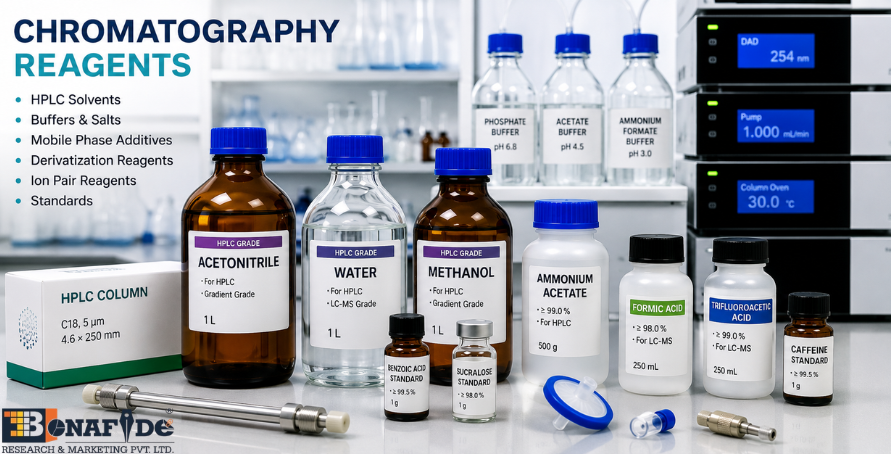
Solvents represent the most widely consumed reagent type in the global chromatography reagents market because they are fundamental to the operation of liquid chromatography systems and are used repeatedly throughout every stage of analytical testing. High-purity solvents such as acetonitrile,
methanol, water,
ethanol, and isopropanol serve as the mobile phase that transports analytes through chromatographic columns, directly influencing separation efficiency, peak resolution, analytical sensitivity, and overall instrument performance. Unlike specialized reagents that are only required for selected analytical methods, solvents are consumed during virtually every chromatographic workflow, including mobile phase preparation, sample dissolution, gradient elution, column conditioning, system equilibration, instrument flushing, cleaning, and routine maintenance. Consequently, laboratories replenish solvent inventories much more frequently than other reagent categories. Across the pharmaceutical industry, chromatography-grade solvents are essential for drug discovery, formulation development, impurity profiling, residual solvent analysis, stability studies, process validation, raw material qualification, and finished product quality control. Biotechnology laboratories similarly depend on ultrapure solvents to characterize proteins, peptides, monoclonal antibodies,
vaccines, biosimilars, nucleic acids, and other complex biological molecules using HPLC, UHPLC, and LC-MS platforms. Food and
beverage laboratories routinely utilize chromatography solvents to detect pesticide residues, veterinary drugs, preservatives, mycotoxins,
food additives, contaminants, vitamins, flavor compounds, and authenticity markers, ensuring compliance with national and international food safety regulations.
Ion chromatography has become the second fastest-growing chromatography technique worldwide because it provides highly selective, accurate, and reproducible analysis of ionic compounds that are increasingly monitored across regulated industries. The technique is specifically designed to separate and quantify inorganic and organic ions such as fluoride, chloride, bromide, nitrate, nitrite, sulfate, phosphate, ammonium, sodium, potassium, calcium, and magnesium, making it indispensable for laboratories that require precise ionic measurements. One of the strongest drivers behind its expanding adoption is the growing emphasis on water quality monitoring. Municipal water authorities, environmental agencies, industrial facilities, and commercial testing laboratories routinely use ion chromatography to analyze drinking water, groundwater, wastewater, desalinated water, and industrial effluents to ensure compliance with environmental regulations and public health standards. The pharmaceutical industry also increasingly relies on ion chromatography for raw material verification, counterion determination, impurity profiling, excipient analysis, cleaning validation, and quality control because many pharmaceutical formulations contain ionic substances that require analytical techniques with superior selectivity and sensitivity. Food and beverage laboratories use ion chromatography to determine mineral composition, preservatives,
organic acids, additives, and contaminant levels while supporting regulatory compliance and product quality verification. The semiconductor, electronics, power generation, and specialty chemical industries have also expanded their use of ion chromatography because trace ionic contamination can significantly affect manufacturing processes, product performance, and equipment reliability.
Quality Control and Quality Assurance have become the most important applications of chromatography reagents because modern industries require highly accurate analytical verification at every stage of product development, manufacturing, and release. Chromatography plays a central role in quality laboratories by enabling the identification, separation, and measurement of chemical components, impurities, degradation products, and contaminants that can directly impact product performance and safety. In the pharmaceutical industry, quality control laboratories extensively use chromatography reagents for testing active pharmaceutical ingredients, excipients, intermediates, and finished medicines to confirm composition, purity, potency, and stability. Regulatory agencies such as the U.S. Food and Drug Administration (FDA), European Medicines Agency (EMA), and other global health authorities require manufacturers to demonstrate consistent product quality through validated analytical methods, making chromatography an essential part of pharmaceutical compliance processes. Biotechnology companies also depend on chromatographic analysis for evaluating complex biological products such as vaccines, monoclonal antibodies, proteins, and other advanced therapies where small variations in molecular structure can affect therapeutic effectiveness. Beyond healthcare, food and beverage companies use chromatography-based quality testing to detect pesticide residues, additives, preservatives, toxins, allergens, and nutritional compounds to ensure consumer safety and meet international food standards. Environmental laboratories apply chromatography techniques to monitor pollutants, industrial chemicals, pharmaceutical residues, and water contaminants, supporting regulatory
environmental monitoring programs.
Contract Research Organizations (CROs) have become the fastest-growing end users of chromatography reagents globally as pharmaceutical, biotechnology, and
medical device companies increasingly rely on external research partners to perform complex analytical and development activities. Modern drug development involves extensive laboratory testing from early-stage compound screening through preclinical studies, clinical trial support, analytical method development, impurity profiling, stability testing, pharmacokinetic evaluation, bioanalysis, metabolite identification, and final regulatory documentation. CROs perform these services for numerous clients simultaneously, resulting in continuous operation of analytical laboratories and high consumption of chromatography-grade reagents. Every stage of chromatographic analysis requires ultrapure solvents, buffers, ion-pair reagents, derivatization reagents, and other specialized chemicals to ensure reliable separation, accurate quantification, and reproducible analytical performance. Unlike pharmaceutical companies that primarily focus on their own product pipelines, CROs manage multiple projects across different therapeutic areas, dosage forms, molecular classes, and regulatory programs, significantly increasing the frequency and diversity of chromatographic testing. The rapid expansion of biologics, biosimilars, monoclonal antibodies,
peptide therapeutics, vaccines, cell therapies, gene therapies, and nucleic acid based medicines has further increased demand for sophisticated chromatographic characterization, encouraging sponsors to outsource highly specialized analytical work to organizations with advanced laboratory expertise.







 We are friendly and approachable, give us a call.