The global
sulphuric acid market is a critical segment of the basic chemicals industry, with sulphuric acid being one of the world's most widely produced and consumed industrial chemicals. Its demand is strongly associated with
fertilizer manufacturing, phosphoric acid production, chemical processing, petroleum refining, mining and metal processing, batteries, pigments, water treatment and other industrial applications. Fertilizers and phosphoric acid remain the largest consumption areas because sulphuric acid is essential for converting phosphate rock into phosphoric acid, which is subsequently used to manufacture products such as DAP, MAP and other phosphate fertilizers. Asia-Pacific represents the largest consumption base because of its extensive fertilizer manufacturing, chemical production, metal processing and industrial infrastructure, while North America and Europe remain important due to established chemical, refining, mining and specialty chemical industries. Sulphuric acid is primarily manufactured from elemental sulphur, sulphur-
bearing gases and metallurgical or smelter gases, while spent-acid regeneration provides an increasingly important circular source. Government regulations are becoming increasingly significant because sulphuric acid production can generate sulphur dioxide, sulphuric-acid mist and particulate emissions. Environmental authorities in major economies therefore impose emission limits, permitting requirements, monitoring obligations and pollution-control standards on sulphuric acid plants. In the United States, regulatory requirements under the Clean Air Act and New Source Performance Standards cover emissions such as sulphur dioxide, particulate matter,
nitrogen oxides and sulphuric-acid mist from relevant facilities.
According to the research report "Global Sulphuric Acid Market Outlook, 2031," published by Bonafide Research, the Global Sulphuric Acid Market was valued at more than USD 33.68 Billion in 2025, and expected to reach a market size of more than USD 48.74 Billion by 2031 with the CAGR of 6.52% from 2026-2031. The global sulphuric acid industry is undergoing gradual structural transformation as producers, traders and downstream consumers seek greater supply security, efficient
logistics, vertical integration and access to regenerated and high-purity acid. Market growth is closely connected with fertilizer production, industrial chemical manufacturing, metal refining and the expansion of emerging applications such as
battery materials and semiconductor processing. Elemental sulphur remains the most important raw material for dedicated sulphur-burning sulphuric acid plants and is primarily recovered as a by-product of petroleum refining and natural-gas processing. Consequently, changes in refinery utilization, crude-oil processing, natural-gas production and sulphur recovery can influence regional sulphur availability and acid production economics. Another important production route is smelter acid, where sulphur dioxide generated during
copper, zinc, lead and other non-ferrous metal smelting is captured and converted into sulphuric acid. This route is particularly important in regions with large metallurgical industries and also provides an environmental benefit by preventing sulphur dioxide from being released into the atmosphere. Pyrite-based production has become less dominant globally but remains relevant in selected markets where alternative sulphur sources are limited. International trade plays an important role because sulphuric acid supply and demand are geographically imbalanced.
Elemental sulfur has a structural advantage in sulfuric acid production because the chemistry of the sulfur-burning contact process is straightforward and the feedstock can be introduced directly into the sulfur burner without the extensive preparation required for many alternative sulfur-bearing materials. In this route, elemental sulfur is combusted with air to form sulfur dioxide (SO?), the SO? is catalytically oxidized to sulfur trioxide (SO?), and the SO? is subsequently absorbed in concentrated sulfuric acid to produce the required acid. EPA documentation specifically identifies elemental sulfur combustion as the predominant source of SO? for sulfuric acid manufacturing and describes sulfur-burning plants as the least complicated configuration among contact-process alternatives. Another important advantage is feedstock purity. Elemental sulfur recovered from petroleum refining and natural-gas processing can be produced at high purity, which helps reduce the burden of removing contaminants before catalytic conversion. USGS identifies recovered sulfur from petroleum refineries and natural-gas-processing facilities as a major source of elemental sulfur, demonstrating that the feedstock is increasingly connected to established hydrocarbon-processing infrastructure rather than depending only on dedicated sulfur mining. This gives acid manufacturers access to sulfur generated as part of refinery and gas-treatment operations, where sulfur compounds are removed from fuels and gas streams to meet processing and environmental requirements.
The increasing importance of mining and metal processing comes from the way sulfuric acid functions as an active processing reagent rather than merely as an auxiliary chemical. In copper production, sulfuric acid is widely used to leach copper from oxide ores and certain secondary sulfide materials, converting the metal into a dissolved form that can subsequently be recovered through solvent extraction and electrowinning (SX-EW). The U.S. EPA identifies acid leaching as a major hydrometallurgical route in which crushed or run-of-mine ore is treated with sulfuric acid solution to dissolve the target metal before purification and recovery. This creates direct and recurring consumption of sulfuric acid at mining operations because the acid participates in the leaching circuit and must be managed as part of the process solution. Copper is particularly important because sulfuric acid is effective for dissolving several copper oxide minerals, including malachite, azurite, tenorite, and chrysocolla, while established SX-EW systems can convert the resulting copper-bearing solution into high-purity cathode metal. Sulfuric acid is also relevant beyond copper. USGS documentation describes pressure-acid-leach technology for nickel, while sulfuric-acid-based hydrometallurgical processes can be applied to other metal-bearing materials under appropriate mineralogical and operating conditions. Another factor is the treatment of lower-grade ores and mining residues.
Industrial/commercial grade sulfuric acid has a leading position by grade because the majority of sulfuric acid consumption is connected to processes that require substantial quantities of chemically effective acid rather than exceptionally high-purity material. Sulfuric acid is a fundamental industrial reagent used across fertilizer production, chemical manufacturing, petroleum refining, metal processing, batteries, steel treatment, water treatment, and several other manufacturing activities. The U.S. Environmental Protection Agency identifies sulfuric acid as a basic raw material for a wide range of industrial processes and notes its use in phosphate fertilizers, copper leaching, inorganic pigments, petroleum refining, paper production, and organic chemical manufacturing. This broad application base naturally favors industrial/commercial specifications because these processes generally do not require the stringent impurity controls associated with reagent, electronic, pharmaceutical, or other specialized grades. The fertilizer industry is particularly important because sulfuric acid is directly required to convert phosphate rock into phosphoric acid, which subsequently serves as an intermediate for phosphate fertilizers. EPA describes phosphate fertilizer manufacturing as involving dedicated sulfuric acid production and wet-process phosphoric acid production, demonstrating how closely sulfuric acid is integrated into large-scale industrial operations. In the wet process, sulfuric acid reacts with phosphate rock and water to produce phosphoric acid and calcium sulfate, meaning the acid is used as a bulk chemical reagent rather than as a specialized high-purity input.
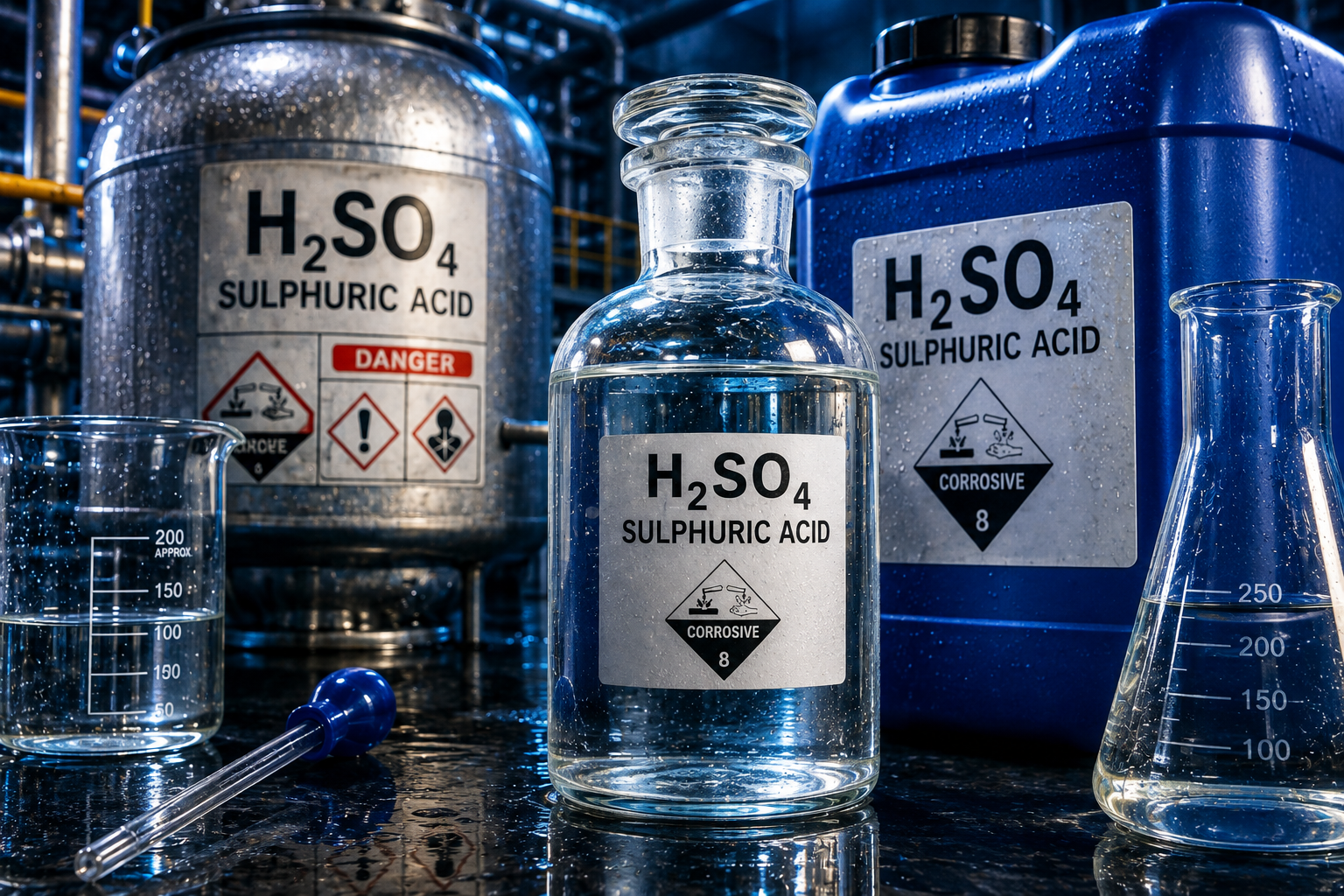
Highly concentrated sulfuric acid is gaining importance because concentration directly influences how sulfuric acid performs in demanding industrial operations, and high-strength material can provide greater chemical effectiveness within applications where water content is undesirable. In fertilizer production, concentrated sulfuric acid is an essential process reagent for converting phosphate rock into phosphoric acid, while sulfuric acid plants commonly produce acid at concentrations appropriate for downstream industrial use. The acid's high strength also makes it valuable in chemical manufacturing, petroleum refining, metal processing, and other operations where dehydration, sulfonation, or strong acidic conditions are required. In petroleum refining, sulfuric acid has historically been used in alkylation processes to create high-octane blending components, while chemical manufacturers use concentrated acid in processes such as sulfonation, nitration-related chemistry, and the production of various inorganic and organic chemicals. The concentration also matters for transportation and storage because shipping a higher-strength acid means moving less water for the same quantity of active H?SO?. However, highly concentrated sulfuric acid requires specialized handling because it is extremely corrosive and reacts strongly with water, generating substantial heat during dilution. Industrial facilities therefore use compatible materials, controlled dilution procedures, dedicated tanks, corrosion-resistant piping, and appropriate safety systems.







 We are friendly and approachable, give us a call.