Bleached kraft pulp is a highly valued raw material in the paper and
packaging industry, renowned for its strength, whiteness, and versatility. Derived from a kraft pulping process that utilizes a chemical treatment to separate fibers from wood, bleached kraft pulp is a key ingredient in a wide range of products, from packaging and printing papers to
tissue paper and specialty papers. This market is propelled by the increasing global demand for paper and packaging, coupled with a growing emphasis on sustainability and environmental responsibility.
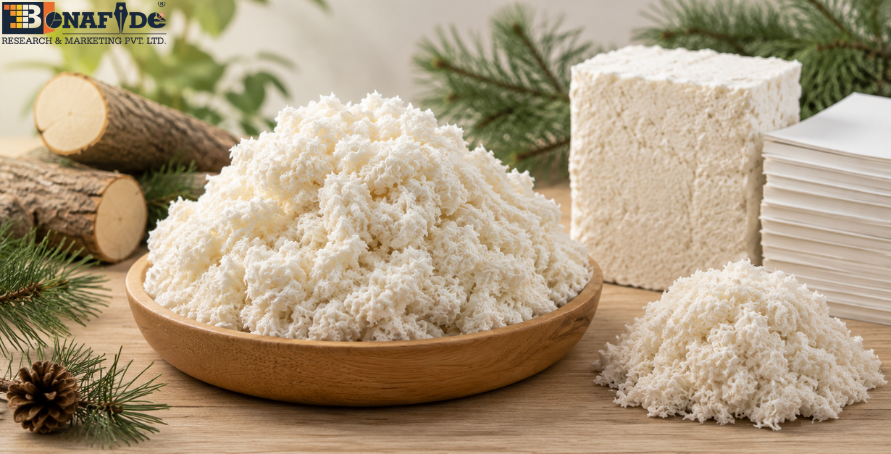
Bleached Softwood Kraft Pulp is produced by chemically digesting softwood logs in the kraft process, using
caustic soda and sodium sulfide, followed by a bleaching sequence to achieve high brightness and fiber purity. Its long fiber length, superior tensile strength, and bulk properties make it the preferred raw material for tissue papers, printing and writing papers, paperboard packaging, and specialty applications such as
filter media and dissolving pulp. The primary growth engine for BSKP is the expanding middle class in developing nations, where rising per-capita income drives increased consumption of tissue and hygiene products that rely heavily on softwood fiber. The global
e-commerce boom has sharply accelerated demand for
corrugated packaging and paperboard, which use BSKP to provide the necessary strength-to-weight ratio for shipping applications. Additionally, heightened regulatory and consumer pressure for fiber-based, recyclable packaging over plastic alternatives continues to widen BSKP's addressable market. Sustainable forestry
certification schemes such as FSC and PEFC also support market expansion by assuring end users of responsible fiber provenance.
According to the research report "Global Bleached Softwood Kraft Pulp Market Outlook, 2031," published by Bonafide Research, the Global Bleached Softwood Kraft Pulp Market was valued at more than USD 27.16 Billion in 2025, and expected to reach a market size of more than USD 36.05 Billion by 2031 with the CAGR of 4.96% from 2026-2031. The existence of the BSKP market is rooted in the fundamental human need for durable, high-quality paper products ranging from printing and writing papers to packaging materials and tissue papers. Technological advancements in chemical pulping and bleaching processes have enabled the industry to produce pulp with increasingly refined qualities, meeting stringent environmental and quality standards. Economically, the rise of e-commerce,
digital printing, and premium packaging has driven demand for superior pulp grades, reinforcing the market’s growth trajectory. Positioned within the broader forest products sector, the BSKP market acts as a critical upstream component for paper manufacturing, which itself feeds into multiple adjacent markets such as packaging, hygiene products, and graphic papers. Its evolution has been shaped by shifts in global paper consumption patterns, environmental regulations, and technological innovations. Initially, the market was dominated by traditional kraft pulping methods in North America and Europe, but over the decades, emerging markets in Asia-Pacific have become significant players, driven by rapid industrialization and urbanization. From its origins in the early 20th century, when kraft pulping technology was first commercialized, the BSKP market has undergone substantial transformation. The advent of chemical bleaching processes in the mid-20th century allowed for the production of brighter, higher-quality pulp, expanding its application scope. Recent decades have seen a focus on sustainability, with innovations aimed at reducing chemical use and environmental impact. Today, the market is characterized by a complex global supply chain, with integrated pulp mills, regional trading hubs, and a growing emphasis on eco-friendly production practices.
Standard BSKP has a leading position because its value comes from versatility rather than dependence on a single end-use application. Softwood kraft pulp contains relatively long fibers that create a strong reinforcing network within the paper sheet, making it particularly useful when manufacturers need to improve tensile strength, tear resistance, wet-web strength, and machine runnability. Technical literature from TAPPI identifies softwood kraft pulp as a reinforcement fiber used across tissue, towel and napkin grades, printing papers, specialty papers, and other paper products. It can also be incorporated with shorter hardwood fibers, which contribute properties such as formation, smoothness, opacity, softness, and
surface quality. This complementary behavior makes standard softwood pulp highly useful in blended furnishes rather than limiting it to products made entirely from softwood fiber. Another important advantage is its ability to support strength while manufacturers optimize other characteristics of the finished sheet. In tissue production, for example, softwood fibers contribute strength and absorbency, while fiber selection and blending influence softness, bulk, formation, and appearance. The same reinforcement principle applies to packaging and paperboard, where stronger fiber networks can help improve resistance to tearing and handling stresses. Standard grade also benefits from established papermaking technology because mills are already equipped to refine, blend, and process conventional bleached kraft pulp within existing production systems. This reduces the need for highly specialized processing adjustments compared with narrowly engineered pulp grades.
Tissue and fluff has become a particularly important application for BSKP because tissue manufacturing requires manufacturers to balance several properties that can work against each other, especially strength and softness. Softwood pulp provides relatively long fibers that form an effective reinforcing network within the sheet, allowing manufacturers to produce lightweight tissue while maintaining sufficient tensile strength and resistance to tearing during use. Technical material from TAPPI identifies softwood virgin pulp as providing flexibility and strength in tissue products, while hardwood pulp contributes properties such as absorbency and softness, which explains why tissue producers commonly combine different fiber types rather than relying on one pulp alone. The role of BSKP becomes particularly important in products such as bath tissue,
facial tissue, hand towels, napkins, and wipes because each product requires a different balance of dry strength, wet strength, softness, and absorption. FAO classifications for household and sanitary papers specifically identify sufficient strength, high absorptive capacity, retention of absorbed fluids, softness, and freedom from lint as important performance characteristics for these products. BSKP also offers flexibility during furnish design because its fibers can be refined and blended with other pulps to modify strength and sheet properties according to the intended product. This allows manufacturers to adjust fiber composition rather than depending entirely on chemical additives to achieve performance targets.
Packaging demand for BSKP is closely connected to the technical requirements of paper and board rather than simply the volume of packaging produced. Softwood fibers are relatively long and can create a strong fiber network within a paper structure, making them useful when packaging producers need improved tensile strength, tear resistance, compression performance, and resistance to handling stresses. TAPPI research explains that paper strength is governed by both individual fiber strength and the bonding between fibers, while research on kraft pulps shows that softwood fibers can provide important mechanical properties in packaging papers. This becomes particularly relevant when manufacturers attempt to reduce material usage while maintaining the performance of boxes, bags, cartons, wrapping papers, and other packaging formats. A stronger fiber furnish can help support lightweight structures without requiring the same increase in basis weight. Research on recycled packaging fibers also demonstrates why virgin softwood reinforcement remains technically useful: repeated recycling can reduce the mechanical properties of
cellulose fibers through structural changes associated with repeated processing, creating situations where additional strength-enhancing fiber or additives are needed. BSKP can therefore complement recovered fiber rather than necessarily replacing it. This blending approach is important because packaging production increasingly uses recovered paper as a major fiber source, but recycled fibers may require reinforcement to achieve specific strength and converting requirements.
ECF bleaching has become the dominant technology for bleached Kraft pulp because it provides a practical balance between pulp quality, bleaching efficiency, environmental performance, and established industrial operation. The defining feature of ECF is the replacement of elemental chlorine with chlorine dioxide, which selectively reacts with residual lignin and helps produce bright, clean pulp without using molecular chlorine in the bleaching sequence. Technical literature identifies chlorine dioxide as the principal bleaching agent used in ECF processes and notes that it became the primary Kraft pulp bleaching chemical as the industry moved away from elemental chlorine. This transition was driven largely by concerns surrounding chlorinated organic compounds generated during conventional bleaching. Research examining mills that converted to ECF found substantial reductions in absorbable and extractable organic halogens in bleach filtrates, demonstrating the environmental advantage of replacing elemental chlorine with chlorine dioxide. ECF also provides an important quality advantage because chlorine dioxide can efficiently remove residual lignin while maintaining desirable cellulose properties, allowing manufacturers to achieve the brightness and cleanliness required for tissue, printing papers, specialty papers, and other high-quality paper products. The technology is also well established within Kraft pulp mills, meaning producers can operate ECF bleaching using proven process configurations, chemical recovery systems, washing stages, and process-control practices rather than relying on comparatively less established bleaching routes.








 We are friendly and approachable, give us a call.