The global
engineered stone market is experiencing steady and sustained growth, driven by rapid urbanization, a global surge in residential and commercial construction activity, and an increasing consumer preference for durable, low-maintenance, and aesthetically versatile surfacing materials. Regulatory oversight related to respirable crystalline silica exposure has become a defining structural factor in the engineered stone market. Worker safety regulations governing fabrication and installation practices have tightened significantly across multiple regions, directly influencing product formulation and manufacturing processes. In a landmark development, Australia implemented a complete national ban on engineered stone containing crystalline silica, effective July 2024, which has had global implications and accelerated the industry's pivot toward low-silica and silica-free alternatives. New Zealand and the US state of California have also raised concerns about silica dust, prompting manufacturers to accelerate development of alternative formulations. In response, major producers including Caesarstone and Cosentino have invested heavily in reduced-silica and silica-free engineered stone surfaces to meet evolving safety requirements without compromising visual or mechanical performance. The U.S. Environmental Protection Agency (EPA) and European Union regulatory bodies continue to strengthen workplace safety standards and evaluate additional restrictions on silica exposure in fabrication environments.
According to the research report "Global Engineered Stone Market Outlook, 2031," published by Bonafide Research, the Global Engineered Stone Market was valued at more than USD 27.58 Billion in 2025, and expected to reach a market size of more than USD 40.24 Billion by 2031 with the CAGR of 6.67% from 2026-2031. In a notable development, Clearwater advised Tenax a world-leading producer of
specialty chemicals,
abrasives, and tooling for natural stone, engineered stone, and ceramic slabs on its acquisition of NEST, an Italian specialist in
diamond tools for quartz processing, with a complete production line for metal-bonded and resin-bonded
diamond tools used in calibration, grinding, and polishing of engineered stone. Raw materials for engineered stone include crushed quartz, polymer resins, pigments, and additives. The Asia/Pacific region is the world's principal supplier of engineered stone, with China leading manufacturing, while production bases in India, South Korea, and Vietnam are also significant to the global market. Western Europe is the second most significant regional manufacturing base, with sizable production in Spain, Italy, Portugal, Belgium, and Germany, and is home to the world's largest engineered stone manufacturer, Spain-based Cosentino. Volatility in raw material prices, including quartz, polymer resins, and pigments, coupled with high energy costs and
logistics expenses, continues to pressure manufacturer margins. The cumulative effect of tariff adjustments has reshaped sourcing strategies, with import duties increasing the emphasis on near-sourcing and regional production capacity to stabilize landed costs and reduce exposure to customs-related delays.
Blocks and slabs represent the leading product segment in the global engineered stone market because they are the primary material formats used to manufacture a wide range of finished
surface solutions for modern construction and
interior design projects. Engineered stone slabs serve as the
foundation for applications such as kitchen
countertops, bathroom vanities,
flooring,
wall cladding, staircases, reception counters, and decorative architectural elements, making them highly important throughout the value chain. The increasing preference for customized interiors and premium surface finishes across residential, commercial, hospitality, and institutional projects has strengthened the adoption of slab-based engineered stone products. Large-format slabs are especially suitable for contemporary architecture because they allow designers and fabricators to create expansive surfaces with fewer joints, cleaner visual appearances, and improved design continuity. Manufacturers and stone processors across major markets have developed advanced capabilities to produce and customize engineered stone slabs using modern technologies such as CNC cutting, automated polishing,
digital templating, and precision fabrication equipment. These technologies enable accurate shaping, edge finishing, and customized installations according to specific project requirements. Blocks also play an important role in the production process by providing manufacturers with flexibility to create slabs in different dimensions, thicknesses, colors, and surface finishes depending on customer needs. The controlled manufacturing process of engineered stone allows slab producers to achieve consistent patterns, textures, and quality, which is highly valuable for architects, builders, and interior designers working on large-scale projects.
Engineered
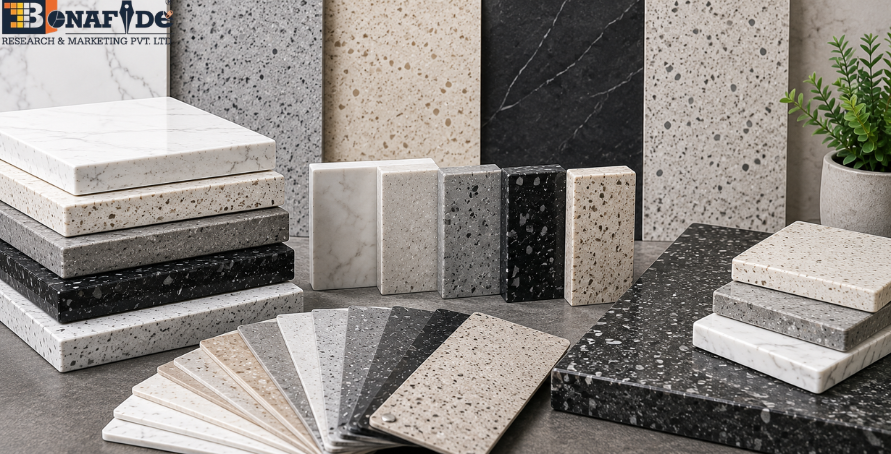
marble holds the second largest position in the global engineered stone market because it successfully combines the premium visual appeal of natural marble with the benefits of controlled manufacturing, making it a preferred choice for various architectural and interior surface applications. Marble has historically been associated with elegance, luxury, and high-quality construction due to its use in iconic buildings, residential interiors, hotels, and decorative projects worldwide. Engineered marble builds on this established preference by offering marble-inspired patterns, refined finishes, and consistent aesthetics while reducing the natural variations often found in quarried marble. This consistency allows architects, designers, builders, and homeowners to achieve coordinated designs across large projects where uniform appearance is important. Engineered marble is widely used for flooring, bathroom vanities, wall panels, countertops, staircases, tabletops, fireplace surrounds, and decorative interior elements because it provides a sophisticated appearance suitable for both traditional and modern design concepts. The controlled production process enables manufacturers to develop slabs with predictable dimensions, textures, and surface qualities, supporting efficient fabrication and installation. This advantage is particularly valuable for commercial developments such as hotels, restaurants, retail spaces, and office buildings where multiple areas require matching finishes and a premium visual identity. Residential users also increasingly choose engineered marble for kitchen renovations, bathroom upgrades, and luxury interior improvements because it offers an elegant stone appearance with easier design selection and customization options.
Countertops represent the leading and fastest-growing application in the global engineered stone market because they are one of the most essential uses of engineered stone, connecting practical daily requirements with contemporary interior design preferences. Across global markets, kitchens and bathrooms have evolved into important lifestyle spaces where consumers and businesses seek materials that provide both visual appeal and dependable performance.
Engineered stone countertops are widely adopted because they offer a consistent appearance, strong surface characteristics, and extensive design possibilities that meet the expectations of homeowners, architects, contractors, and commercial developers. The controlled manufacturing process allows engineered stone producers to create countertops with uniform colors, patterns, thicknesses, and finishes, helping designers achieve a coordinated look across residential and commercial projects. This consistency is especially valuable for large housing developments, hotels, restaurants, offices, healthcare facilities, and retail environments where maintaining a consistent interior style is important. Countertops experience frequent exposure to moisture, heat, food preparation activities, cleaning agents, and everyday use, making durability a key consideration when selecting materials. Engineered stone provides a reliable solution for these demanding environments while offering a premium appearance similar to natural stone surfaces. The increasing popularity of modern kitchen layouts, including open-plan kitchens, large islands, integrated dining spaces, and multifunctional living areas, has strengthened the demand for large-format engineered stone countertops that create seamless and visually attractive surfaces.
The residential sector represents the second largest end-user segment in the global engineered stone market because engineered stone has become a widely preferred material for homeowners, builders, and interior designers seeking a combination of functionality, durability, and aesthetic appeal in living spaces. Across different regions, residential construction, renovation activities, and home improvement trends have increased the demand for high-quality surface materials that can support modern lifestyles. Engineered stone is extensively used in residential applications such as kitchen countertops, bathroom vanity tops, backsplashes, flooring, wall features, shower surfaces, and decorative interior elements because it provides a refined appearance while maintaining reliable performance in frequently used areas. Modern homeowners increasingly view kitchens and bathrooms as important design spaces rather than purely functional areas, creating greater interest in premium surfaces that improve both usability and visual appeal. Engineered stone meets these expectations through its controlled manufacturing process, which delivers consistent colors, patterns, thicknesses, and finishes, allowing designers and homeowners to create coordinated interiors with predictable results. Unlike many natural stone materials that may vary significantly in appearance from one piece to another, engineered stone offers greater uniformity, making it suitable for residential projects where design consistency is important.







 We are friendly and approachable, give us a call.