The global
bioceramics market is experiencing robust growth as healthcare providers increasingly adopt advanced ceramic biomaterials for orthopedic reconstruction,
dental restoration, spinal surgery, trauma care, and
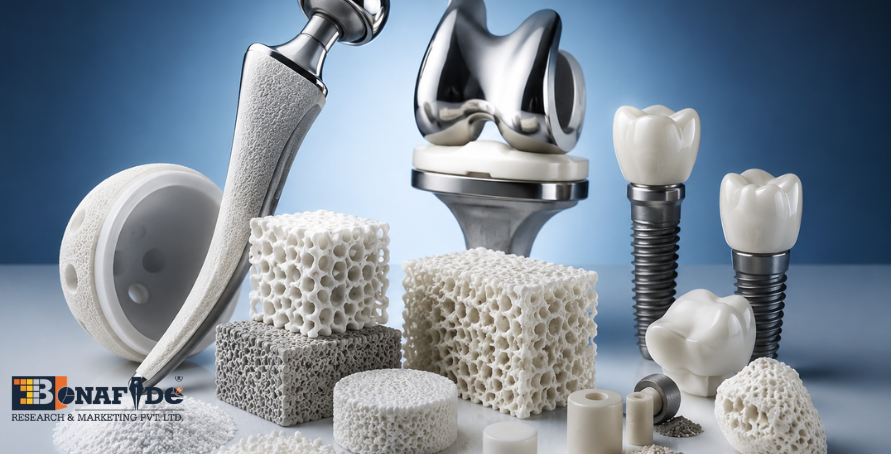
regenerative medicine. Bioceramics have emerged as one of the most important classes of implantable biomaterials due to their superior biocompatibility, exceptional wear resistance, excellent chemical stability, and ability to integrate effectively with human bone and surrounding tissues. Unlike conventional metallic implants, advanced ceramic materials exhibit outstanding corrosion resistance, low friction characteristics, minimal ion release, and superior long-term clinical performance, making them increasingly preferred for permanent implant applications that demand durability, reliability, and improved patient outcomes.
Bioceramics encompass a diverse range of advanced materials, including alumina, zirconia, hydroxyapatite, calcium phosphate, bioactive glass, and silicon nitride, each designed to address specific clinical requirements across multiple medical disciplines. These materials are extensively utilized in hip and knee replacements,
dental implants, spinal fusion devices, craniofacial reconstruction, bone graft substitutes,
tissue engineering scaffolds, and various regenerative medicine applications. Continuous advancements in ceramic processing technologies, additive manufacturing, nanotechnology, and biomaterial engineering have significantly improved the mechanical performance, fracture toughness, biological activity, and customization capabilities of modern bioceramic products, enabling healthcare professionals to treat increasingly complex musculoskeletal and dental conditions with greater confidence.
According to the research report, "Global Bioceramics Market Outlook, 2031," published by Bonafide Research, the Global Bioceramics Market was valued at more than USD 5.92 Billion in 2025 and is projected to exceed USD 8.92 Billion by 2031, expanding at a CAGR of 7.24% during the forecast period from 2026 to 2031. Market expansion is being driven by the growing prevalence of orthopedic disorders, increasing demand for aesthetic dental restorations, rapid technological advancements in biomaterials, expanding geriatric populations, and greater investments in regenerative healthcare solutions. Rising healthcare expenditure across both developed and emerging economies, combined with growing awareness regarding the long-term benefits of ceramic implants, continues to create significant opportunities for manufacturers operating throughout the global
medical ceramics industry.
The increasing burden of musculoskeletal disorders has become one of the strongest factors supporting long-term market growth. According to the World Health Organization (WHO), approximately 1.71 billion people worldwide are affected by musculoskeletal conditions, making them the leading contributor to disability globally. Simultaneously, the International Osteoporosis
Foundation estimates that more than 37 million fragility fractures occur annually among adults over the age of 55, highlighting the growing demand for durable orthopedic reconstruction materials. Rising incidences of osteoarthritis, osteoporosis, rheumatoid arthritis, traumatic injuries, degenerative spinal disorders, and sports-related fractures continue to increase the volume of
joint replacement surgeries and orthopedic interventions performed worldwide, directly supporting demand for advanced ceramic implant materials.
Demographic transformation represents another major structural growth driver for the global bioceramics industry. The continuous increase in global life expectancy has significantly expanded the elderly population, resulting in higher incidences of age-related bone degeneration and chronic musculoskeletal diseases requiring surgical intervention. Older patients increasingly require implant materials capable of maintaining long-term structural integrity while minimizing wear, inflammatory responses, and revision procedures. Bioceramics meet these clinical requirements through exceptional hardness, superior wear characteristics, excellent corrosion resistance, and long-term biological compatibility. As healthcare systems increasingly prioritize improved patient mobility, faster rehabilitation, and reduced lifetime healthcare costs, ceramic implant technologies are becoming an integral component of modern orthopedic and dental treatment strategies.
Rising Orthopedic and Dental Procedure Volumes Continue Driving Global Bioceramics Demand
The steady increase in orthopedic reconstruction procedures worldwide remains the primary driver of the global bioceramics market. Total hip arthroplasty, total
knee replacement, spinal fusion,
shoulder replacement, trauma fixation, and revision surgeries continue expanding due to aging populations, increasing obesity prevalence, growing sports participation, and improved accessibility to specialized orthopedic care. Ceramic femoral heads, acetabular liners, spinal cages, and bone graft substitutes are increasingly utilized because they provide superior wear resistance, reduced friction, and excellent long-term implant survival compared with many conventional biomaterials.
Dental healthcare is also emerging as one of the fastest-growing application areas for advanced bioceramics. Increasing consumer awareness regarding oral health, rising disposable incomes, expanding
cosmetic dentistry procedures, and growing preference for metal-free restorations are significantly accelerating demand for zirconia-based crowns, bridges, implant abutments, veneers, and full-arch prosthetic restorations.
Bioinert Ceramics Maintain Market Leadership Through Superior Clinical Performance
Among product categories, bioinert
ceramics continue to dominate the global bioceramics market owing to their outstanding mechanical properties, exceptional chemical stability, and proven long-term clinical performance across orthopedic and dental implant applications. Materials such as alumina and zirconia have established decades of successful clinical use because they exhibit extremely low wear rates, high compressive strength, excellent corrosion resistance, and remarkable biological compatibility. These characteristics significantly reduce implant degradation while minimizing inflammatory responses and extending implant longevity, making bioinert ceramics the preferred material for permanent load-
bearing implants.
Manufacturers continue investing heavily in advanced ceramic processing technologies including hot isostatic pressing, precision powder engineering, high-temperature sintering, laser machining, and computer-controlled finishing techniques that further improve fracture toughness, dimensional accuracy, and mechanical reliability. Continuous innovations in zirconia-toughened alumina composites, multilayer translucent zirconia, and high-purity ceramic powders are enabling production of next-generation implant systems capable of supporting increasingly demanding orthopedic and restorative dental procedures.
Zirconia Emerges as the Fastest-Growing Material Segment Owing to Superior Strength, Aesthetics, and Long-Term Clinical Reliability
Among all material categories, zirconia continues to strengthen its position as both the largest and the fastest-growing segment within the global bioceramics market. Its unique combination of exceptional flexural strength, transformation toughening mechanism, fracture resistance, and outstanding biocompatibility has made zirconia the preferred ceramic material for numerous orthopedic and dental applications. Unlike conventional metallic biomaterials, zirconia demonstrates remarkable resistance to corrosion and wear while eliminating concerns associated with metal ion release, making it particularly suitable for long-term implantation in demanding physiological environments.
Within
restorative dentistry, zirconia has revolutionized aesthetic dental treatments by enabling the production of highly durable, natural-looking crowns, bridges, veneers, implant abutments, and full-arch restorations. Continuous improvements in multilayer translucent zirconia, enhanced coloring technologies, and high-speed CAD/CAM milling systems have significantly improved restoration aesthetics while maintaining superior mechanical performance. These advancements are encouraging dentists and prosthodontists to increasingly replace traditional porcelain-fused-to-metal restorations with fully ceramic alternatives that provide improved esthetics, enhanced patient satisfaction, and longer clinical service life.
Orthopedic Reconstruction Continues to Dominate While Regenerative Medicine Opens New Growth Opportunities
Orthopedic surgery remains the largest application segment within the global bioceramics market due to the increasing incidence of degenerative joint diseases, osteoporosis, trauma-related fractures, spinal disorders, and sports injuries worldwide. Ceramic materials have become an essential component of modern orthopedic reconstruction because they provide superior wear resistance, excellent mechanical stability, and exceptional biological compatibility compared with many conventional implant materials. Total hip arthroplasty, total knee replacement, spinal fusion, shoulder reconstruction, and revision surgeries continue generating substantial demand for ceramic-bearing implants capable of maintaining long-term structural integrity while reducing implant wear and associated inflammatory complications.
Hospitals Continue Leading Adoption While Digital Dentistry Accelerates Growth Across Specialized Clinics
Hospitals remain the largest end-user segment within the global bioceramics market because they perform the majority of complex orthopedic, trauma, spinal, and reconstructive surgical procedures requiring advanced ceramic implant systems. Large tertiary care hospitals possess sophisticated imaging technologies, robotic-assisted surgical platforms, multidisciplinary orthopedic teams, and specialized operating facilities necessary for performing highly complex joint replacement and reconstructive procedures. Continuous investments in
digital operating rooms, precision navigation systems, and minimally invasive surgical technologies are further strengthening hospital demand for premium ceramic implant materials capable of delivering superior long-term patient outcomes.
Technological Innovation Continues Transforming the Global Bioceramics Industry
Continuous technological advancement remains one of the strongest
catalysts supporting long-term expansion of the global bioceramics market. Manufacturers are investing extensively in advanced ceramic processing technologies designed to improve mechanical strength, biological performance, manufacturing precision, and product customization capabilities. Innovations across material science,
digital manufacturing, and biomedical engineering are enabling production of increasingly sophisticated ceramic implants capable of addressing complex clinical challenges while improving long-term patient outcomes.
Key technological developments shaping the industry include:
• Three-dimensional printing enabling patient-specific ceramic implants with optimized porous architectures.
• CAD/CAM manufacturing systems improving precision and production efficiency for dental restorations.
• Hot isostatic pressing enhancing ceramic density, fracture resistance, and structural reliability.
• Nano-engineered ceramic surfaces promoting faster osseointegration and improved biological responses.
• Bioactive
ceramic coatings accelerating bone healing while improving implant fixation.
• Injectable ceramic bone substitutes supporting minimally invasive orthopedic procedures.
•
Artificial intelligence-assisted implant design optimizing anatomical fit and surgical planning.
• Hybrid ceramic composites combining superior mechanical performance with enhanced biological activity.
The convergence of digital healthcare, additive manufacturing, biomaterial engineering, and
precision medicine is fundamentally reshaping the future of ceramic implant development. Increasing collaboration between research institutions,
medical device manufacturers, healthcare providers, and biotechnology companies is expected to accelerate commercialization of next-generation ceramic biomaterials capable of delivering improved clinical outcomes across orthopedic surgery, dentistry, spinal reconstruction, and regenerative medicine.
As healthcare systems worldwide continue emphasizing personalized treatment, minimally invasive surgery, and long-term implant durability, technological innovation will remain one of the primary competitive differentiators within the global bioceramics market, creating significant growth opportunities for manufacturers investing in advanced research, product development, and precision manufacturing capabilities.
North America Maintains Market Leadership Through Advanced Healthcare Infrastructure, High Procedure Volumes, and Continuous Innovation
North America continues to dominate the global bioceramics market owing to its highly developed healthcare infrastructure, favorable reimbursement policies, advanced medical device ecosystem, and strong adoption of innovative orthopedic and dental technologies. The region benefits from high awareness among healthcare professionals, well-established regulatory standards, extensive clinical research activities, and continuous investments in biomaterial innovation. Increasing demand for
total joint replacement procedures, spinal surgeries, dental implant treatments, and trauma reconstruction continues supporting sustained adoption of advanced ceramic biomaterials across hospitals and specialty care centers.
Europe Strengthens Market Position Through Manufacturing Excellence and Evidence-Based Clinical Practice
Europe remains one of the most mature and technologically advanced markets for bioceramics, supported by strong orthopedic manufacturing capabilities, highly developed healthcare systems, comprehensive arthroplasty registries, and stringent medical device regulations. Countries such as Germany, France, Italy, and the United Kingdom continue investing in advanced orthopedic care, digital dentistry, and regenerative medicine while maintaining high clinical standards through evidence-based treatment protocols and continuous post-market surveillance.
Asia-Pacific Emerges as the Fastest-Growing Regional Market Driven by Healthcare Modernization and Rising Medical Device Manufacturing
Asia-Pacific is projected to register the highest growth throughout the forecast period as governments continue investing heavily in healthcare infrastructure, medical technology, and domestic medical device manufacturing. Rapid urbanization, improving healthcare accessibility, increasing disposable incomes, demographic aging, and growing awareness regarding advanced orthopedic and dental treatments are collectively transforming the regional healthcare landscape. Continuous expansion of private hospitals, specialty surgical centers, and digital dentistry clinics is further accelerating demand for advanced ceramic biomaterials.
South America and the Middle East & Africa Present Long-Term Growth Opportunities Through Healthcare Modernization
South America continues witnessing gradual expansion of the bioceramics market as governments and private healthcare providers increase investments in orthopedic care, dental services, and specialized surgical infrastructure. Brazil remains the region's largest market due to its substantial patient population, expanding orthopedic procedure volumes, well-developed dental industry, and increasing adoption of advanced implant technologies. Colombia and Chile are also demonstrating promising growth supported by expanding private healthcare investment, rising dental tourism, and improving access to specialized reconstructive procedures.
The Middle East & Africa represents an emerging market with considerable long-term potential as governments continue investing in healthcare diversification, hospital modernization, and advanced medical technologies. Saudi Arabia leads regional demand through large-scale healthcare transformation initiatives under Vision 2030, increasing orthopedic surgeries, and growing investments in specialized medical centers. The United Arab Emirates is rapidly expanding through medical tourism, adoption of innovative healthcare technologies, and increasing availability of premium orthopedic and dental services. South Africa remains one of the most established healthcare markets within Sub-Saharan Africa, supported by experienced orthopedic specialists and improving access to advanced implant procedures. Although affordability and healthcare accessibility remain important challenges across several developing countries, continuous infrastructure improvements are expected to create significant opportunities for global bioceramics manufacturers during the coming decade.
Future Outlook
The global bioceramics market is expected to witness strong growth through 2031, driven by the rising prevalence of musculoskeletal disorders, expanding geriatric populations, increasing orthopedic reconstruction procedures, and growing demand for aesthetic dental restorations. Healthcare systems across developed and emerging economies are increasingly adopting advanced ceramic biomaterials because of their superior biocompatibility, durability, and long-term clinical performance, supporting sustained market expansion.
Future growth will be fueled by continuous advancements in material science, additive manufacturing, regenerative medicine, digital dentistry, and personalized healthcare. Innovations such as 3D-printed patient-specific implants, bioactive ceramics, AI-assisted implant design, and minimally invasive surgical solutions are expected to enhance treatment outcomes and broaden clinical applications. Increasing investments in research and development, healthcare infrastructure, and advanced medical technologies will further strengthen the long-term outlook of the global bioceramics market.
About the Report
Bonafide Research's "Global Bioceramics Market Outlook, 2031" provides comprehensive analysis of market size, growth forecasts, competitive landscape, product innovations, technological advancements, regulatory developments, and regional opportunities shaping the future of the global bioceramics industry. The report covers detailed segmentation by Product Type, Material Type, Application, End User, and Form, along with in-depth analysis across North America, Europe, Asia-Pacific, South America, and the Middle East & Africa. It offers strategic insights for manufacturers, investors, healthcare providers, distributors, and industry stakeholders seeking to capitalize on the rapidly evolving global market for advanced ceramic biomaterials.







 We are friendly and approachable, give us a call.