The global
trauma devices market encompasses a comprehensive range of specialized medical instruments, implants, and fixation systems designed to treat traumatic injuries including fractures, soft tissue damage, dislocations, and complex musculoskeletal injuries resulting from road traffic accidents, sports injuries, violence, falls, and natural disasters. The regulatory landscape for trauma devices is increasingly stringent and complex. In the United States, the FDA enforces rigorous compliance frameworks including Design Controls (21 CFR 820.30), premarket pathways, and Quality System Regulation (QSR), with mandatory
Medical Device Reporting (MDR) requiring manufacturers and importers to electronically report device-related deaths, serious injuries, and malfunctions. The Safe Medical Devices Act (SMDA) further mandates user-facility MDR reporting and postmarket surveillance. In the European Union, the Medical Devices Regulation (MDR) has raised requirements for clinical data, technical documentation, post-market surveillance, and quality management, with devices lacking MDR
certification unable to be sold in EU member states. The increasing adoption of non-metallic and bioabsorbable fixators represents a major trend, alongside rising demand for lightweight fixation materials, anatomically contoured implants, and minimally invasive trauma procedures. Patient-specific implants enabled by
3D printing and CAD/CAM technologies are gaining traction. The Asia-Pacific region offers the fastest-growing market opportunity, driven by favorable demographics, rising healthcare infrastructure investments, increasing road traffic incidents, and growing middle-class access to surgical care.
According to the research report "Global Trauma Devices Market Outlook, 2031," published by Bonafide Research, the Global Trauma Devices Market was valued at more than USD 15.53 Billion in 2025, and expected to reach a market size of more than USD 20.94 Billion by 2031 with the CAGR of 5.24% from 2026-2031.The raw materials supply chain for trauma devices is intrinsically linked to medical-grade metals and polymers. Primary materials include medical-grade 316L
stainless steel, Ti6Al4V titanium alloy compliant with ASTM F138 and ISO 5832, cobalt-chrome alloys, PEEK polymers, and bioabsorbable options. However, geopolitical conflicts have introduced significant turbulence. Ukraine and Russia together supply approximately 30% of global titanium sponge a critical material for orthopaedic implants and post 2022 war escalation pushed titanium prices up by 40–60%, forcing OEMs to seek alternative suppliers in Japan, China, and Kazakhstan. Implant-grade steel costs rose 25–35% in 2022–23 due to soaring energy costs. Tariffs have further increased costs of imported titanium alloys, stainless steel components, precision machining equipment, and specialized medical-grade polymers.
Logistics disruptions, including the Red Sea crisis (2023–24), forced medical device shipments to reroute around the Cape of Good Hope, adding 10–14 days to delivery timelines and up to 20% to per-unit logistics costs. Lead times for specialty implants extended from 6–8 weeks to 14–20 weeks in some cases. These pressures are, however, encouraging domestic implant manufacturing, localized supply chains, and increased investment in cost-efficient orthopedic device production. Import-export trade remains vital, with North America and Europe most affected by reliance on globally sourced implants, while Asia-Pacific faces cost pressures on export-oriented manufacturing.
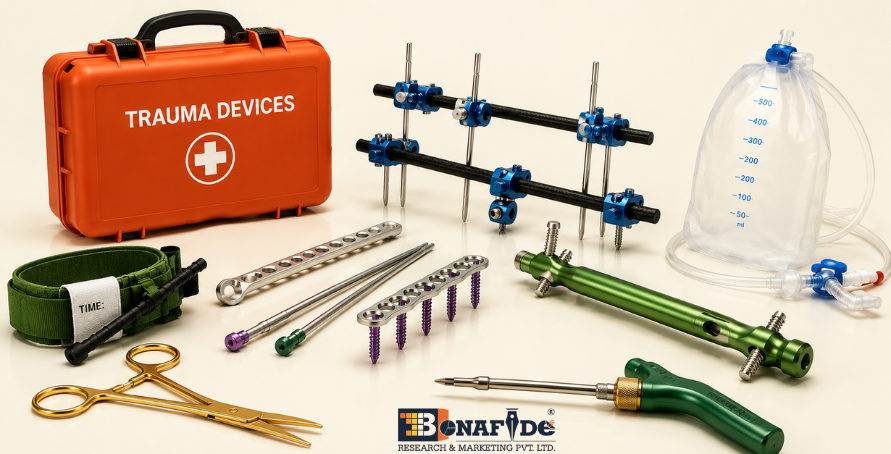
Internal fixation devices represent the leading product type in the global trauma devices market due to their extensive clinical applications and ability to effectively manage different types of fractures and skeletal injuries. These devices, including plates, screws, intramedullary nails, wires, and pins, are widely used by orthopedic surgeons to secure fractured bones internally and maintain proper alignment during the healing process. Their ability to provide stable support while allowing patients to begin movement and rehabilitation earlier has made them an essential component of modern fracture treatment worldwide. From simple fractures to complex injuries involving multiple bone fragments, internal fixation systems offer versatile solutions that can be adapted to different anatomical locations and patient requirements. The increasing number of trauma cases globally contributes significantly to the widespread use of internal fixation devices. Road traffic accidents, workplace injuries, sports-related incidents, falls, and other accidental events frequently result in fractures that require surgical stabilization. Injuries involving the femur, tibia, hip, spine, wrist, and other weight-
bearing or functionally important areas often require precise fixation to restore mobility and reduce complications. Internal fixation allows surgeons to achieve direct stabilization at the fracture site, improving the ability to restore normal bone structure and support long-term recovery. Advancements in implant technology have further strengthened the role of internal fixation devices in trauma care.
The increasing adoption of upper extremity trauma devices in the global trauma devices market is driven by the growing need for precise treatment of injuries affecting the hand, wrist, forearm, elbow, and shoulder regions. These anatomical areas are essential for performing daily activities, maintaining independence, and supporting professional and personal functions, making effective fracture management a major clinical priority. Upper extremity injuries frequently occur due to road accidents, workplace incidents, sports activities, falls, and other traumatic events, creating continuous demand for specialized orthopedic solutions. Unlike some larger bones that mainly require structural stabilization, injuries involving smaller bones and joints of the upper limb often require highly accurate fixation because even minor alignment problems can affect mobility, grip strength, and overall function. Advancements in orthopedic implant design have significantly improved the treatment of upper extremity fractures. Modern trauma devices, including anatomically shaped plates, locking screws, and low-profile fixation systems, allow surgeons to address complex fracture patterns while reducing interference with surrounding soft tissues. These improvements are particularly important in areas such as the wrist and hand, where maintaining joint movement and minimizing stiffness are critical for successful recovery. The development of minimally invasive surgical approaches has also supported the increasing use of specialized upper extremity devices by helping reduce tissue damage and improve postoperative rehabilitation.
Hospitals represent the leading end-user segment in the global trauma devices market due to their central role in diagnosing, treating, and managing a wide range of traumatic injuries that require immediate medical attention and specialized orthopedic intervention. Trauma cases caused by road accidents, workplace injuries, sports activities, falls, and other unexpected events are primarily treated in hospital settings because these facilities have the necessary resources to handle both emergency stabilization and complex surgical procedures. Severe fractures involving the spine, pelvis, femur, tibia, joints, and multiple injury sites often require advanced trauma devices such as plates, screws, intramedullary nails, external fixation systems, and other orthopedic implants, which are widely utilized in hospitals equipped with operating rooms and trauma care departments. Hospitals have an advantage because they offer a complete healthcare environment where emergency physicians, orthopedic surgeons, trauma specialists, radiologists, anesthesiologists, and rehabilitation teams work together to provide coordinated patient care. This multidisciplinary approach is essential for treating complex injuries that may involve multiple bones, soft tissue damage, or other complications requiring continuous monitoring and specialized treatment plans. The availability of advanced diagnostic technologies, including imaging systems that help identify fracture patterns and injury severity, enables surgeons to select appropriate trauma devices and surgical techniques.
The increasing adoption of bioabsorbable materials in the global trauma devices market is driven by the growing preference for innovative orthopedic solutions that support bone healing while minimizing long-term implant-related concerns. Unlike traditional metallic implants that may remain permanently in the body, bioabsorbable materials are designed to provide necessary mechanical support during the healing phase and gradually break down through natural biological processes once their function is completed. This characteristic has created significant interest among orthopedic surgeons who seek treatment options that can reduce the possibility of additional procedures and improve patient comfort after fracture recovery. Bioabsorbable materials are particularly useful in selected trauma applications involving smaller bones, pediatric fractures, sports injuries, and cases where implant removal may create unnecessary surgical challenges. By eliminating the need for a second operation in suitable cases, these materials can help reduce patient inconvenience, recovery time, and potential risks associated with additional surgical intervention. This advantage has encouraged healthcare providers to explore their use as part of modern fracture management strategies. Advancements in biomaterial science have played an important role in improving the acceptance of bioabsorbable trauma devices. Researchers and medical device manufacturers have developed improved polymers and
composite materials with better strength characteristics, controlled degradation rates, and enhanced compatibility with human tissues.





 We are friendly and approachable, give us a call.