The global
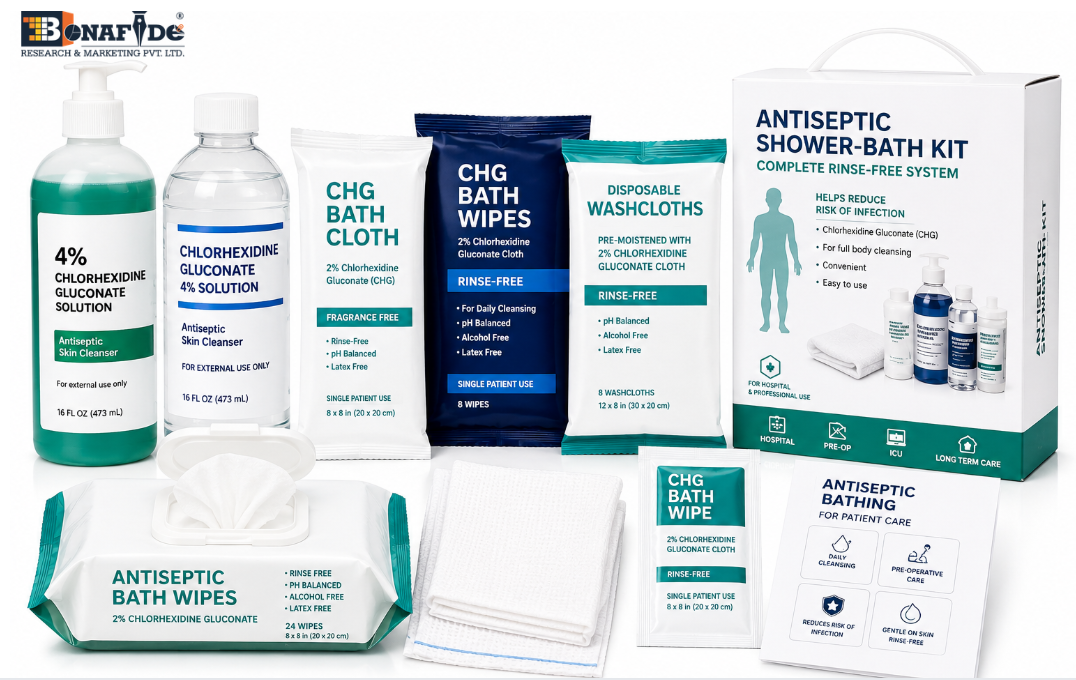
antiseptic bathing products market comprises specialized bathing, cleansing, and skin-care products formulated with antiseptic or antimicrobial agents to reduce microbial contamination on the skin and support infection prevention. The market includes chlorhexidine gluconate (CHG)
bath towels and wipes, CHG solutions, antiseptic bathing solutions, antiseptic wipes, medicated cleansers, and other specialized bathing products used across hospitals, ambulatory care centers, long-term-care facilities,
home healthcare, and selected consumer settings. The market is highly relevant to infection prevention because antiseptic bathing is incorporated into patient-care and preoperative protocols to reduce exposure to pathogens and the risk of healthcare-associated infections (HAIs). Rising HAI incidence, increasing surgical volumes, growing awareness of hygiene and infection prevention, expanding healthcare infrastructure, an aging population, and increasing home healthcare utilization are key factors supporting demand. The market is also benefiting from greater emphasis on patient safety, infection-control regulations, antimicrobial-resistance concerns, and adoption of standardized bathing protocols in hospitals and long-term-care facilities. Product innovation, including convenient pre-moistened wipes, ready-to-use solutions, improved formulations, and longer-lasting antimicrobial technologies, is further supporting market development. Relevant industry associations and healthcare bodies include the World Health Organization (WHO), Society for Healthcare Epidemiology of America (SHEA), Infectious Diseases Society of America (IDSA), and Association for Professionals in Infection Control and Epidemiology (APIC), whose infection-prevention activities, guidance, education, surveillance, and advocacy contribute to awareness and adoption of evidence-based antiseptic practices. Manufacturers are primarily engaged in research and development, formulation improvement, clinical evaluation, regulatory compliance, product manufacturing, hospital procurement partnerships, distribution, and infection-prevention education.
According to the research report "Global Antiseptic Bathing Products Market Outlook, 2031," published by Bonafide Research, the Global Antiseptic Bathing Products Market was valued at more than USD 24.12 Billion in 2025, and expected to reach a market size of more than USD 33.98 Billion by 2031 with the CAGR of 6.03% from 2026-2031. .Key companies include Ecolab, Becton, Dickinson and Company (BD), 3M, Medline Industries, Stryker, The Clorox Company, Reckitt, M?lnlycke Health Care, and Kemin Industries. CHG solutions represented the largest product segment in 2023, with majority revenue share, highlighting continued demand for chlorhexidine-based patient cleansing and antisepsis. Companies are pursuing opportunities through product innovation, infection-prevention partnerships, expanded healthcare distribution, sustainable materials, and solutions designed for acute-care, surgical, intensive-care, and long-term-care environments. For example, Medline offers ReadyPrep CHG, a pre-saturated CHG cloth, while Stryker expanded its patient-safety portfolio through its acquisition of Sage Products, strengthening its position in CHG-based bathing and cleansing solutions. Ecolab launched
Disinfectant 1 Wipe in 2024, focusing on plastic-free materials and hospital disinfection, demonstrating the industry shift toward sustainability, although this product is a disinfectant wipe rather than a bathing product. The supply chain begins with active-ingredient suppliers providing CHG and other antimicrobial chemicals, followed by substrate, nonwoven,
packaging, and formulation suppliers. Manufacturers then formulate, saturate, package, sterilize where required, and test products before supplying hospitals and healthcare systems through direct institutional sales, medical distributors, and group purchasing organizations. Pharmacies and online channels serve selected products and consumer-oriented applications. Key supply-chain opportunities include localized manufacturing, resilient sourcing, sustainable substrates, automated production, inventory optimization, and distribution into ambulatory and home healthcare.
Chlorhexidine gluconate (CHG) has a particularly strong position in antiseptic bathing because it is a long-established topical antiseptic with extensive use across hospital infection-prevention practices. CHG is active against a broad range of microorganisms, including important Gram-positive and Gram-negative bacteria, and has consequently been incorporated into cleansing solutions, pre-impregnated cloths, washes, and other skin-care formats. Clinical evidence has also demonstrated that CHG bathing can be useful in particular high-risk settings. For example, a prospective study involving medical inpatients reported reductions in hospital-associated MRSA and VRE following implementation of daily CHG bathing, although compliance was only 58%, showing that correct and consistent application is an important determinant of effectiveness. Other evidence is more mixed: the ABATE Infection trial found that universal CHG bathing combined with targeted nasal mupirocin did not significantly reduce multidrug-resistant organisms or bloodstream infections across
general medical and surgical units. These findings explain why CHG remains important without implying that it is universally necessary for every patient. Its strength is its established role within targeted, evidence-based protocols. CHG can also be formulated into different delivery systems, allowing hospitals to choose liquid cleansers, disposable cloths, or ready-to-use bathing formats according to their workflow. This flexibility is valuable because infection-prevention programs increasingly emphasize standardized procedures, staff training, compliance monitoring, and surveillance.
Medical wards provide an important setting for antiseptic bathing because patients may remain hospitalized for several days or longer while receiving treatment for acute illnesses, chronic conditions, infections, or complications requiring continuous clinical monitoring. During these stays, patients may undergo intravenous therapy, catheterization,
wound care, diagnostic procedures, respiratory support, and other interventions that increase the importance of maintaining appropriate skin hygiene. Unlike a single procedure-centered environment, medical wards involve repeated daily nursing interactions, making them suitable for standardized bathing protocols when a hospital determines that antiseptic cleansing is clinically appropriate. WHO describes infection prevention and control as relevant to every healthcare interaction and identifies healthcare-associated infections as a major patient-safety concern. Evidence specifically supports the potential role of CHG bathing in some medical populations. A prospective study of medical inpatients found that hospital-associated MRSA decreased by 55% and VRE by 36% after daily CHG bathing was introduced, although the study also identified sustained application and compliance as important implementation challenges. This is particularly relevant because medical wards contain diverse patient groups rather than a single homogeneous population. Some patients may benefit from targeted antiseptic bathing while others may be adequately managed with routine cleansing. The growing importance of healthcare-associated infection surveillance also supports more structured approaches to prevention. WHO's 2024 practical handbook encourages healthcare facilities to strengthen HAI surveillance so that infection patterns can be measured and prevention activities can be appropriately targeted.
Octenidine dihydrochloride has attracted increasing clinical interest because it is an established topical antiseptic with applications in skin, mucosal, and wound care, particularly in European healthcare practice. A 2023 review of clinical evidence described octenidine as a widely used antiseptic and evaluated its potential role in preventing healthcare-associated infections and reducing Staphylococcus aureus carriage or transmission. The ingredient has also been investigated specifically in antiseptic bathing. A multicenter randomized study published in 2024 evaluated octenidine-impregnated washcloths across 44 intensive-care units in 23 German hospitals, involving more than 93,000 patients and over 104,000 ICU episodes. The study was designed to assess whether octenidine could provide an alternative to CHG for reducing ICU-acquired bacteremia and multidrug-resistant organisms. Earlier observational evidence also reported a significant reduction in nosocomial VRE following the introduction of universal octenidine-based bathing together with a standardized washing regime. These studies help explain why octenidine is attracting attention as manufacturers and healthcare organizations consider alternatives and complementary options for antiseptic
skin care. However, the clinical evidence should be interpreted carefully because results are not uniform across every indication, and the 2024 randomized study demonstrates that interest in octenidine is still being evaluated through rigorous clinical research rather than establishing universal superiority over CHG.
Medical and healthcare distributors are increasingly important in antiseptic bathing products because professional healthcare customers require more than simple product availability; they need reliable supply, appropriate documentation, regulatory compliance, inventory management, and delivery to multiple healthcare facilities. Hospitals often purchase
antiseptic products through established procurement systems involving manufacturers, wholesalers, distributors, group purchasing organizations, and institutional purchasing departments. Specialized distributors can simplify this process by maintaining inventories and supplying multiple healthcare facilities from regional distribution networks. WHO states that the medical-product supply chain includes manufacturers, distributors, repackagers, importers, agents, traders, wholesalers, and retailers, with regulatory oversight and good storage and distribution practices required throughout the chain. WHO also identifies distribution and supply as critical steps because medical products must remain safe, effective, and of appropriate quality throughout handling and transportation. This is especially relevant to antiseptic bathing products used within formal hospital protocols, where interruptions in supply can make standardized procedures difficult to maintain. Distributors can also help manufacturers enter markets where they do not have direct sales teams or warehousing infrastructure. This is particularly valuable globally because healthcare procurement practices and regulatory requirements vary significantly between countries. WHO's quality-assurance policy explicitly recognizes manufacturers and wholesale distributors as important participants in the procurement process and requires suppliers participating in WHO procurement to meet defined quality provisions.







 We are friendly and approachable, give us a call.