The global
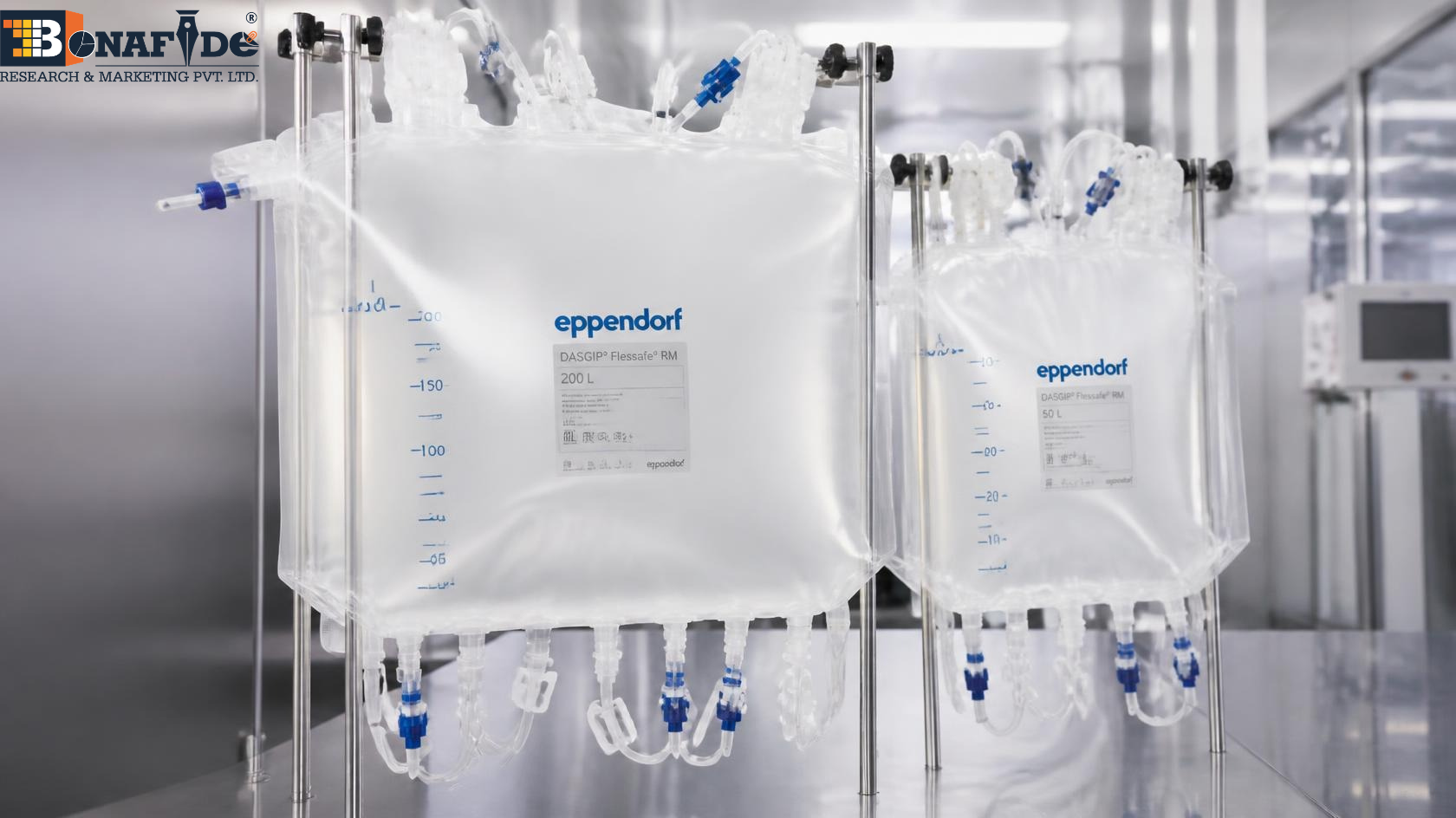
bioprocess bags market comprises specialized single-use flexible containers designed for the storage, mixing, transport, sampling, and processing of biological fluids throughout biopharmaceutical manufacturing. These bags are manufactured from multilayer polymer films engineered to provide sterility, chemical compatibility, mechanical strength, and protection for sensitive biological materials. They are widely used in upstream processing, downstream purification, formulation, and bulk drug storage for products such as monoclonal antibodies, recombinant proteins,
vaccines,
biosimilars, plasma-derived therapies, cell therapies, and gene therapies. The market continues to grow because pharmaceutical and biotechnology manufacturers are increasingly adopting single-use technologies to improve manufacturing flexibility, reduce contamination risks, eliminate cleaning and sterilization requirements, and simplify production workflows. Bioprocess bags play a vital role in maintaining closed-system operations, which are essential for preserving product quality and meeting stringent regulatory expectations for aseptic manufacturing. Their compatibility with disposable
bioreactors, mixers, filtration systems, and automated fluid transfer assemblies has strengthened their position as essential components of modern biologics production facilities. The market is also supported by expanding investments in biologics research, increasing outsourcing to contract manufacturing and development organizations, and the establishment of new biopharmaceutical production plants designed around single-use processing platforms. Industry organizations such as BioPhorum and International Society for Pharmaceutical Engineering contribute to the advancement of best practices, standardization, and knowledge sharing related to bioprocessing technologies, including
single-use systems. Continuous innovation in film materials, connector technologies,
sensor integration, and sterile assembly designs has further enhanced the performance and reliability of bioprocess bags. As manufacturers prioritize operational efficiency, contamination control, rapid facility deployment, and scalable production, bioprocess bags have become indispensable tools supporting the safe, consistent, and efficient manufacture of modern biological medicines across research, clinical, and commercial production environments.
According to the research report "Global Bioprocess Bags Market Outlook, 2031," published by Bonafide Research, the Global Bioprocess Bags Market was valued at more than USD 4.67 Billion in 2025, and expected to reach a market size of more than USD 11.22 Billion by 2031 with the CAGR of 16.16% from 2026-2031. The market is characterized by continuous innovation from leading manufacturers such as Thermo Fisher Scientific, Sartorius AG, Merck KGaA (MilliporeSigma), Danaher (Cytiva), Avantor, and Saint-Gobain Life Sciences, which continue expanding their portfolios with advanced multilayer films, integrated tubing assemblies, sterile
connectors, and sensor-compatible bag systems. Companies are investing in higher-performance polymer materials with improved chemical resistance, lower extractables and leachables, and greater mechanical durability to meet the evolving requirements of biologics manufacturing. Recent industry developments include expansion of single-use manufacturing capacity, strategic collaborations with biopharmaceutical manufacturers, and investments in regional production facilities to strengthen supply resilience and reduce lead times. Significant opportunities exist as cell and gene therapy manufacturing, personalized medicine, biosimilars, and vaccine production increasingly rely on flexible, contamination-controlled processing platforms. From a supply chain perspective, the market begins with the sourcing of medical-grade polymer resins,
specialty films, tubing, connectors, filters, and molded components supplied by advanced materials manufacturers. These materials undergo precision film extrusion, bag fabrication, welding, sterilization, quality testing,
packaging, and distribution before reaching original equipment manufacturers, biopharmaceutical companies, biotechnology firms, and CMOs/CDMOs. Close coordination among raw material suppliers, component manufacturers, system integrators,
logistics providers, and end users is essential because bioprocess bags are critical manufacturing consumables that directly affect production continuity. Manufacturers are also diversifying production sites, qualifying multiple raw material sources, and strengthening inventory strategies to improve supply chain reliability while supporting the growing adoption of single-use bioprocessing technologies across research, clinical, and commercial biologics manufacturing.
3D bioprocess bags have become the preferred product configuration because they are specifically designed to manage large liquid volumes in commercial biopharmaceutical production without compromising sterility or process efficiency. Their three-dimensional geometry allows them to expand uniformly inside rigid containers, making them suitable for handling process fluids such as culture media, buffers, harvest material, purified intermediates, and formulated drug substances. Unlike reusable stainless-steel vessels, these disposable systems eliminate cleaning, steam sterilization, and cleaning validation procedures, significantly simplifying manufacturing operations. They are compatible with a broad range of single-use equipment including mixers, bioreactors, filtration systems, and automated transfer assemblies, enabling seamless integration throughout biologics production facilities. Their multilayer polymer construction provides mechanical durability, chemical compatibility, and barrier properties that protect sensitive biological materials from environmental exposure while maintaining product quality. The increasing manufacture of monoclonal antibodies, recombinant proteins, biosimilars, vaccines, and advanced therapies has reinforced demand because these products require contamination-controlled fluid handling throughout production. Modern 3D bags are supplied with integrated tubing, sterile connectors, sampling ports, and sensor-ready assemblies, allowing efficient process monitoring and closed-system transfers. Their availability in multiple capacities enables manufacturers to standardize operations from pilot-scale development to commercial production using similar technologies.
Downstream processing has become the fastest-growing application area for bioprocess bags because this stage involves recovering, purifying, concentrating, and formulating biologic products after cell cultivation has been completed. At this point in manufacturing, the biological material has undergone substantial processing and possesses
high economic value, making contamination prevention and product preservation extremely important. Bioprocess bags are extensively used for intermediate storage, chromatography feed and collection, ultrafiltration operations, buffer preparation, virus filtration, formulation, and bulk drug substance storage. Disposable bag systems maintain closed processing environments that reduce microbial contamination risks while minimizing product exposure during fluid transfers. Unlike reusable vessels, single-use bags eliminate cleaning and sterilization activities between batches, allowing manufacturers to increase operational efficiency while reducing turnaround times. Many downstream purification processes involve multiple transfer steps between filtration units, chromatography systems, and formulation equipment, and sterile disposable bags provide secure, leak-resistant connections throughout these operations. Increasing production of complex biologics, including monoclonal antibodies, antibody-drug conjugates, recombinant proteins, viral vectors, and gene therapy products, has further increased demand for reliable disposable fluid management systems capable of preserving sensitive molecules. In addition, downstream facilities often manufacture multiple products within the same production suites, making rapid product changeovers essential. Single-use bags simplify multiproduct manufacturing by reducing cross-contamination risks and supporting flexible production scheduling. Manufacturers also benefit from standardized bag assemblies equipped with integrated tubing, sampling ports, and sterile connectors that improve workflow consistency and regulatory compliance.
Contract Manufacturing Organizations and Contract Development and Manufacturing Organizations have become major adopters of bioprocess bags because their business model requires exceptional manufacturing flexibility across diverse customer programs. These organizations routinely develop and manufacture biologics for multiple pharmaceutical and biotechnology companies, often producing different products in the same facilities while meeting strict quality and regulatory standards. Bioprocess bags enable rapid transition between manufacturing campaigns because they eliminate cleaning validation and sterilization procedures associated with traditional stainless-steel equipment. This allows contract manufacturers to reduce downtime while maximizing facility utilization across numerous customer projects. The increasing number of biotechnology companies without dedicated manufacturing infrastructure has encouraged greater outsourcing of biologics production, creating stronger demand for adaptable single-use processing technologies. Bioprocess bags are used throughout media preparation, buffer storage, cell culture support, purification, formulation, and bulk product storage, allowing CMOs and CDMOs to standardize operations while accommodating varying batch sizes and process requirements. Their closed-system design helps maintain product segregation, preventing cross-contamination when different therapeutic products are manufactured sequentially. Standardized disposable assemblies also simplify qualification activities and improve manufacturing consistency across multiple production sites. Integration with automated process equipment further enhances productivity while supporting reproducible manufacturing outcomes for clients. Additionally, many contract manufacturers invest in modular production facilities where single-use technologies allow faster expansion without major infrastructure modifications.









 We are friendly and approachable, give us a call.